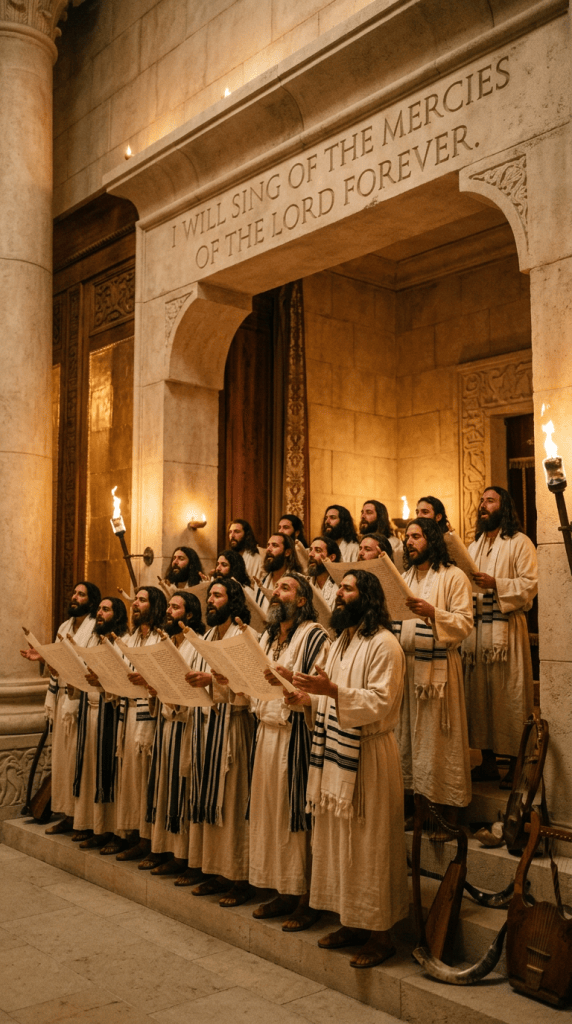
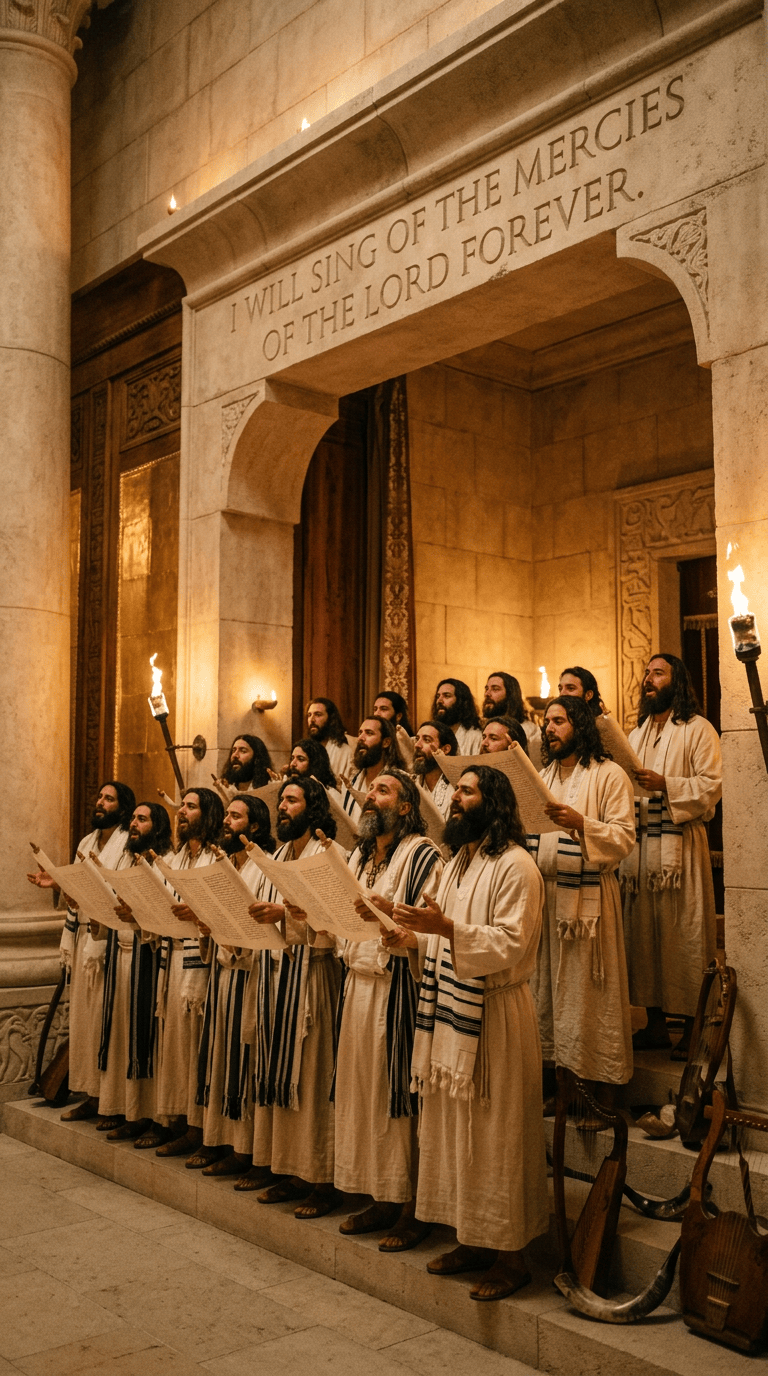
I will sing of the mercies of the LORD for ever (v1)
The contrast between Psalms 88 and 89 could scarcely be greater. While it is evident that the writers were both facing problems that seemed insurmountable, the tone of these Psalms is quite different. God, in His mercy and grace, follows the darkness of the 88th Psalm with the light of the 89th. They are companions, capturing the depths of human sorrow, yet declaring that such sorrow is ultimately vanquished by the light of the Gospel. Christopher Wordsworth (Bishop of Lincoln, 1869–1885) captures this beautifully:
“That Psalm was a dirge of Passion-Tide, this Psalm is a carol of Christmas” (Christopher Wordsworth, quoted by C. H. Spurgeon in his “Treasury of David”)
Ethan the Ezrahite was in all likelihood one of David’s three leading musicians. He is referred to in several places in the historical writings. He was a composer of psalms and led the worship in the tabernacle and probably in the temple after the death of David (1 Chronicles 15:17).
There are strong indications towards the end of the Psalm that it was written during the national disaster which followed the division of the kingdom under Rehoboam (2nd Chronicles 10). The invasion of Shishak, king of Egypt, brought further humiliation to the nation, with the treasures of the temple and the king’s house being taken away (2nd Chronicles 12). If this identification is correct, Ethan had witnessed the reigns of David and Solomon and was now, as an old man, reflecting upon the passing of Israel’s golden age. He had seen the glory of the kingdom and now witnessed its humiliation.
As well as possessing musical and literary talents, Ethan was renowned as a man of wisdom (1 Kings 4:31). When Solomon began to exhibit the wisdom with which God endowed him, he surpassed the wisest men in the nation. Interestingly, Ethan the Ezrahite is named first among these distinguished men. This may suggest that he held a position of particular prominence among them. Certainly, he was a man of considerable reputation and ability. The wisdom and deep spirituality of Ethan shine through in this remarkable Psalm. As an older man, reflecting upon the mercies of God, he brings a deep and profound message to his people. This is a message that continues to resonate within the Church of Christ today and always. We too can sing of the mercies of God forever.
The Purpose of the Psalm
I will make known thy faithfulness to all generations (Psalm 89:1)
The great theme of the Psalm is that God is faithful and always will be faithful. It was Ethan’s burden that the children and their children would never forget the goodness of God toward His people. He was living in a period when it seemed the people were forgetting the LORD. He therefore called the people to pause and remember that God is faithful.
He urged reverence in the sanctuary. He must be feared greatly “in the assembly of the saints” (Psalm 89:7). We too are called to gather for worship. In worshiping we must revere God, acknowledging his faithfulness.
This faithful God is great and mighty. He has no equal (Psalm 89:8). The heavens, the earth, and the fullness thereof belong to Him (Psalm 89:11). He can execute all of His promises. There is no resource that is not at His disposal.
He is a God whose faithfulness can be absolutely trusted because:
Justice and judgment are the habitation of thy throne: mercy and truth shall go before thy face.
The God whose character is just and who exercises that pure nature in acting with mercy and truth is one we can absolutely rely upon. He cannot lie. He will not go back on His Word. He is a faithful God.
So unlike us. We forget but He never forgets. We are unfaithful but He remains faithful.
This is a message for our children and future generations – “I will sing of the mercies of God forever…”.
The Promise in the Psalm
I have made a covenant with my chosen, I have sworn unto David my servant, Thy seed will I establish for ever, and build up thy throne to all generations. Selah. (Psalm 89:3-4).
The promise of the throne relates to David and his posterity. Later in the Psalm this covenant is repeated:
“My covenant will I not break, nor alter the thing that is gone out of my lips. Once have I sworn by my holiness that I will not lie unto David. His seed shall endure for ever, and his throne as the sun before me. It shall be established for ever as the moon, and as a faithful witness in heaven. Selah.” (Psalm 89:34-37).
Observe how the holiness of God is engaged as the guarantor. If God swears by His holiness, He will indeed be a faithful witness.
This covenant was made with David after he was denied the opportunity to build a temple. Rather than being disappointed by this refusal, David was humbled because his son Solomon would build the temple. Not only would Solomon do this work, but the line from David would not fail:
“And it shall come to pass, when thy days be expired that thou must go to be with thy fathers, that I will raise up thy seed after thee, which shall be of thy sons; and I will establish his kingdom. He shall build me an house, and I will stablish his throne for ever. I will be his father, and he shall be my son: and I will not take my mercy away from him, as I took it from him that was before thee: But I will settle him in mine house and in my kingdom for ever: and his throne shall be established for evermore. According to all these words, and according to all this vision, so did Nathan speak unto David.” (1 Chronicles 17:11-15)
This drew from David the exclamation “Who am I”. The honour that God bestowed upon him and his posterity was greater than anything he could have anticipated.
This was a promise, however, that went far beyond the physical kingdom. There would come a day when the natural line of kings from the house of Judah and the family of David would indeed fail. But the lineage would remain until that moment when David’s greatest Son, Christ Himself, would be born in Bethlehem, the city of David.
Jacob foresaw the lion of Judah.
“Judah is a lion’s whelp: from the prey, my son, thou art gone up: he stooped down, he couched as a lion, and as an old lion; who shall rouse him up? The sceptre shall not depart from Judah, nor a lawgiver from between his feet, until Shiloh come; and unto him shall the gathering of the people be.” (Genesis 49:9-10)
This promise was partially fulfilled in David. The grand and complete fulfillment is in Christ. His is a kingdom which extends across every frontier. This was exactly what the angel told Mary regarding the Son whom she would bear:
“He shall be great, and shall be called the Son of the Highest: and the Lord God shall give unto him the throne of his father David: And he shall reign over the house of Jacob for ever; and of his kingdom there shall be no end” (Luke 1:32-33).
This is the New Testament counterpart of ancient Israel. Christ is King, ruling and reigning over His Church. His reign cannot be broken and His Church cannot fail. God is faithful.
The Plea through the Psalm
How long, LORD? Wilt thou hide thyself forever? (Psalm 89:46)
The final section of the psalm leads to a prayer. Ethan witnessed good times. The transfer of power to Solomon and the erection and dedication of the temple were times of spiritual renewal. Israel reached the zenith of her power during Solomon’s golden age.
But he also witnessed Solomon’s backsliding and the forewarning of what would come. As an old man, the kingdom divided and decline set in. How Ethan mourned and wept:
“But thou hast cast off and abhorred, thou hast been wroth with thine anointed. Thou hast made void the covenant of thy servant: thou hast profaned his crown by casting it to the ground. Thou hast broken down all his hedges; thou hast brought his strong holds to ruin. All that pass by the way spoil him: he is a reproach to his neighbours. Thou hast set up the right hand of his adversaries; thou hast made all his enemies to rejoice. Thou hast also turned the edge of his sword, and hast not made him to stand in the battle. Thou hast made his glory to cease, and cast his throne down to the ground” (Psalm 89:38-44).
How intense was his cry for God to return and restore.
There was the acknowledgement, however, that God had done this on account of the sins of the people. Ethan took ownership of these sins. He recognised that what had occurred was not more than they deserved:
“If his children forsake my law, and walk not in my judgments; If they break my statutes, and keep not my commandments; Then will I visit their transgression with the rod, and their iniquity with stripes.” (Psalm 89:30-32).
The faithful God rebukes and chastises. He deals faithfully with the sins of His people.
We are often much better at pinpointing, with precision, the sins of others than humbly confessing our own sins and the sins of our fathers. The Church in Britain has experienced a long and dramatic decline. But this is not greater than our sins deserve. Is God not chastening His Church by permitting the wicked to bear rule over us? Is He not dealing with our prayerless spirits, our shallow roots, our hypocrisies, our secret sins, our gossiping tongues, our bitter spirits, our proud hearts, and our judgmental attitudes?
But there is a way back. There is a path to restoration, renewal and revival.
“How long” Ethan cried…”wilt thou be angry with us forever”.
This prayer is still worth praying because God is faithful. In the hard times, in days of judgment when the enemy is on the rise and the cause of truth is laid low, we must have this message. We need this message. God is faithful; His covenant cannot be broken.
God is building His Church. Christ is reigning. His Church is advancing. Revival is coming. The Devil will not win. God is faithful.
The Priority for the Psalmist
Remember how short my time is (Psalm 89:47)
The writer was old. His sun was fast setting. But there was a rising generation who must represent God in a society that had changed dramatically. Ethan had little time to make his mark. There was an urgency in his words. But after an impassioned final plea, he gives God all the glory:
Blessed be the LORD for evermore. Amen, and Amen.
There was a humble resignation. Whatever God does will be good. Ethan didn’t necessarily see the sins of his nation resolved, but by faith he foresaw a better day because God is faithful. Ultimately, He will be honoured and glorified.



Leave a Reply