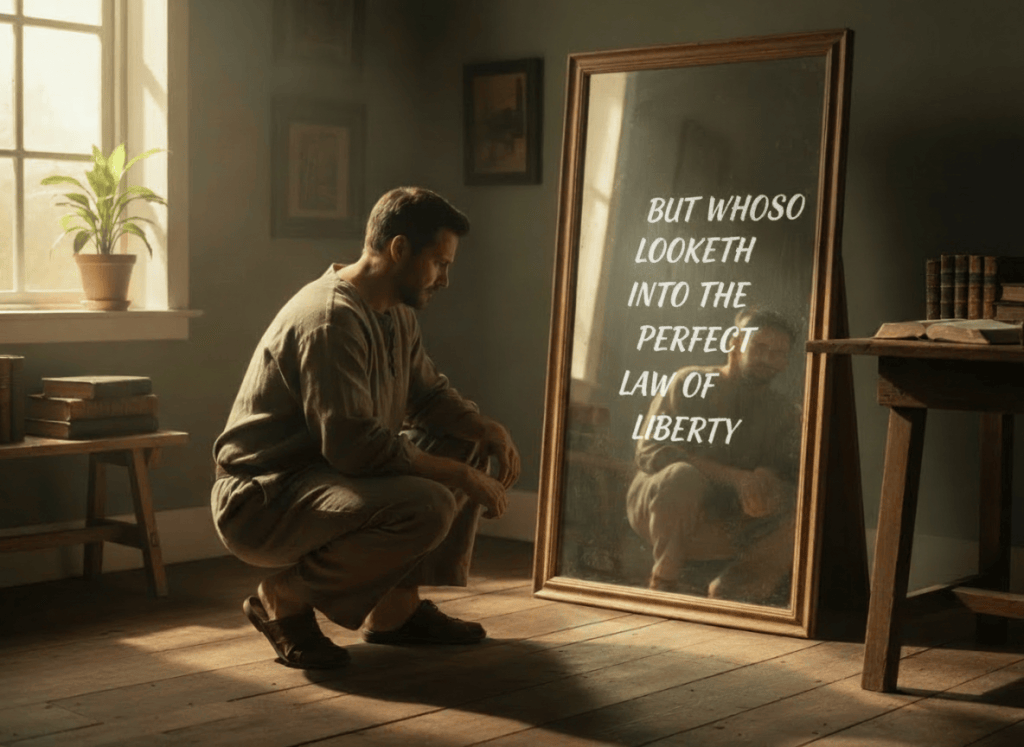
“But whoso looketh into the perfect law of liberty, and continueth therein, he being not a forgetful hearer, but a doer of the work, this man shall be blessed in his deed.” (James 1:25)
All too often the law of God is characterised as something that is restrictive. It is, in the eyes of some, too demanding, it curtails freedom and is oppressive. Sadly this spirit works its way into the evangelical church. What our forefathers stood for is not for this age. We can lighten up and loosen up. They were too strict back then. Their separation was too narrow. We want more freedom today.
Where traditions are non-biblical they need to be challenged. We need to be quite clear about this. The Lord spent a large proportion of His ministry confronting the blind leaders of the blind who were bound by their own exacting and punishing traditions.
But never, ever, reject the plain teaching of Scripture. Where God’s Word is clear we must abide by it and live it out. We must never complain about Truth as being narrow, restrictive or difficult. We must not yearn for an easier path that promises greater freedom. Freedom to wander is not freedom. It is fool’s gold.
James teaches us here that the Word of God, rather than being restrictive and binding, is actually freedom. Those that are captivated by the Word are the people who are free.
George Matheson captured this concept beautifully in his famous hymn:
Make me a captive, Lord, and then I shall be free; force me to render up my sword, and I shall conqu’ror be. I sink in life’s alarms when by myself I stand; imprison me within Thine arms, and strong shall be my hand.
My heart is weak and poor until its master find; it has no spring of action sure, it varies with the wind. It cannot freely move till Thou hast wrought its chain; enslave it with Thy matchless love, and deathless it shall reign.
My pow’r is faint and low till I have learned to serve; it wants the needed fire to glow, it wants the breeze to nerve. It cannot drive the world until itself be driv’n; its flag can only be unfurled when Thou shalt breathe from heav’n.
My will is not my own till Thou hast made it Thine; if it would reach a monarch’s throne, it must its crown resign. It only stands unbent amid the clashing strife, when on Thy bosom it has leant and found in Thee its life.
The Bible is therefore the Perfect Law of Liberty.
The Acceptance of the Law of Liberty
“But be ye doers of the word, and not hearers only, deceiving your own selves” (James 1:22)
Hearing the Word is insufficient. Yes, the Word must reach and become the engrafted Word. But where the Word is truly engrafted there will be a life of obedience.
Therefore a true hearing of the Word is accompanied by surrender, a willingness to be a doer and not just a hearer. We all require more learning and extra tuition. The reason is not always because of our lack of knowledge. We regularly fall short and therefore the teaching is designed to guide aright, that we might walk in God’s paths.
Such a spirit demands preparation of heart. As our hearts are prepared for the Word, we are taught surrender to the Word. Therefore we come to the Word prayerfully, carefully and with humility knowing that we stand in need of the Word, because we must be changed and transformed by its power and under its influence.
The plough is a pertinent illustration. The plough cuts deep into the soil, breaking up the hard ground in preparation for the sowing, for the rains and for the harvest. We all have hearts that need ploughed before the Word can come, transforming the hearer into a doer.
What is it that must be ploughed up?
“Wherefore lay apart all filthiness and superfluity of naughtiness” (James 1:21)
Note the words carefully:
“Lay aside” – this means to undress. The New Testament elsewhere relates the change that needs to take place in our lives as taking off the old and putting on the new. We need a change of moral garments – “The night is far spent, the day is at hand: let us therefore cast off the works of darkness, and let us put on the armour of light” (Romans 13:12). Paul’s words tie in with one of the major themes of James. Time is short, this little brief life is decaying fast. Soon the eternal day will dawn. Do we want to be empty handed? Life is too short to indulge ourselves in that which matters little. Let us cast off the old and put on the new.
“filthiness” – James alone employs this particular Greek word and only on this occasion. It is a humbling word because it indicates how evil Christians can be. We have moral filth clinging like parasites to our characters. These garments that must be removed are not beautiful or lovely. They are dirty rags. They need to be cast off. They are not needed. They are harmful. They offend God.
“superfluity of naughtiness” – this indicates that we have a superabundance of wickedness in our natures. There is so much that we need to repent of. Sometimes we wring our hands and ask why a professing Christian would perform a certain action or speak in a particular manner. The problem is this – we make these kinds of judgements without recognising the plague of our own hearts. There is an abundance of wickedness in every one of our hearts; more than ever we could identify.
The casting off is a definite act. But the putting on of the new can only be effective as we yield ourselves to the Word. This is why we must surrender ourselves and be more than hearers – that our lives might be shaped by the will of God.
This filthiness and superfluity of naughtiness is bondage. Sin binds and fetters a man or a woman. There is no liberty in sin. Those who think they are free because they can break off the shackles of God’s law and live as they please are the people in bondage. Those who say, “Preacher, don’t tell me I am wrong” are not free. They are in bondage to their own sinful desires. If you are truly to be free and liberated you need to be surrendered to the truth of Scripture and live it out in your life.
The Metaphor for the Perfect Law of Liberty
“For if any be a hearer of the word, and not a doer, he is like unto a man beholding his natural face in a glass: For he beholdeth himself, and goeth his way, and straightway forgetteth what manner of man he was. But whoso looketh into the perfect law of liberty, and continueth therein, he being not a forgetful hearer, but a doer of the work, this man shall be blessed in his deed.” (James 1:23-25)
In verse 21 the metaphor for the Word was the seed, “the engrafted Word”. In these verses the metaphor changes to the mirror. As we look into a mirror and see our own image, so we must look into God’s Word in order that we might see ourselves. James, however, identifies two ways whereby we look at the Scriptures.
The Casual Look
The person who hears the Word without obedience looks in the mirror but does not take note. He looks into the mirror and forgets what he has seen.
How often have we not done this with Scripture. Our sins are revealed and our shortcomings portrayed. Yet we are unchanged and unmoved.
It seems almost ridiculous that you could look at your own face in the mirror and forget what you have seen.
Why might that be?
Perhaps you did not like what you saw. This is to run from reality. When God’s Word reveals our sinfulness this is the reality check that we need.
How foolish the person is who looks into the mirror and sees a face needing washed but does nothing about it. Or the man who looks at the stubble and then forgets to shave, or looks at the unkempt beard which he neglects to trim. Yet we do this with the Word. We are directed what to do and we refuse to agree. The Word is wrong. That’s not for me. No change!
The term “natural face” is expressive. God’s Word reveals what we are by nature. We have these lusts, which are ours by nature. Wicked tendencies and desires plague us. For some this is an uncontrolled temper. For others it is an unbridled tongue. For some it is immorality, for another some private addiction. For others it is the love of money and for some it is pride.
As you look into God’s Word what does your natural face look like? What does God see today?
The look that goes away wilfully forgetting what he or she has seen is a casual look. God deliver us from a casual approach to these matters – these weighty issues of the soul!
A Closer Inspection
The person who is the doer of the Word looks in a different kind of way. The word “looketh” in verse 25 is different in the Greek from the “beholdeth” in verse 24. This verb describes a person who stops, who crouches down and who closely examines. This is a man or a woman who spends time.
These are two extremes when it comes to looking into the mirror. One extreme looks, doesn’t like the view and moves on. The other extreme spends a prolonged time looking at the mirror, examining all of those aspects of the face that can be improved through shaving, washing, or by brushing every strand of hair.
When it comes to the Word we must spend time. We need to learn the art of meditation. Reading, praying over the Scripture and applying its truth to our lives.
This is, after all, the “perfect law of liberty”. If we want to be truly free we must be chained to the Word. The Word is perfect, it is pure and will never fail to teach us aright if we give ourselves to its precepts.
The 119th Psalm focuses entirely upon the Word and its impact upon lives. The longest chapter of Scripture is all about the Word. This is lesson enough from God, is it not? Each stanza begins with a different letter from the Hebrew alphabet. The Hebrew alphabet is pictorial. Each letter is a little picture. And many of these pictures, by way of application, teach us something about the Word.
The first letter is Aleph, the picture of which is an ox. The ox represents service. Therefore Psalm 119 begins “Blessed are the undefiled in the way, who walk in the law of the Lord”. Here is a man who has looked in, he has dealt with his sin, and he walks in the Lord’s law. He is a faithful servant.
The second letter is Beth which represents a house. If we are to build our houses and our homes aright the Word of God must be our foundation. Therefore the Psalmist under Beth writes “Thy word have I hid in mine heart, that I might not sin against thee”.
The sixth letter is particularly expressive. Vau means a hook. A nail is used to hang items on – “My hands also will I lift up unto thy commandments, which I have loved; and I will meditate in thy statutes”. We need to lift up our hands and hang our lives upon the Scriptures. Only then will we be truly free.
The Outworking of the Perfect Law of Liberty
“If any man among you seem to be religious, and bridleth not his tongue, but deceiveth his own heart, this man’s religion is vain. Pure religion and undefiled before God and the Father is this, To visit the fatherless and widows in their affliction, and to keep himself unspotted from the world”. (James 1:26-27)
James now introduces in a broad sweep themes that he will return to in his letter; namely bridling the tongue and caring for the orphans and widows. The lesson is clear. Those who look into the Word and live it out will make a difference in the world and to the world. The key phrase is “keep himself unspotted from the world”.
There is a form of Christianity abroad now which is come easy, go easy. It demands little consecration, no surrender and calls for no sacrifices. It is a far cry from the Saviour who called his disciples to take up the cross and follow. William Booth was quite right, prophetic even, as he looked out upon the Twentieth Century:
I consider that the chief dangers which confront the coming century will be religion without the Holy Ghost, Christianity without Christ, forgiveness without repentance, salvation without regeneration, politics without God, and heaven without hell.
William Booth
This was not the religion of James. He called for earnest Christian living. I once heard a story about a man who got saved back in the day when repentance was real and when conversion meant real transformation. He was accustomed to going, as we would say in Ulster, on the “tear” – drinking heavily and then terrorising the wife and kids and even the poor old dog. Then the man got saved. Instead of rolling home shouting his obscenities he bathed the kids that Saturday night. Everyone knew there was a change. Everyone knew that husband and father was converted. Even the old dog which once cowered away knew that the master was saved.
May God deliver us from a sham Christianity. May God deliver us from Sunday-only religion. May God deliver us from a Christianity which is just about suits and hats and big Bibles. May God give us real Christianity by making us a people who are doers and not just hearers of the Word.


Leave a Reply