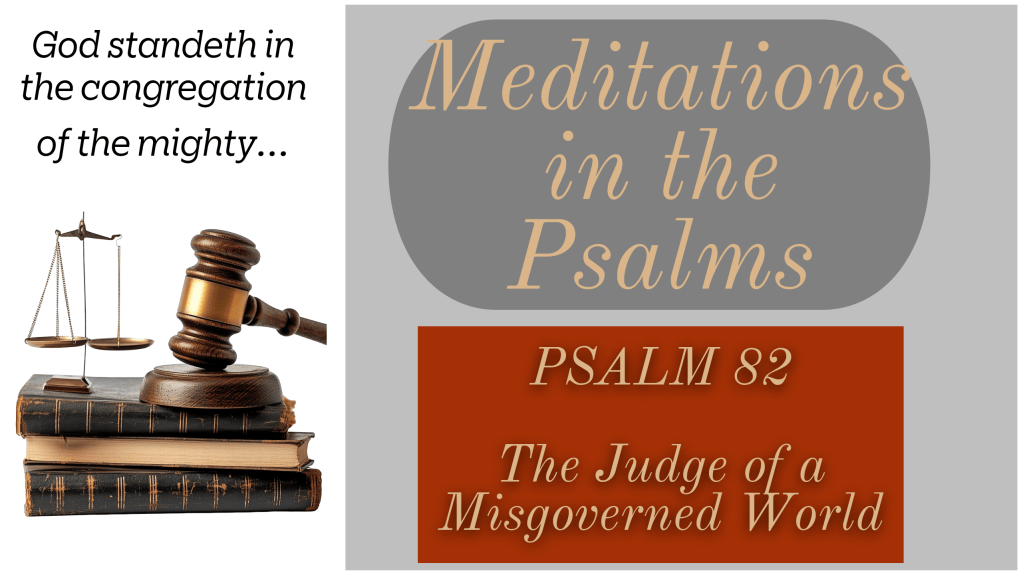
“Arise, O God, judge the earth: for thou shalt inherit all nations” (Psalm 82:8).
The nineteenth-century Scottish Presbyterian preacher Andrew Bonar described Psalm 82 as presenting
“Messiah the true Judge of a misgoverned world.”
That is an apt description of this Psalm. Men do not govern this world properly. Injustice abounds. Those entrusted with authority frequently misuse it. The weak are oppressed, wickedness is tolerated and sometimes even rewarded, while the foundations upon which society rests are gradually moved out of their place.
Yet Psalm 82 reminds us that human government is never the highest government. Above every parliament, every court, every president, prime minister, king and ruler there stands another Judge. God will have the last word. The Psalm begins:
“God standeth in the congregation of the mighty; he judgeth among the gods” (verse 1).
The “gods” referred to here are not divine beings equal with God. The term is being applied to those who exercise judicial and governmental authority. They are men to whom God has entrusted the solemn responsibility of judgment and government. In our modern context we can apply the principle not merely to judges, but to legislators, parliamentarians, presidents, prime ministers and all who exercise civic authority.
Psalm 82 therefore presents a remarkable picture. God summons the rulers of the earth before Him.
1. GOD STANDING
“God standeth in the congregation of the mighty; he judgeth among the gods.”
It is as though God convenes a great council. The judges of the earth are there. Kings and queens are there. Presidents and prime ministers are there. Parliamentarians are there. Those involved in the humbler responsibilities of local government are there also.
Every person who exercises authority is ultimately accountable to God. Government itself is a divine institution. God has delegated authority to men for the orderly government of society. Paul teaches this very clearly in Romans 13:
“For he is the minister of God to thee for good” (Romans 13:4).
The magistrate is described as the minister of God. He bears the sword. He has responsibility for restraining wrongdoing and administering justice.
For this reason the Christian should never be an anarchist. We respect authority. We obey the law. Even when those who govern us are not godly people, the institution of government remains ordained of God.
There is, of course, a limit. Whenever government commands what God forbids, or forbids what God commands, the Christian must say with the apostles:
“We ought to obey God rather than men” (Acts 5:29).
But ordinarily the Christian should be known as a person who respects lawful authority.
Yet there is another side to this truth. With authority comes accountability. Those who make laws will themselves answer to the Lawgiver. Those who sit in judgment will themselves be judged. Those who exercise power must one day stand before the One from whom all legitimate authority ultimately comes.
God stands among the rulers. And He does not stand merely to observe them. He stands to judge them. He also stands to instruct them.
This is where the Church has an important responsibility in society. The Church must faithfully uphold the moral standards of God’s Word. We are not called to govern the nation, but neither are we called to silence when moral questions arise.
God’s Word speaks to rulers as surely as it speaks to ordinary men. Those who bear rule need to hear the Word of God and be brought to account for their failure to apply Scripture to their roles. Ultimately the Scriptures must be at the heart of governance because our nation needs the Bible.
2. GOD SPEAKING
God addresses these rulers:
“How long will ye judge unjustly, and accept the persons of the wicked? Selah. Defend the poor and fatherless: do justice to the afflicted and needy. Deliver the poor and needy: rid them out of the hand of the wicked” (verses 2–4).
God is deeply concerned about injustice.
Where men suffer genuine oppression, God cares.
Where wicked people exploit the vulnerable, God cares.
Where the poor and defenceless are mistreated, God cares.
And therefore the Church should care.
There is no Christian virtue in being indifferent to injustice.
The language of “social justice” has sometimes been captured by political movements and attached to agendas which the Christian cannot support. But we must never allow the misuse of a term to rob us of a biblical truth.
God cares for the poor. God cares for the fatherless. God cares for those who are afflicted. God cares for those who are oppressed by wicked men.
The rulers are therefore commanded:
“Rid them out of the hand of the wicked.” (verse 4)
Government has a responsibility to restrain evil.
We require honourable people in public life. Society does not benefit when dishonesty, corruption or personal wickedness are treated as matters of little consequence.
And the principle reaches much further. Abuse is an injustice. Theft is an injustice. Extortion is an injustice. Fraud and scams which rob vulnerable people are injustices. And the taking of innocent life is an injustice.
God is interested in righteousness because God Himself is righteous.
This is why morality can never finally be neutral.
There are currently important debates in Northern Ireland concerning how religion and morality should be presented within education. The proposed RE syllabus expressly seeks teaching that is “objective, critical and pluralistic,” while continuing to recognise the historic and cultural significance of Christianity.
The Christian must understand the implications of these discussions carefully. Christianity does not present itself merely as one equally valid explanation among many. Christ says:
“I am the way, the truth, and the life” (John 14:6).
Society needs foundations. It needs firm ground.
It needs moral standards which do not change whenever cultural opinion changes. It needs the instruction of the Word of God.
There are likewise contemporary legislative debates surrounding conversion practices, including proposals dealing with sexual orientation and gender identity. These matters raise significant questions for churches concerning preaching, pastoral counsel and the historic Christian understanding of repentance and conversion.
Whatever laws men formulate, the Church must continue faithfully to declare what God has revealed.
For when God’s standards are displaced, the warning of verse 5 becomes terribly relevant.
3. THE FOUNDATIONS OUT OF COURSE
“They know not, neither will they understand; they walk on in darkness: all the foundations of the earth are out of course.” (verse 5)
What a description!
The foundations are out of course.
Once a society begins to redefine morality according to human preference, the foundations inevitably move.
What is right?
What is wrong?
What is a man?
What is a woman?
What is marriage?
What is sin?
What is repentance?
Who decides?
If every generation is free to redefine these things according to its own desires, we have no permanent foundation.
The Psalm tells us why. Men “walk on in darkness.” Rejection of the light of God’s Word will be followed by the onset of spiritual and moral darkness.
This is not merely an intellectual problem. It is a moral problem. The tragedy of unjust government is that men and women who have received authority from God may exercise that authority while refusing to acknowledge the God who gave it to them.
Yet God reminds these rulers of something they easily forget.
4. YE SHALL DIE LIKE MEN
“I have said, Ye are gods; and all of you are children of the most High.
But ye shall die like men, and fall like one of the princes” (verses 6–7).
What solemn words! You have been given high office. You have received authority. People rise when you enter the room. Your name appears in newspapers. Your words move markets, armies and nations.
But:
“Ye shall die like men.”
Kings, Presidents and Prime Ministers are mere mortals and death is coming to all. The reported dying remark attributed to Alexander the Great — that the man who conquered the world would leave it empty-handed — is true of us all.
This is something we must always remember – especially in these uncertain and unsettling times.
The nations possess enormous military arsenals. There is war and instability. We look at events in Ukraine and the Middle East. We hear threats between nations. We know that men possess weapons capable of causing destruction on an almost unimaginable scale.
Such things understandably trouble us. Yet Psalm 82 teaches us that the world will never spin beyond the control of God.
Rulers and empires will rise and fall. Men who once appeared almost invincible eventually lie down in death like everyone else.
They “die like men” and afterwards they meet God.
Therefore the answer to a misgoverned world is not despair. The answer is to look higher.
5. ARISE, O GOD
Asaph concludes with a prayer:
“Arise, O God, judge the earth: for thou shalt inherit all nations.”
He has looked around him. He has seen injustice perpetrated by wicked rulers. He has watched men walking in darkness. He has seen the foundations of society moved out of their proper place.
And then he looks up.
“Arise, O God.”
That is still the prayer of the Church.
When society troubles us — look up.
When governments disappoint us — look up.
When the foundations appear to be moving — look up.
When wickedness seems strong — look up.
Isaiah tells us that before God:
“the inhabitants thereof are as grasshoppers” (Isaiah 40:22).
The great nations are merely:
“a drop of a bucket” (Isaiah 40:15).
We must commit our nation to God. We must commit our society to God. We must commit the world to God.
For the Psalm closes with tremendous confidence:
“Thou shalt inherit all nations.”
There is optimism here.
The course of the Gospel has not yet been fully run.
The Great Commission has not failed. Christ commanded His Church:
“Go ye therefore, and teach all nations” (Matthew 28:19).
The Gospel continues its march through the world. Christ is gathering His people from every tribe, tongue and nation. Hearts are being changed through the Word of truth.
God is not finished with this world because it is His inheritance.
Therefore we should never allow the darkness of one particular period of history to cause us to lose confidence in the purposes of God.
The world may be misgoverned by men. But it is not ungoverned.
Above every earthly ruler there is a King and above every human court there is a Judge. Above every parliament there is a throne; that is infinitely higher and greater and more powerful than the British throne ever was.
And the final word of Psalm 82 is not given to injustice, tyranny, darkness or unbelief.
The final word belongs to God:
“Arise, O God, judge the earth: for thou shalt inherit all nations.”


Leave a Reply