Then the fire of the Lord fell…there is a sound of abundance of rain (1st kings 18:38,41)
On Sunday morning, we reflected upon the first study of two regarding the double-minded man mentioned in James 1:8. Read our study on The Double-Minded Man.
The message concluded with Elijah’s challenge to the undecided people of Israel who had gathered around Carmel to see which God would answer by fire—Jehovah, the covenant-keeping God of Israel, or Baal.
How long halt ye between two opinions? if the LORD be God, follow him: but if Baal, then follow him. And the people answered him not a word. (1st kings 18:21)
It is significant that as Elijah laid out his life and ministry on Carmel for the honour of God, there was not one to stand with him. He stood alone, and when the challenge was presented, none spoke. All of this was to change:
“And when all the people saw it, they fell on their faces: and they said, The LORD, he is the God; the LORD, he is the God.” (1st Kings 18:39)
What made the difference? The Prophets of Baal spent hours crying unto their god, and nothing happened. But when Elijah repaired the altar that had been broken down, the fire consumed not only the sacrifice but also the water that saturated the offering and filled the trench around the altar. It was an awesome demonstration of power and a vindication of God’s honour.
When God stepped into the situation, everything changed. The people’s hearts were turned, and three years of famine were reversed by the sound of an abundance of rain.
So it is today. Change for the good only comes about when God steps in. We need divine intervention today on many levels and in various fronts.
God Steps inConverting Souls
Sinners are only saved by the intervention of God. Salvation is a work of grace and will only take place according to His will. Faith and repentance occur only after regeneration has been accomplished in the hearts of the unconverted. Therefore, when the sinner cries unto God for salvation, he or she does so because the Lord had already stirred the heart. Faith and repentance are the first acts of the newly regenerated soul. Therefore, as we preach and evangelise and as we pray for souls, we are cast upon the mercies of God. So it is in our own lives. Unless the Lord had stirred us, we would not be saved today.
“It is of the LORD’s mercies that we are not consumed, because his compassions fail not. They are new every morning: great is thy faithfulness.” (Lamentations 3:22-23)
The God who intervenes to save individual sinners is also the God who intervenes to revive His people.
God Steps in Reviving His Church
In 1st Kings 18, I believe two factors were at work. There were conversions, but simultaneously there was revival. God had revealed Himself to His people in a very dark and forlorn day. The northern Kingdom of Israel in the days of Ahab was at a low spiritual ebb. The situation had never been darker than at this moment. Not only was the nation overrun by Baal worship, but the people were suffering from a calamitous famine, which was the judgment of God. But on Mount Carmel, the hearts of the people were moved as God came down.
The years of compromise with false religion had gone. The years of acceptance of false religion as a reality of life were no more. The years of indecision were reversed in this solemn yet dramatic moment. While the policy of the King and Queen would continue to be with Baal worship their religious system was in turmoil as many withdrew their allegiance in favour of Jehovah, the God of Israel.
Where they refused to answer Elijah’s challenge, they were now compelled to confess that Jehovah was God. When the Lord comes down, the effect is irresistible.
Thy people shall be willing in the day of thy power (Psalm 110:3)
This reminds us that revival is a sovereign work of the Holy Spirit. We are also taught that this is a most necessary work of the Spirit. Without set times for such interventions the cause of truth is lost forever. It is His plan and purpose that there will be these periods for favouring His Church.
“Thou shalt arise, and have mercy upon Zion: for the time to favour her, yea, the set time, is come.” (Psalm 102:13)
History is replete with such times from Paul to Patrick, from Luther to Knox, from Whitefield to Moody – millions have been brought into the Kingdom.
Revival, however, is a most solemn event. God comes down in all his holiness, revealing our pride and sinfulness. As the people saw the fire suddenly fall consuming that altar they were compelled to confess their allegiance.
This what we need in this congregation. This is the need of the hour for the Free Presbyterian Church. This is what Northern Ireland and the United Kingdom needs above and beyond anything in this depraved age in which we have been called to serve.
A breath from heaven.
The fire, however, also represents judgement.
God Steps in Judging His Enemies
The 450 prophets of Baal and the 400 prophets of the groves had deceived Israel for too long with their false and cruel religion. Mutilated and bleeding after their savage attempts to bring fire from heaven – their days were numbered. With the people against them and supporting Elijah the prophet of God was no longer alone. These enemies of the souls of men met a grisly end that day. Judgment had arrived.
When God reveals Himself sin is dealt with. He will not allow the moral rebellion and spiritual apostasy of this age to go unchecked. A day will arrive when God will reveal Himself and those who defy Him today will be humiliated..
Why do the heathen rage, and the people imagine a vain thing? The kings of the earth set themselves, and the rulers take counsel together, against the LORD, and against his anointed, saying, Let us break their bands asunder, and cast away their cords from us. He that sitteth in the heavens shall laugh: the Lord shall have them in derision. (Psalm 2:1-4
God Steps in Responding to His People
When God intervenes, He regularly does so in response to the prayers and the faithfulness of His surrendered people. I employ these words carefully and we can clearly see them demonstrated from the experience of Elijah.
But before we look at Elijah’s prayer, faithfulness and surrender I wish to respond to the big question.
If God is sovereign and if we are utterly dependent on Him to come down what value do our prayers have?
i understand the question. It brings us to the age old dilemma where man has endeavoured to explain the intersection between God’s sovereignty and man’s responsibility. Perhaps, a better way to understand the dilemma is to ask:
Do we believe in the responsibility of man?
It is quite impossible to read the Scriptures and deny human responsibility. God has made us His accountable creatures. The Scriptures are taken up with teaching us our follies and irresponsibility, which is our sinfulness. The Scriptures also teach us how to live, how to be responsible.
Yes – God is sovereign but we are also responsible.
How then, do we understand this with respect to the subject before us? – God coming down, intervening in the affairs of His people as the sovereign Lord and master.
The response is very simple – In accomplishing His sovereign actions God stirs up His people, so that their prayers, faithfulness and surrender becomes the means; thereby preceding the outpouring of His power.
Let us consider this in the ministry of Elijah at Carmel.
Totally surrendered to Jehovah Elijah stood alone at Carmel laying his life on the line.
When the priests of Baal failed, collapsed – exhausted from their exertions and bleeding from their self mutilation – Elijah stepped forward to repair the broken altar.
Subsequently He served, preparing the sacrifice, carefully cutting it up and setting it on the altar.
Having done all of this He prayed:
And it came to pass at the time of the offering of the evening sacrifice, that Elijah the prophet came near, and said, LORD God of Abraham, Isaac, and of Israel, let it be known this day that thou art God in Israel, and that I am thy servant, and that I have done all these things at thy word. 37 Hear me, O LORD, hear me, that this people may know that thou art the LORD God, and that thou hast turned their heart back again. (1 Kings 18:36-37)
The timing was significant. In the south across the border, in the temple at Jerusalem the priests of God were offering the evening sacrifice according to the divine pattern. Elijah was a man serving according to God’s principles.
Having prepared the altar and the sacrifice Elijah prayed. If he had not prepared the altar, his praying would have been meaningless. Having served faithfully he prayed.
His prayer was a brief cry which focused upon the glory of the sovereign Lord. His heart was His nation that the heart of the people might be turned back again. He accepted that what he did was extremely restricted.
Elijah could repair the altar but he could not send the fire.
He could appeal to the people but he could not turn their hearts. Therefore he prayed as a man who had done his utmost, but now he was cast upon the mercies of the sovereign Lord.
So it is for us.
There are the souls we feel burdened for.
There is the church that needs revival.
There is our nation with hearts that only God can turn back to Him.
What are we to do? Follow Elijah’s path.
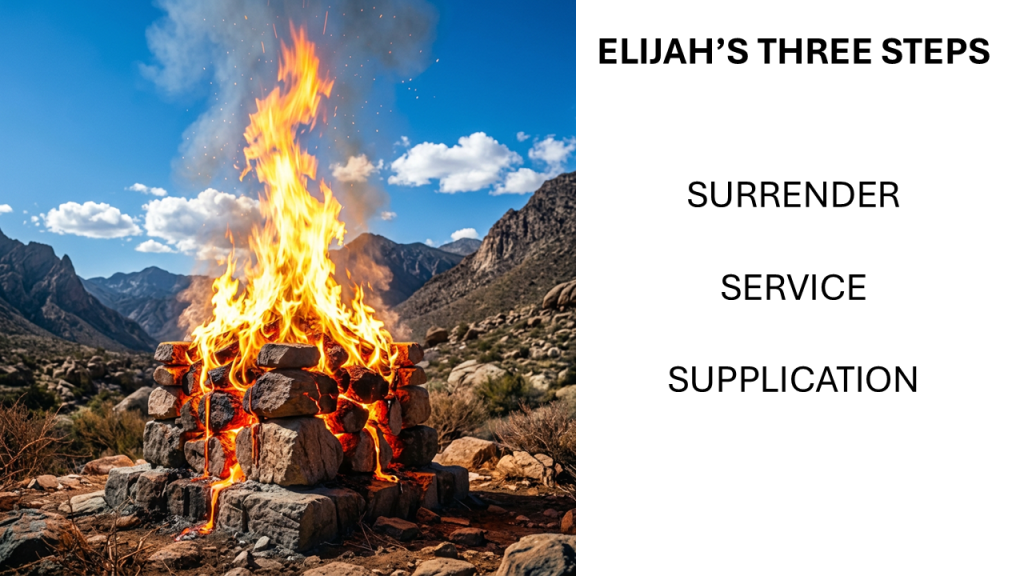
Our Surrender
We must be wholly surrendered to God. We need to be taking up the cross. Grace is not cheap – it comes at a price. For Elijah this meant standing alone for God.
There are altars that must be repaired. Where we have allowed the world to steal our hearts and time we must take note and be restored to our first love. What are the repairs that must be made to take us back to the God of our salvation?
Is there anyone who doesn’t have a broken altar to repair?
Our Service
We need to prepare the offering. What are we going to present to God? What are we willing to give to Him? Are we willing to sacrifice, to go all out for Jesus Christ. Or are we holding back.
FB Meyer tells the story of how he was challenged to serve. He described his Christian experience with these words, before being challenged by the joy and the vision of Stanley Smith and CT Studd, who had given themselves to the mission field:
Before then my Christian life had been spasmodic and fitful, now flaming up with enthusiasm, and then pacing weariedly over leagues of gray ashes and cold cinders.
How many can honestly make that confession? Inconsistency mars many a Christian testimony. He spent a whole evening talking to these young men who challenged him to full surrender. FB Meyer later spoke of getting alone with God holding a bunch of keys. Each key represented a different door leading to a room in his life. One by one he laid out the keys. ‘Lord you can have that room…here’s this key Lord’. Then finally when all the keys were given, so it seemed, the Lord said, ‘FB – the last key’. Meyer replied – ‘Not that key Lord, not that room, not that area of life’. It was only when that young man surrendered the area of life that he had long held back that he entered into blessing.
Very memorable was the night when I came to close quarters with God…At last I said feebly, “Lord, I am willing to be made willing. I am desirous that Your will should be done in me and through me as thoroughly as it is done in heaven. Come and take me and break me and make me.”
Meyer said there was no euphoria, only a quiet and gentle resolve; “And now I give myself to You: body, soul and spirit; in sorrow or in joy; in the dark or in the light; in life or in death; to be Yours only, wholly, and forever. Make the most of me that can be made for Your glory.”
He faced a spiritual crisis, a period of challenge, as God drew him into His crucible in order that he might come forth as gold.
Many years later as a mature preacher Meyer told this story at the Keswick Convention. That night the lamps burned long as God’s people wrote letters of apology to those they had wronged, letters of forgiveness to those they held spite against and letters accompanied by cheques to those to whom they owed money.
Being tested by God under crisis is tough business. It’s humbling work. It tests our pride, it exposes our harshness, it brings our secret sins to light and challenges our carelessness. Who doesn’t need tested? Who doesn’t need to lay it all out on the altar to God?
I understand that Christ must be Lord of all or we are not saved. I shrink from the idea that some may be considered to be living a higher life than others. We are all sinners saved by grace. But without a doubt some walk closer and more humbly with God than others. They are usually the people who little realise how inspiring their lives are because they are so humble, so aware of their own failings. But they are a people near to God.
The Lord’s business is improving us, drawing us into sweeter consecration, making us the people we need to be in order that we might serve.
Our Supplication
Having done all that we can do we must pray pleading that God would come down and do a new thing among us.
Then the fire will fall and the sound of abundance of rain will be heard.
The God of Elijah still lives today. He intervenes in the affairs of men. He will build His Church. He is the God of the covenant. And He uses people who pray.
Elijah was saturated with prayer. After the fire fell and the people were turned and after the false prophets were slain – Elijah prayed for the needed rain. He held onto God for that cloud the size of a man’s hand, which promised the deluge that would come.
England has been suffering drought for a few weeks. There has been much excitement this week on the media because the rain is falling. Soon the parched land will be green once more. The farmers particularly will feel reprieved as autumn approaches.
Sadly our nation is suffering from a greater and more acute famine – of hearing the word of God.
Behold, the days come, saith the Lord GOD, that I will send a famine in the land, not a famine of bread, nor a thirst for water, but of hearing the words of the LORD: And they shall wander from sea to sea, and from the north even to the east, they shall run to and from to seek the word of the LORD, and shall not find it.
Amos 8:11-12
Our nation needs to see streams in the desert and experience the outpouring of God’s Spirit.
The fires must fall, however, before the rains can come.
The fire represents judgment. If revival is a work that takes place within the Church of Christ, then judgment must begin in the House of God.
As God’s holiness comes down our sins are exposed – extracting confessions and repentance. Then the showers of blessing will fall. We have no hope of survival except the Lord will come. But his promise is secure, let us hold onto the Pentecostal vision which is our pattern for this New Testament age.
And, behold, I send the promise of my Father upon you: but tarry ye in the city of Jerusalem, until ye be endued with power from on high. (Luke 24:49)



Leave a Reply