
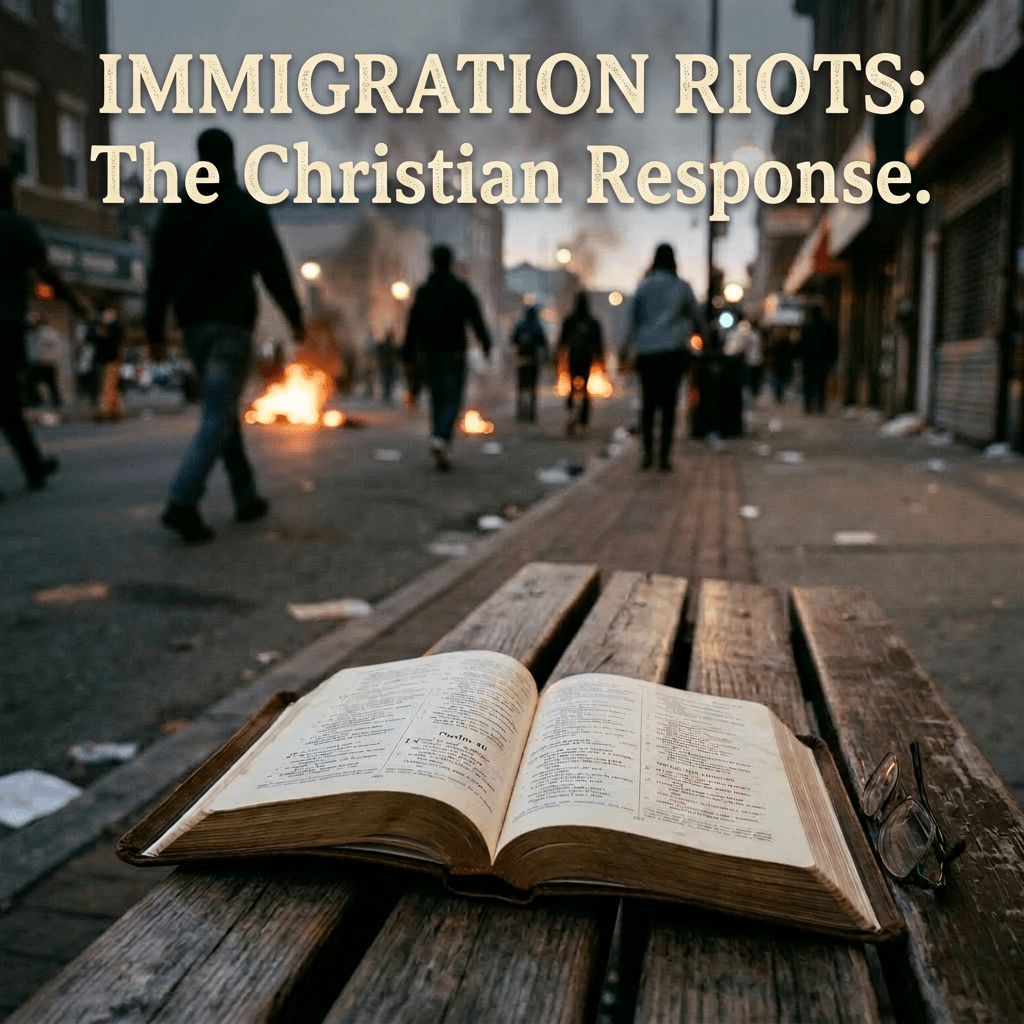
We are watching parts of Northern Ireland descend into violence, disorder and hatred. Fear and uncertainty fill the air.
All of this has followed the dreadful attempted murder, according to reports, at the hands of an immigrant to our shores.
Our prayers are with the victim. We also pray that the perpetrator will face trial and the full force of the judicial system for this dreadful act of barbarity.
As a consequence, much of the fear and suspicion that many people already feel concerning immigration has risen to the surface.
Let us be clear. Uncontrolled immigration presents challenges. It is an issue that governments must address. There are legitimate questions surrounding borders, integration, housing, public services and the rule of law. The British Government does have to take responsibility for its failings to create community cohesion and alleviate the fears of local populations. Such a policy has helped to feed the fear and mistrust which such an outrage sparks into uncontrolled fury.
But are we to take these concerns out upon the many foreign nationals who live among us?
Is that right?
Can it ever be right to attack innocent people, to intimidate families, to burn property, or to bring carnage onto our streets?
The answer is no.
The Word of God says, “Let every soul be subject unto the higher powers” (Romans 13:1). Again, speaking of the civil authority, Paul writes, “For he beareth not the sword in vain” (Romans 13:4). God has ordained government to maintain order and administer justice. The state bears the sword; the mob does not.
Whatever frustrations people may feel, lawlessness can never be excused. No-one is at liberty to take the law into their own hands or to terrorise people on the basis of their ethnicity or country of origin.
But there is another aspect to all of this that we must consider.
Are There Borders with God?
In one sense, yes.
The Lord has ordered the nations of the world. Paul declared that God “hath made of one blood all nations of men for to dwell on all the face of the earth, and hath determined the times before appointed, and the bounds of their habitation” (Acts 17:26).
Nations are not an accident. God has His purposes in them.
Yet nations are not eternal.
Borders change. Kingdoms rise and fall. Empires come and go. The history of the world demonstrates this repeatedly.
How important then are nations in the economy of God?
Important, certainly. But only for a time.
There are ultimately but two kingdoms in this world: the kingdom of God’s dear Son and the kingdom of Satan. Paul tells us that believers have been delivered “from the power of darkness” and translated “into the kingdom of his dear Son” (Colossians 1:13).
Our first concern therefore must be to ensure that we belong to Christ’s kingdom.
Some who are rioting may profess to be loyalist. Some may profess to be Protestant. Some may even profess to be “Christian”, but such conduct is wholly inconsistent with the religion of Christ.
Yet such labels do not place a man in the kingdom of Christ.
Indeed, it is entirely possible, however, that those who claim a “Christian” cultural identity are persecuting people who truly belong to Christ, simply because of the colour of their skin or their country of origin.
Such behaviour is entirely wrong, and those who engage in it shall answer to God.
The words of Christ should solemnise our hearts:
“I was a stranger and yet took me not in…Inasmuch as ye did it not to one of the least of these, ye did it not to me.” (Matthew 25:43-46).
Does One Race Have Priority Over Another?
I hesitate to use the word race.
Biblically speaking, there is only one race—the human race.
We all descend from Adam. We all bear the image of God. We all belong to that one humanity of which Adam was the father.
As we have already seen, God “hath made of one blood all nations of men” (Acts 17:26).
Regardless of skin colour, ethnicity, language or nationality, every person is a human being. Every person possesses dignity. Every person matters to God.
And every person needs the gospel.
Our Lord commanded His church, “Go ye into all the world, and preach the gospel to every creature” (Mark 16:15).
Not merely to our own people.
Not merely to those who look like us.
Not merely to those who speak our language.
Every creature.
Every person needs Christ.
An Opportunity for the Church
For generations, Christians left these shores and travelled to distant lands carrying the gospel to people of different cultures and languages.
Now many of those cultures have come to our shores.
Should we not see this as an opportunity?
The nations have come to us.
Some immigrants have come seeking work. They contribute to society. They pay taxes. They raise families. Many businesses would struggle to function without them.
Others have come fleeing war, persecution and circumstances that many of us can scarcely imagine.
And yet some who have fled hatred elsewhere have arrived only to encounter hatred here.
What then are we to do with the stranger?
The Scriptures answer plainly.
“Be not forgetful to entertain strangers: for thereby some have entertained angels unawares” (Hebrews 13:2).
Again we are reminded of the solemnity attached to Christ’s words. However we interpret this passage we cannot fail to be struck by the gracious and merciful responsibility that we owe to the visitors in our midst:
“Then shall the King say unto them on his right hand, Come, ye blessed of my Father, inherit the kingdom prepared for you from the foundation of the world…I was a stranger and ye took me in…” (Matthew 25:34-40).
The Christian is called to hospitality. The Christian is called to kindness. The Christian is called to love his neighbour.
That does not mean abandoning common sense. It does not mean that governments have no responsibility to regulate immigration. They do.
But it does mean that we must treat people as image-bearers of God and as souls for whom Christ died.
A Better Vision
We are horrified by the attempted murder that has brought us to this point.
We are likewise horrified by those who have used the situation as an excuse for disorder, destruction and violence.
The church of Christ must offer something better.
We need a vision of love for all men and women.
We need a vision for the spread of the gospel among all peoples.
We need a vision that looks beyond nationality, ethnicity and language to the greater reality of Christ’s kingdom.
God’s purpose is not merely that people would share a common humanity, important though that is.
His purpose is that men and women from every tribe, tongue and nation would come to Christ and become one in Him.
As Paul writes, Christ has made “in himself of twain one new man, so making peace” (Ephesians 2:15).
At a time when fear, anger and suspicion threaten to divide communities, the church must point people to the Prince of Peace.
And while the kingdoms of this world will continue to rise and fall, Christ’s kingdom shall stand forever.
We pray for all who suffer, have been rendered homeless or who are filled with fear as a result of these events. We pray for the power of the gospel bringing peace in the midst of disturbance, bringing love in the midst of hatred and bringing order out of confusion.


Leave a Reply