
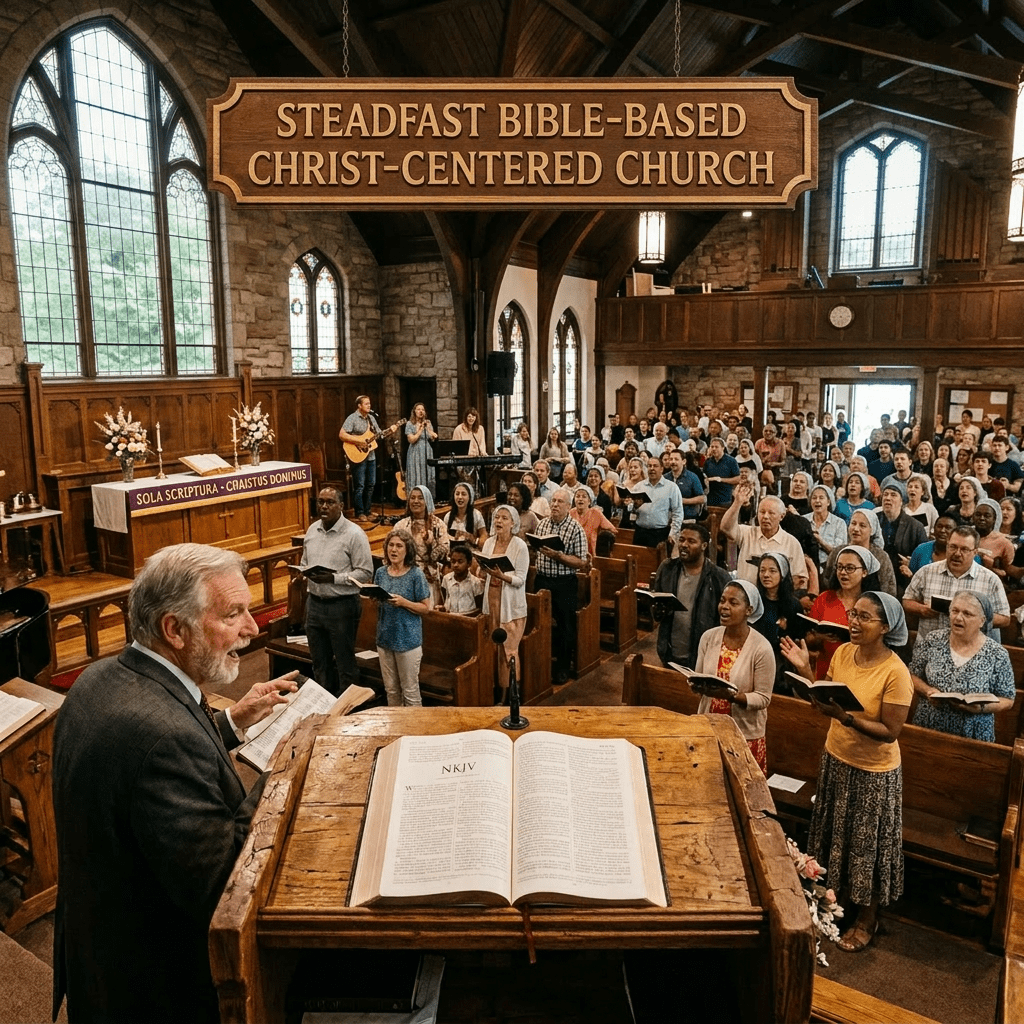
“Therefore, my beloved brethren, be ye stedfast, unmoveable, always abounding in the work of the Lord, forasmuch as ye know that your labour is not in vain in the Lord.” (1 Corinthians 15:58)
In many respects 1st Corinthians is a spiritually troubling and perplexing book. Church problems are fraught affairs and are not easily disentangled. There had been pain and division within this flock and now they had been exposed to the sharp cutting edge of Paul’s sword. These were discouraging for the work of God.
As Paul reaches the conclusion of his epistle, however, he leads the people onto more encouraging territory. Should the people give up and leave the Church because of the division, the sin and the false gifts. No – they were to remain and make things better. They were not to abandon the Lord’s people but rather to continue on in the work of Gospel. This of course, was on the proviso that the Church follows Paul’s instructions in dealing with these matters that he raises. Sin can never be swept under the carpet in Church life. It must be exposed and repented of. But even so – this is difficult even when we are doing what is right.
In difficult days when there is division and chastening what are we to do?. We must continue and persevere in the work of the Lord.
Defining the Work
The work encompasses the entirety of the ministry of the Church; each aspect of Church life forms part of the work. The word “work” is a uniquely Christian and New Testament way of describing Church ministry.
The word “work” in this instance is ergon, a common New Testament word translated work, works, deed or deeds. |t means toil, effort or labour. Church work requires energy and commitment. This takes us back to a place in this letter where Paul described the Church members as “labourers together with God” (1st Corinthians 3:9).
This work, however, belongs to the Lord. It is is not reserve of the elders, the deacons or the Church members. We dare not treat the work with carelessness or in a selfish or political manner. Constantly we must reflect on the One who is the great shepherd of the flock.
The Manner with which we Engage in the Work
Stedfast and Immovable
The Greek word, hedraios, used three times in the New Testament, carries the the thought of being sedentary or motionless. A solid object is situated on a firm foundation. The degree to which we are steadfast is dependent on the firmness of the foundation. When we are truly on Christ we will remain true to Him and to His cause.
The word immovable is drawn from the Greek ametakinetos – It teaches us that we are planted in the work and we are not to be moved in our devotion and commitment.
Do these two terms not encourage us to remain in our posts? We are to be loyal to the work of the Church. Whatever the Lord has given us to do, let us continue in the task.
Always Abounding
The word perissyoo means to superabound. The word appears on thirty-nine occasions in the New Testament and means to be abundant or to increase. As this is a superlative it also carries the thought of excelling.
This certainly teaches us that God’s work deserves the best we have to offer in terms or time, energy, commitment and talents. We are not to withold from Him what He has given to us.
Our hearts must be engaged in the work. We dare not perform the work in a perfunctory and stale manner. There must be enthusiasm and vision accompanying all of our efforts.
The abounding is preceded by the word “always”. The work of God is to be our constant commitment. We are not to be deflected by discouragements or disagreements. We should not be dictated by our feelings and fears. We remain persevering with consistency week in week out, throughout the years until the work is done and the God calls us home to His eternal rest.
Pressing On
Despite their sins and their rebukes the Corinthians must press on. Why? Because of themselves? For the sake of their leaders and teachers? No! Because of Christ.
This commences with the pivot – “Therefore”. This is based on everything Paul has written in the 15th chapter. The entire teaching of the chapter leads to this final and climactic challenge. Why must the Church continue on in the work? The answer is found in the One who is subject of the chapter – Christ.
1: We Continue Serving because of CHRIST CONFESSED
“For I delivered unto you first of all that which I also received, how that Christ died for our sins according to the scriptures; And that he was buried, and that he rose again the third day according to the scriptures”
(1 Corinthians 15:3-4)
This, many recognise, as an early example of a Christian creed. Paul is articulating the subject of his ministry. The topic which is the beating heart and soul of the Church ministry is Christ’s death, burial and resurrection.
In dying He paid the price for our sins. His sacrificial death provided an atonement, a covering for our sins by His precious blood. He propitiated or appeased the wrath of God for us by taking that wrath Himself. He was a substitute being sacrificed in our place in order that redemption would be accomplished.
He died and was buried. His burial would become a key element in the proof for the resurrection. By enduring death he bore the greatest sign of the curse which sin inflicted upon this world. The mystery of immortality yielding to the power of death is beyond all of our thoughts. Jesus Christ died for me.
He rose on the third day according to the Scriptures. Paul now brings us to the heart of the discourse in 1st Corinthians 15. In the v14 he would declare “if Christ be not risen, then is our preaching vain, and your faith is also vain”. Without the resurrection the Christian faith has no validity.
Paul pointed out carefully that Christ rose “according to the Scripture”. By so doing he corroborated the Gospel record and all the eye witness accounts. He went much further however:
Every promise, type and prophecy recorded in the law, in the prophets, and in the psalms, concerning his sufferings and death, had their fulfillment in him
John Gill
If Christ truly died for our sins as a sacrifice, if he was buried and rose again and if the Bible is true then we have every reason to continue in the work.
2: We Continue Serving because of CHRIST’S CONSOLATION
“If in this life only we have hope in Christ, we are of all men most miserable.” (1 Corinthians 15:19)
The reality of Christ’s resurrection is not merely a doctrine to be defended; it is a comfort to be enjoyed. Paul reminds the Corinthians that if Christ has not risen, then the Christian life is ultimately futile. Our hopes would be confined to this present world, and all our sacrifices, sufferings and labours would be empty.
But Christ is risen. The Christian therefore possesses a living hope which stretches beyond the grave. Our comfort is not found in favourable circumstances, earthly success or even good health. Our consolation rests in a living Saviour who has conquered death and now intercedes for His people.
The Corinthians had experienced divisions, disappointments and chastening. Yet Christ remained unchanged. He still loved His Church. He still reigned in glory. He still prayed for His people. Their comfort was not found in themselves but in Him.
Because Christ lives, every promise of God remains certain. The believer can endure affliction, opposition and sorrow knowing that the risen Saviour is working all things together for good. We may be discouraged at times, but we are never without hope. We may be cast down, but we are never forsaken.
Therefore we continue serving. We do not labour for a dead master but for a living Lord who walks with His people, strengthens them in their weakness and sustains them by His grace until the day He calls them home.
3: We Continue Serving because of CHRIST’S CONQUERING
“Then cometh the end, when he shall have delivered up the kingdom to God, even the Father; when he shall have put down all rule and all authority and power. For he must reign, till he hath put all enemies under his feet. The last enemy that shall be destroyed is death. For he hath put all things under his feet. But when he saith all things are put under him, it is manifest that he is excepted, which did put all things under him. And when all things shall be subdued unto him, then shall the Son also himself be subject unto him that put all things under him, that God may be all in all.” (1 Corinthians 15:24-28)
The Corinthians were a beleaguered group of Christians serving in a hostile pagan city. There were adversaries without and troubles within. But Jesus, as the resurrected Saviour was reigning and would continue reigning until every enemy was put under his feet.
Herein we observe the onward progress of Christ’s kingdom. Christ will ensure that His Church will go forward and be triumphant in the world.
On this account we continue in His service – He is King of Kings and Lord of Lords.
4: We Continue Serving because of CHRIST’S COMING
“Behold, I shew you a mystery; We shall not all sleep, but we shall all be changed, In a moment, in the twinkling of an eye, at the last trump: for the trumpet shall sound, and the dead shall be raised incorruptible, and we shall be changed. 53 For this corruptible must put on incorruption, and this mortal must put on immortality. So when this corruptible shall have put on incorruption, and this mortal shall have put on immortality, then shall be brought to pass the saying that is written, Death is swallowed up in victory. O death, where is thy sting? O grave, where is thy victory? The sting of death is sin; and the strength of sin is the law. But thanks be to God, which giveth us the victory through our Lord Jesus Christ.” (1 Corinthians 15:51-57)
Paul brings the Corinthians to the ultimate and final triumph when Christ will return. The emphasis here is upon the resurrection of our bodies. While the soul is with Christ from death, the body lies dormant in the grave. When Christ returns, however, death will be finally defeated as the body once corrupted will be raised in corruption. Redemption purchased at the cross will be finally accomplished and applied as the souls of believers are reunited with bodies – glorious like Christ’s glorious body.
We live in this world with the shadow of death hanging over us. But for the Christian, death will be defeated by the returning Christ as all of God’s people are physically and bodily assembled as the general assembly and church of the first born as we worship Him day and night in His temple. The shadows will flee away. The night will be over. Our new bodies will never suffer nor will they perish. We will have gained the ultimate, the eternal victory through our Lord Jesus Christ.
Who would not want to serve such a master?
Conclusion
The final words of our text sum all up:
“…forasmuch as ye know that your labour is not in vain in the Lord.”
Such a labour for such a Saviour can never be in vain.
On occasions we are inclined to measure success by human standards. We look for the commendation of others. We look for “results” and for instant success. At times this is not forthcoming. Does this mean that the work in is in vain?
The labour of Christians will not be lost labour
Matthew Henry
The truth is – the work is never in vain because we serve a resurrected Saviour who is King of Kings and who is returning in order to gather His church into the happy eternal state.
Therefore let us continue with conviction, courage and compassion.


Leave a Reply