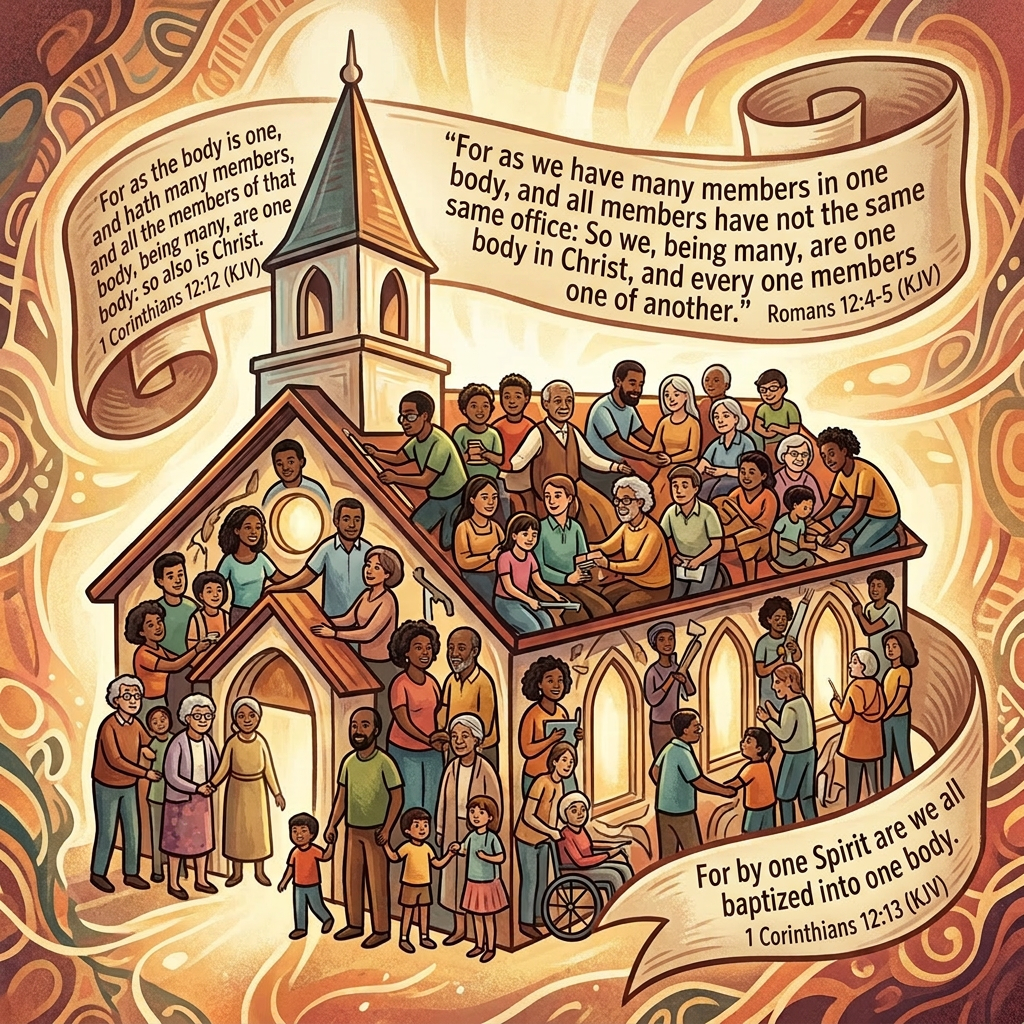
“For as the body is one, and hath many members, and all the members of that one body, being many, are one body: so also is Christ.”
I
Gifted but Dysfunctional
Corinth was a gifted church, but it was also a deeply dysfunctional church. There were divisions, jealousies, pride, misuse of spiritual gifts, immorality, lawsuits, and disorder in worship. Instead of functioning together as a healthy spiritual body, many in the church were pulling against one another.
In 1 Corinthians 12 Paul reminds them that the church is like a human body. Every believer is more than a member of the Church, each one is part of Christ’s body. Christ has many members and we are those members – “Now ye are the body of Christ” (v27).
The Mystical Body
For this reason Christ’s body is known as a mystical body. It is difficult to grasp how poor sinners, could be brought into the body of Christ. Yet the mystery is revealed. By grace we are one with Christ.
In Colossians Christ is especially depicted as the Head of the body (Colossians 1:18). While that truth is not absent from 1 Corinthians 12, Paul’s primary emphasis here is upon the function of the body — how the various members work together in harmony.
One Body Many Members
Every member has a place, every member has a purpose, and every member matters. When each member functions properly the body grows strong, but when selfishness, pride, neglect, and division enter in, the whole body suffers.
The lesson from Corinth is clear: church dysfunction begins when believers stop thinking about the good of the body and begin thinking only about themselves.
The Church is one body and many members. Paul shows us what a healthy church should look like as the body works together for the glory of Christ.
1: UNITY
V.13
“For by one Spirit are we all baptized into one body…”
We share in the one salvation wrought by the one Spirit.
“By one Spirit are we all baptised into one body” emphasises the divine work in salvation, while being “made to drink into one Spirit” reminds us of the believer’s personal participation in that grace.
The basis for church unity is regeneration. That is why we strive to maintain a church membership consisting only of the converted. Church membership formally recognises by public confession our place within the body of Christ.
Paul reminds the Corinthians that the church unites people who otherwise would be divided.
“Whether we be Jews or Gentiles, whether we be bond or free…”
Within the Church Jew and Gentile could be one in Christ. In our own society many divisions still exist — religious, social, financial, political — but the gospel brings people together upon the common ground of grace.
The rich and the poor stand equal at the foot of the cross.
The church is not divided into superior and inferior classes. Every believer has value because every believer belongs to Christ.
There is a unity between old and young, men and women.
Within the Church ethnic and political distinctions are erased together with our differences over non essential matters as we find our essential unity in Christ.
But Corinth had forgotten this unity. Party spirit had entered the church:
“I am of Paul… I am of Apollos…”
A body divided against itself is unhealthy. A dislocated shoulder affects the whole body. In the same way unresolved division weakens the entire church.
The body’s unity is organic — alive and active.
Before conversion the Corinthians worshipped dead idols in magnificent temples. Their religion was ritual without life. But now they belonged to a living body animated by the Holy Ghost.
The church should never become a cold formality. There should be spiritual life, warmth, prayer, joy, power, and movement amongst the people of God.
Let us not neglect our foremost duty – to teach the world the glory of Christ. One of the ways we do this is by embracing and cultivating a spirit of unity. Because Christ’s body is one.
2: INDIVIDUALITY
Unity does not mean uniformity.
Within the unity of the church there is room for different personalities, different temperaments, and different abilities.
Paul points to the various members of the human body. The ear is unlike the hand. The foot differs from the eye. They have different appearances and different functions, yet all belong to the same body.
God has not made us identical.
To begin with, believers possess different personalities which God can use for His glory.
Amongst the disciples:
Peter was impulsive,
John was thoughtful and tender,
Thomas was cautious and pessimistic.
Grace did not erase their personalities; Christ sanctified and employed them.
Unity in Diversity; Diversity in Unity
With those personalities come differing gifts and abilities.
V.11
“Dividing to every man severally as he will.”
V.18
“But now hath God set the members every one of them in the body, as it hath pleased him.”
You have something you can do in the work of God — something suited to your temperament, personality, and ability.
Corinth became dysfunctional because spiritual gifts were being used for self-promotion rather than service.
Instead of asking,
“How can I help the body?” – Many were asking , “How can I be noticed?”
A church becomes unhealthy when prominence matters more than usefulness.
3: INTERDEPENDENCE
Individuality must never become independence.
Every part of the human body needs the others.
V.21
“And the eye cannot say unto the hand, I have no need of thee…”
The church needs its young people — future elders, Sunday School teachers, committee members, and workers.
But the youth also need the older believers — their wisdom, steadiness, experience, and counsel.
Individualism without interdependence is rebellion.
Dysfunction comes when believers either overestimate their importance or underestimate their usefulness.
Some in Corinth were jealous of other people’s gifts.
V.15
“If the foot shall say, Because I am not the hand, I am not of the body…”
How ridiculous for the foot to envy the hand.
Interdependence means accepting the place God has given us while appreciating the contribution of others.
It also means keeping our own role in proportion.
V.17
“If the whole body were an eye, where were the hearing?”
Matthew Henry wrote:
“What a monster would a body be if it were all eye, or ear, or arm.”
A body made entirely of one member is not impressive — it is monstrous.
A church where only one voice matters, one age group matters, or one type of gift matters will never be spiritually healthy.
We must work together, using our own gifts while allowing others to fulfil theirs also.
4: HIDDEN TREASURES
Often the members most necessary are the least noticed.
V.22
“Those members of the body, which seem to be more feeble, are necessary.”
Think of the thumb without which we could not grip, or the big toe without which balance becomes difficult.
Some things appear insignificant yet are absolutely essential.
V.23-24
Paul speaks of the unseen parts of the body.
The heart, lungs, kidneys, and liver are not visible like the face or hands, yet they are far more vital.
One mark of a dysfunctional church is that visible gifts are admired while quiet faithfulness is overlooked.
Prayer may be more important than eloquence.
An aged saint confined to home may contribute more to the strength of the church through prayer than someone constantly in public view.
In 1949 on the Isle of Lewis, two elderly sisters — Peggy and Christine Smith, aged 84 and 82 — burdened by the spiritual condition of their community, began to pray earnestly for revival. One was blind and the other bent double with arthritis, yet God used their hidden ministry of prayer mightily. They urged the minister to gather the elders and deacons to seek God, and eventually Duncan Campbell was invited to preach. The result was a remarkable spiritual awakening.
The world values visibility, but God values faithfulness.
Some of the greatest treasures in a church are hidden from public view.
5: RELATIONSHIPS
V.25
“That there should be no schism in the body; but that the members should have the same care one for another.”
Paul warns against schism and division within the church.
When relationships break down, the body is dismembered. The church loses strength, testimony, usefulness, and beauty.
When the church divides we portray Christ in a poor light. By not working and operating as a cohesive unit we present Christ to the world as a deformed body.
Satan delights in creating dysfunction within the body through jealousy, suspicion, hurt feelings, pride, and unresolved offences.
We are united by far more than the things upon which we may differ.
Recently I visited one of the great historic preaching churches in London. The architecture still reflected the centrality preaching once held there, yet much had changed. I left reminded how easily churches can drift from their original spiritual purpose.
It also made me thankful for the heritage and privileges God has given us. We are far from perfect, yet we have much to preserve, much to defend, and much to unite around.
The word “care” is important.
That there should be no schism in the body; but that the members should have the same care one for another. And whether one member suffer, all the members suffer with it; or one member be honoured, all the members rejoice with it.
1st Corinthians 12:25-26
We care by refusing to harbour a harsh attitude. We should not constantly be judging one another critically.
We care by showing grace and tolerance. Romans 14 teaches that in non-essential matters we must allow our brother to be fully persuaded in his own mind. We have already observed this when pondering 1st Corinthians 6 and the meat offered to idols debate. We must respect one another’s consciences and avoid trampling over sincerely held convictions.
We also care by showing practical concern for one another.
V.26
“And whether one member suffer, all the members suffer with it; or one member be honoured, all the members rejoice with it.”
If one part of the body hurts, the whole body feels it.
So it should be within the church.
We should carry one another’s burdens and rejoice in one another’s blessings.
The answer to church dysfunction is not merely better organisation, but genuine Christlike love — the very subject Paul moves into in the next chapter.
Conclusion
Corinth teaches us that a church may possess gifts, activity, ability, and outward success, yet still be spiritually unhealthy.
The body only functions properly when every member humbly takes their God-given place and labours for the good of the whole.
Every member matters. Every member is needed. Every member has a place.
The hand needs the eye. The old need the young. The young need the old. The public worker needs the hidden intercessor.
May God preserve us from pride, jealousy, division, and selfish ambition, and teach us to function together as a healthy body for the glory of Christ.
“Now ye are the body of Christ, and members in particular.”



Leave a Reply