“Now in this that I declare unto you I praise you not, that ye come together not for the better, but for the worse. For first of all, when ye come together in the church, I hear that there be divisions among you; and I partly believe it. For there must be also heresies among you, that they which are approved may be made manifest among you. When ye come together therefore into one place, this is not to eat the Lord’s supper. For in eating every one taketh before other his own supper: and one is hungry, and another is drunken. What? have ye not houses to eat and to drink in? or despise ye the church of God, and shame them that have not? What shall I say to you? shall I praise you in this? I praise you not. For I have received of the Lord that which also I delivered unto you, That the Lord Jesus the same night in which he was betrayed took bread: And when he had given thanks, he brake it, and said, Take, eat: this is my body, which is broken for you: this do in remembrance of me. After the same manner also he took the cup, when he had supped, saying, This cup is the new testament in my blood: this do ye, as oft as ye drink it, in remembrance of me. For as often as ye eat this bread, and drink this cup, ye do shew the Lord’s death till he come. Wherefore whosoever shall eat this bread, and drink this cup of the Lord, unworthily, shall be guilty of the body and blood of the Lord. But let a man examine himself, and so let him eat of that bread, and drink of that cup. For he that eateth and drinketh unworthily, eateth and drinketh damnation to himself, not discerning the Lord’s body. For this cause many are weak and sickly among you, and many sleep. For if we would judge ourselves, we should not be judged. But when we are judged, we are chastened of the Lord, that we should not be condemned with the world. Wherefore, my brethren, when ye come together to eat, tarry one for another. And if any man hunger, let him eat at home; that ye come not together unto condemnation. And the rest will I set in order when I come.” (1st Corinthians 11:17-33)
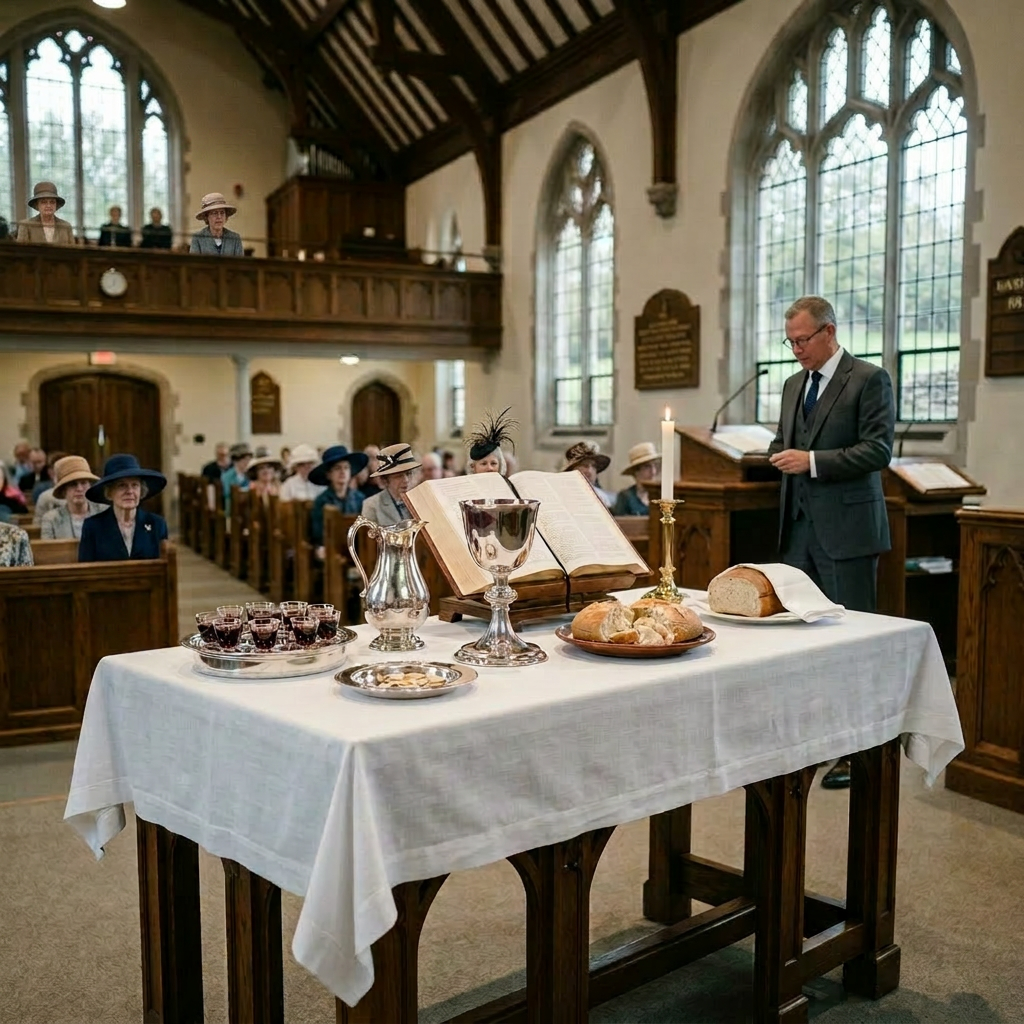
This study brings us to the most sacred and solemn moment of the Christian experience—communing with Christ and with one another through partaking of the bread and wine in faith at the Lord’s Table.
The Corinthian church was flawed in that the Lord’s Table had degenerated into a worldly feast, and the true meaning was forgotten. With a sense of grief, Paul wrote of one being hungry and another being drunken. To correct this abuse, Paul provides the most definitive statement on the Communion feast in all the New Testament.
The Sacrament of the Lord’s Supper
Paul emphasises the sacramental nature of the ordinance:
For I have received of the Lord that which also I delivered into you, That the Lord Jesus the same night he was betrayed took bread
1st Corinthians 11:23
The Shorter Catechism succinctly defines the sacraments:
A sacrament is an holy ordinance instituted by Christ, wherein, by sensible signs, Christ, and the benefits of the new covenant, are represented,sealed, and applied to believers.
Westminster Shorter Catechism Q92
In engaging at the Lord’s Table the Holy Ghost seals and assures of our position within the new covenant. The old covenant extended to Israel was represented by the Passover snd circumcision. The new covenant was sealed by the shedding of Christ’s blood, with the Lord’s Supper and Baptism being its tangible and sensible sign.
Christ instituted the Communion feast at the final Passover, celebrated on the eve of the crucifixion. Therefore, it is incumbent upon the Church to observe this sacrament in fulfilment of His command: “This do in remembrance of me” (1 Corinthians 11:24–25).
In calling us to remembrance Christ was all to aware of our tendency to forget.
There could be no need for this loving exhortation, if there were not a fearful supposition that our memories might prove treacherous, and our remembrance superficial in its character, or changing in its nature.
CH Spurgeon, New Park Street Pulpit
The celebration of the feast is therefore a duty for both the individual Christian and the Church—one that we are called to obey and to engage in seriously.
The Preparation for the Lord’s Table
It is appropriate now to consider the preparation required of those who partake:
Wherefore whosoever shall eat this bread, and drink this cup of the Lord, unworthily, shall be guilty of the body and blood of the Lord. But let a man examine himself, and so let him eat of that bread, and drink of that cup. For he that eateth and drinketh unworthily, eateth and drinketh damnation to himself, not discerning the Lord’s body.
(1st Corinthians 11:27-28)
The Lord’s Table has a sanctifying effect. One of its sacred purposes is to prompt heart-searching, confession, and repentance.
Therefore, we must examine our own hearts and ensure that we are in the faith. Only those who are truly converted are fit to partake.
As Christians, we dare not come to the Lord’s Table while holding on to unconfessed sin. We all sin more than we realise, and we are guilty of sins we fail to recognise. This, however, is not what Paul is primarily addressing. Rather, he warns against knowingly holding onto sin and living in defiance of God. Such sin must be repented of before approaching the Communion feast.
For this reason, the Kirk Session has the right of discipline to withhold the sacrament from any whose testimony would bring the Lord into disrepute. This authority is to be exercised sparingly and with discretion. The elder is a shepherd, not a tyrant. He must act in collaboration with his brethren and not on impulse or on the basis of hearsay. Nevertheless, one of the functions of the Kirk Session is to guard the Lord’s Table.
It is a solemn matter for a professing Christian to refuse to put his or her life right before God as the appointed time for the feast approaches. The Communion Feast is a call to holiness; it is a call to devote ourselves to Christ. To neglect this, and then to absent oneself, is as culpable as partaking unworthily and without repentance.
The Mystery of the Lord’s Supper
The nature of the Communion feast has long been a cause of contention within the Church.
The Roman Catholic Church developed the doctrine of transubstantiation, teaching that the consecrated bread and wine become the actual body and blood of Christ. The table thus becomes an altar, and the Mass a sacrifice. Yet there is nothing in the New Testament to suggest that Christ’s sacrifice is repeatable. He died once for sins. Whatever Christ meant by the words “This is my body… this cup is the new testament in my blood,” He did not mean what is asserted in the Mass.
Martin Luther struggled with this issue. He rejected transubstantiation but proposed what is often called consubstantiation, teaching that Christ’s physical presence exists “in, with, and under” the elements.
Ulrich Zwingli rejected this view and emphasised that the Communion feast is a simple memorial. The Anabaptists during the Reformation period also focused upon the memorial aspect.
John Calvin adopted a different approach. His teaching, reflected in the Reformed confessions, holds that the bread and wine are more than mere symbols. While unchanged in substance, they truly represent Christ. As we partake, we feed upon Christ by faith. We commune with Him, sharing in His death and resurrection, and are spiritually nourished. Dr Alan Cairns writes of faith looking beyond the visible elements, settling on Christ, represented in them.
The Lord’s supper is a sacrament, wherein, by giving and receiving bread and wine, according to Christ’s appointment, his death is showed forth; and the worthy receivers are, not after a corporal and carnal manner, but by faith, made partakers of his body and blood, with all his benefits, to their spiritual nourishment, and growth in grace.
Westminster Shorter Catechism Q96
The mystery of the Lord’s Table reminds us of our communion snd unity with one another and with the entire universal Church for whom Christ died:
It is true, as Edwards points out, that participation at the Lord’s Table declares our ‘communion with the universal church throughout the whole world’, for ‘all are united in the same Head; all are partakers of the same spiritual blessings, same the body of Christ, the same spiritual food, the same body and blood of Christ.’
The Lord’s Supper, An earthly encounter with the heavenly Christ. Dr Alan Cairns
The Devotion through the Lord’s Supper
As we feed spiritually upon Christ, there is nourishment for our souls in this feast that we will not receive elsewhere. The sacraments are therefore a means of grace. A sinner is not converted through partaking, but a Christian who partakes in faith will grow in grace through communion with Christ.
With humility, we express our gratitude to the Saviour whose body was broken and whose blood was shed for us.
In doing so, we pledge our allegiance to Christ and surrender ourselves afresh to Him. The Lord’s Table becomes a place of consecration, dedication, and renewal.
It also becomes a place of assurance. As we feed upon Christ, our faith is strengthened. Should a doubting and struggling Christian partake? Absolutely. It is here that faith is nourished and strengthened.
The Lord’s Table is a rare and sacred moment in a busy world—a time of quiet reflection, free from distraction, in which we focus upon Christ.
This is not an optional extra. It is central to the Christian life. Without it, we are spiritually impoverished.
So often we are burdened with the affairs of this life. Concerns of family, health, business, or even of the Lord’s work, crowd in on us and cast a fog over our souls. It is not that we renounce our faith in Christ, but our hearts grown cold and unresponsive. We feel unworthy even to sit at the Lord’s Table. And yet this is the very place we need to be, a place to turn our thoughts away from all else but Christ.
The Lord’s Supper, An earthly encounter with the heavenly Christ” Dr Alan Cairns
The Abuse of the Lord’s Table
In Corinth, God chastened those who abused the Communion feast. Some were weak and sick, and others were taken home to glory because they treated it with contempt.
This both warns and challenges us to live holy and godly lives. We do so with gratitude for Christ, who offered Himself for us. We are called to be lights in a dark world, mindful of our solemn responsibilities.
Let us therefore live for God, before it is too late.


Leave a Reply