“Be ye followers of me, even as I also am of Christ. Now I praise you, brethren, that ye remember me in all things, and keep the ordinances, as I delivered them to you. But I would have you know, that the head of every man is Christ; and the head of the woman is the man; and the head of Christ is God. Every man praying or prophesying, having his head covered, dishonoureth his head. But every woman that prayeth or prophesieth with her head uncovered dishonoureth her head: for that is even all one as if she were shaven. For if the woman be not covered, let her also be shorn: but if it be a shame for a woman to be shorn or shaven, let her be covered. For a man indeed ought not to cover his head, forasmuch as he is the image and glory of God: but the woman is the glory of the man. For the man is not of the woman; but the woman of the man. Neither was the man created for the woman; but the woman for the man. For this cause ought the woman to have power on her head because of the angels. Nevertheless neither is the man without the woman, neither the woman without the man, in the Lord. For as the woman is of the man, even so is the man also by the woman; but all things of God. Judge in yourselves: is it comely that a woman pray unto God uncovered? Doth not even nature itself teach you, that, if a man have long hair, it is a shame unto him? But if a woman have long hair, it is a glory to her: for her hair is given her for a covering. But if any man seem to be contentious, we have no such custom, neither the churches of God.” (1st Corinthians 11:1-16)
Hotly Contested
This study brings us to the most hotly contested passage in 1st Corinthians. This passage divides not so much the liberal church from the evangelical church as much as it divides evangelical Christians themselves.
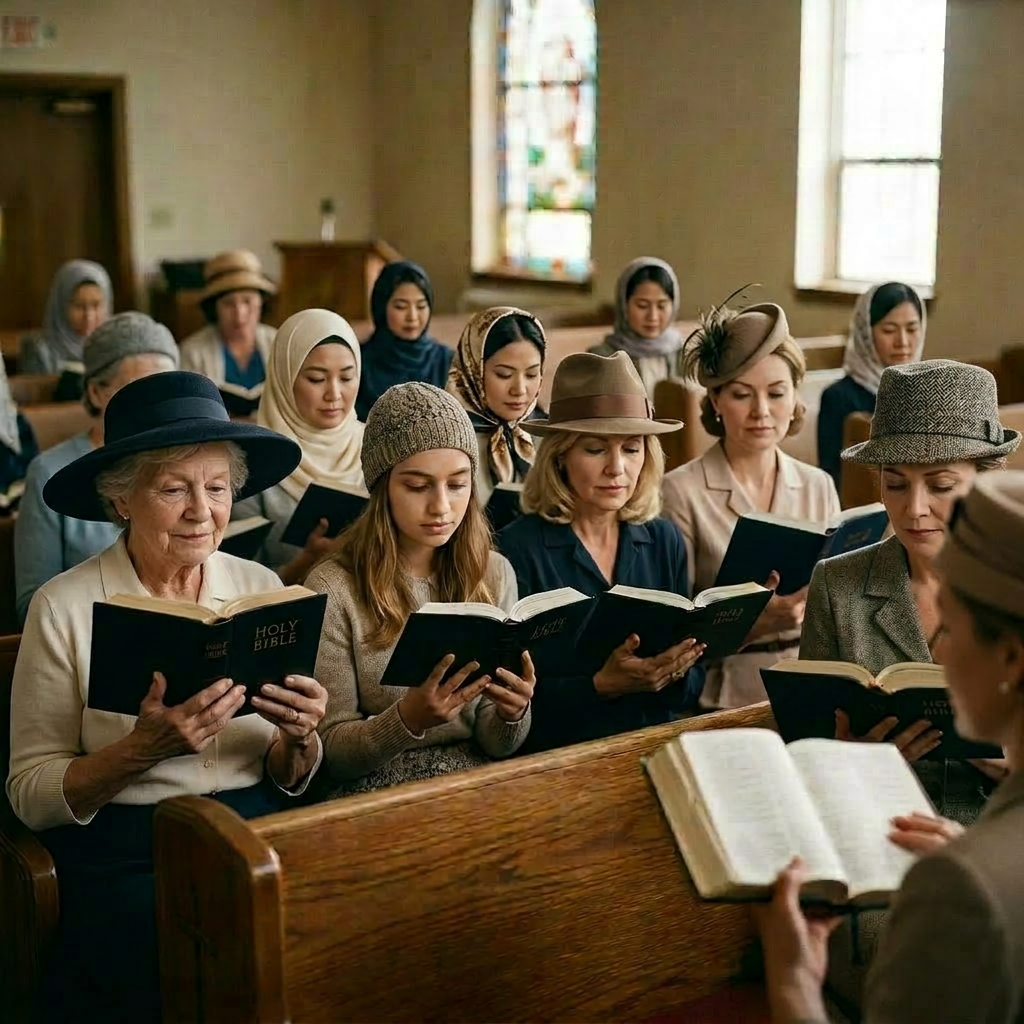
For many the question of the chapter is – ‘Should a woman wear a head covering to Church or should she not? Is this necessary?’
This certainly is the direction in which the passage leads us – but why does it point in this direction? This is the key question we must address in this study.
It’s not all about Hats
We must never get into a position, however, where ladies without head coverings feel ostracised or not welcome to our services. This is not the case currently and I do not want this to be the case. Let us never be like the church that refused a woman contemplating suicide admittance to their service because she had no hat. Thankfully there was a group of Christians nearby who did welcome her and she was converted and brought to perfect peace. This teaching is for Christians and has particular relevance to Church members.
Nor would I want a woman to turn around and go home because she had forgotten her hat. I have heard of that happening also. God understands our frailties. We live in His presence and seek His approval above all. I thank God for every lady who comes hat or not and I thank God for men who come in casually dressed. We should be careful about our attitude to every person who comes to worship God. After all – God sees the heart.
Counter Cultural
This passage is hotly contested largely because it is counter cultural.
Societal culture today is dominated by the feminist movement. Feminism argues that there is no difference between the genders in terms of roles within the marriage, within society or within the Church. Therefore the traditional perception of the woman being a mother and a homemaker was flawed. This in turn led to a breaking down of the traditional and cultural distinctions between the genders. Unisex hair styles developed as well as unisex clothing. A woman, in terms of the feminist movement was now liberated. She was not to be restricted by the cultural or religious ideas. She could dress as she pleased. If she wanted to wear trousers, which at one time was deemed outrageous, that was fine, or if she wanted to wear scantily clad provocative clothing that was fine as well. The woman was the master of her own destiny.
It is a blessing of course that women have an equal right to education and to the highest and best paid jobs in industry and other professional careers. But in some cases, however, the pendulum has swung much too far.
The head covering emphasises that there are two genders which are distinct, in keeping with the ordinances of God since creation. For this reason it is deemed to be a counter cultural practice.
Gender Critical Theory
The gender critical theory today actively works to discriminate against men in favour of women. The critical theory believes that to address perceived oppression you must actively favour the oppressed. In this case women.
Christianity is regarded as the greatest problem in preventing the change that society needs. The role of the woman is but one example of this. We see the critical theory at work in terms of ethnicity, immigration, homosexuality, lesbianism and gender reassignment. Speak up in a way that is opposed to the “woke” lobby and you are caricatured as spreading hatred. There are modern ideas which are deemed to be beyond criticism.
The bible counters this reengineering of the culture of our society. Therefore the Church will be under scrutiny and is being pressurised to change. We are obliged to be counter cultural and remain with the teaching of Scripture.
Is the head covering one area in which even the evangelical church has largely capitulated?
Complementary Roles
The Bible nowhere teaches that the woman is inferior to the man. Scripture affirms the equal dignity and spiritual standing of men and women before God, while also maintaining distinct and complementary roles. In 1st Corinthians 7:4 for example both husband and wife had equal power over the body of the other. This was revolutionary in a society which treated wives as the personal property of husbands.
Christianity does not use the terms superiority and inferiority to define the roles and men and women. Rather we use the term complementary. Man is incomplete without the woman. The woman has her role, her vitally important role, which is different from the male role. Our genders are different. We should not act out of sync with nature and Scripture.
Therefore the man is called to lead within marriage and within the Church. Leadership is not the calling of the women. She cannot usurp authority over the man.
The headcovering, therefore is taught in 1st Corinthians 11 as the symbol of the distinction between the genders in the sight of God and the work of the Church.
Feminism in the Church
Throughout the long centuries of Christianity head covering was practiced among Christians. The decline of this practice has been matched in parallel with the development of feminism within society. Feminism has deeply impacted Christianity with the introduction and subsequent growth of female clergy.
Feminism is a feature though of the west.
Therefore it is no accident that the decline of the head covering is significantly associated with western Christianity. In the east the head covering has not declined, where the roles of women are much more traditionally based. The woman may not necessarily wear a hat but she will pull her head scarf over her hair as worship commences; a practice I have personally witnessed in the Far East.
Therefore we should look at this subject carefully. If we were to jettison the head covering are we in reality bringing the culture of this world into the Church? To diverge from the universal practice of Christians since the earliest days of the Church, and from a practice that still persists among millions of Christians worldwide, may be a dangerous course to follow for this generation and the next.
Public Worship
1st Corinthians 11 contains Paul’s directive for Christians when they gathered together as the Church. Therefore this instruction for the Church relates to our attitude to God as we worship Him. This is a most important and terribly solemn matter. We cannot worship God however we wish. Our worship is regulated by Scripture and we must dress in a way that is befitting to His glory.
He stresses the head covering as this is the issue that is of immediate concern. By inference though there is a challenge to our men also. We dress for the glory of God. We have a duty to dress in a way that befits the one in whose presence we stand. We can, in one sense, overstate the matter of dress because God looks at the heart. But there is another sense in which dress, if worn out of conviction – reflects the dignity of the one whom we serve.
Church Order Stemming from Creation
The head covering is reflective of church order. Man was created first while woman was created out of the man. There was a progression here indicating that the woman was placed under the loving headship of the man, while both were under God.
Christ is the head of the man and the man is the head of the woman. Therefore we want our ladies to wear the head covering out of conviction. Not because of tradition but with acceptance that ‘I dress as I do because this is taught in God’s Word and because it honours the Lord’.
Common Practice Among the Churches
The 2nd verse shows that this was an ordinance that Paul delivered to the Church. Verse 16 highlights that to do otherwise is contentious and there is no contrary custom. This was a practice among Christians which we can trace back to the earliest years of the Church.
Some argue that this was Paul’s own personal view or that he was responding to a local cultural problem in Greece. These words, however, were inspired by the Holy Ghost. To say otherwise makes a huge statement about the infallibility and relevance of the Word of God.
The Glory of the Woman’s Hair
One of the chief biblical ways of defining the distinctions between the genders is hair. While it is a shame for a man to have long hair a woman’s hair is her glory. In some eastern cultures a woman’s hair was regarded a sexually provocative and only for the eyes of her husband. Some Islamic codes practice this custom to the present day.
Paul develops this argument that the glory of the woman should be covered in the presence of God as the Church together assembles for worship.
For those who argue that the hair itself is the only covering intended, we should proceed with caution. Earlier in the chapter Paul states that if a woman will not be covered, she should also be shorn. This clearly points to an additional covering beyond the natural covering of hair. While he refers to hair as a covering this was with respect to her gender distinction. Her hair gives her a beauty that the man does not possess. If hair alone were sufficient, however, the contrast would lose its force. Paul’s argument is that her natural glory should be covered in the public worship of God.
A Sense of Perspective
We must weigh this subject in the light of the entirety of 1st Corinthians.
The difficulty with the head covering (or the veiled face) was one problem among several.
Because we practice head covering doesn’t mean that we are perfect or that we are morally and practically superior. When we become proud of our distinctions they become an idol and we neglect the other sins that are more grievous.
This church had divisions over lesser issues. They made idols out of men by falling out over Paul and Apollos. They were taking one another to court and tolerating sin that made even the Corinthians blush. If the head covering had been the only problem in Corinth, this letter may never have been written.
At times we are very good at focusing on issues where we feel ourselves to be sound. But we fail to address greater sins, because we are complicit in them; ‘Let’s criticise those people for eating meat offered to idols but don’t talk to be about my relationship with my father’s wife – thats my business!’. ‘Oh there’s a woman coming without her veil to worship but I will still take my brethren before the pagan court rather than deal with this in the Church’. ‘I am faithful to all that the Free Church has stood for over these seventy-five years – I use the King James Version, I am a staunch separatist, I believe that ladies should wear hats BUT don’t criticise me for gossip, for ridiculing my brothers and sisters or not subjecting myself to my elders – The sins of the saints!
The take home lesson challenges us to focus on our own sins rather than the sins of others. There is a strong and conclusive case for head covering. But we all must focus in on our hearts because there is much that displeases God.



Leave a Reply