

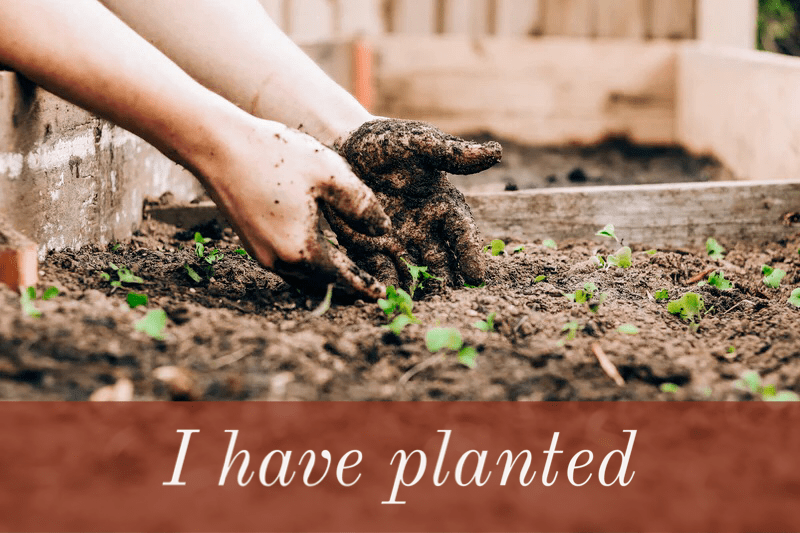
I have planted, Apollos watered; but God gave the increase….For we are labourers together with God
1st Corinthians 3:6,9
In Christian ministry we often call the local congregation “a work” with those who serve being “the workers”. This is a biblical concept, it was very much current in the New Testament Church, and it teaches us much about our duty and responsibilities to the fellowship of believers and our wider community of unbelievers.
THE COMMITTMENT

God might plough and sow His chosen farm, the Church, by miracle, or by angels, but it is a great instance of His condescension towards His Church that He blesses her through her own sons and daughters. He employs us for our own good, for we who are labourers in His fields receive much more good for ourselves than we bestow. Labour develops our spiritual muscle and keeps us in health.
C.H. Spurgeon
The word “labour” produces an image of graft, of sweat, of toil and of energy. Labour is never easy and has many discouragements. We are all agreed though, that nothing was ever achieved in life without toil and that some of the greatest and most lasting success stories were only realised as a result of strenuous and sacrificial effort.
This is especially true where the work of the Church is concerned. The ministries of men like Luther and Calvin, Matthew Henry, George Whitefield, John Wesley and CH Spurgeon were realised only as a result of years of extreme labour. The Apostle Paul, who wrote these words was a most prolific worker; as a traveller, writer and preacher.
God does not bring us into the church to be an ornament; rather we are instruments, tools in the hands of the Redeemer, fulfilling a great and noble purpose. Nor has He brought us into the congregation to be spectators watching and commenting upon the players; we are all to be participants, in the thick of the action,
Commitment is required, absolute 100% commitment, if the ministry is to make progress in our community.
THE CULTIVATION
These are precious seed, such as the husbandman sows when corn is dear and he has but little for his family, and therefore weeps to part with it, yet buries it under ground, in expectation of receiving it again with advantage…Those that sow to the spirit, in this vale of tears, shall of the spirit reap life everlasting, and that will be a joyful harvest indeed.
Matthew Henry
One of the metaphors employed by Paul in this passage about Christian ministry is farming. He describes himself as the planter, the sower of seed.
Sowing is an expensive business. The seed is costly and must be committed to the ground without instant reward. The harvest will only arrive many months later after weeks of sunshine and rain, of weeding and irrigation. The sowing is vital but it is by no means a quick fix. Patience and faith are important ingredients in the whole exercise, even in the physical farm.
Yet the ground is naturally is hard and barren. It is a most unlikely place in which to cast precious seed. Ground left alone will be soon become wasted in just a few weeks. But when ploughed and sown and tended, it will become most productive.
We need to be spiritual farmers who are sowing, planning and preparing for the future harvest. Souls will not be saved unless we sow. Henry Ward Beecher said that some ministers work only for the moment never sowing for the future, others like the pedigree farmer have a chief interest in names and awards, other are consumed with building fences to keep others out but there are no open gates to welcome the lost, some go hunting for predators and vermin but never care for the sheep or tend the land. We need the right balance by investing much time into sowing, treasuring the seed and casting it forth with tears having a passion for the lost.
THE COMRADES

They may have differences of sentiment in minor things; they may have their debates and contests; but they heartily concur in the great design of honouring God and saving souls, by promoting true Christianity in the world
Matthew Henry
The Kingdom of Grace rarely advances through individuality and personality. It is God’s will for the world that God’s people act together as one, embracing our common purpose. The congregation is a band of comrades, a family of brothers and sisters who value each other in the work of the Kingdom.
Paul introduced this theme of working together, to deal with the problem of personality and cliques within the body of the Church. The Corinthians had become divided over their allegiances to certain Church leaders. Paul, Apollos and Cephas had attracted their followers. Division, criticism and jealousy had crept in and the work of God was suffering.
Paul, however, was at pains to teach that every Christian has a special and valuable role. He, for example, had sown but Apollos had come to water the seed. Both were required and neither could do the job that belonged to the other.
In any team sport every player accepts his or her position and in so doing supports the other roles. In soccer the defenders are not strikers but both are needed and both have a different skill set. In Rugby the forwards and the backs complement one another to achieve the momentum required to gain territory. Ultimately every good team, however, has the spirit of old fashioned tug of war – every member pulls in the one direction.
We must always learn to accept the skills of one another, fulfil our own role and use our own talents with enthusiasm; work with and never against each other.
THE COMFORT

They are working together with God, in promoting the purposes of his glory, and the salvation of precious souls; and he who knows their work will take care they do not labour in vain
Matthew Henry
If the work of a church is to be compared to a farm we must never forget that the proprietor of the farm is God. The work is His, it is never ours to do with as we please. We are His workmen, acting according to His directions.
There is comfort, however, derived from the one who equips us, calls us and perfects His plan through us. The Lord’s land is a successful and productive enterprise. Our purpose is to sow the seed, to preach the Word and maintain a Gospel witness. He will irrigate the soul, warm the heart and induce the harvest. He will give the increase.
In one district a congregation may labour through difficult seasons of discouragement but the tide will turn. A Gospel mission may occur without obvious signs of conversion but a planted seed will root and mature in several years time. A child may appear never to listen but a heart will be shaped unseen by us, by the gracious influences of God.
Let us never forget that our labours are never in vain. Putting our hand to the plough we must not turn back. Let us pray for passion and energy as we work the Lord’s land, whether we are called to winter, summer, springtime or the harvests of autumn.
 Clogher Valley Free Presbyterian Church
I enjoyed this message very much most instructive and comforting
LikeLiked by 1 person