
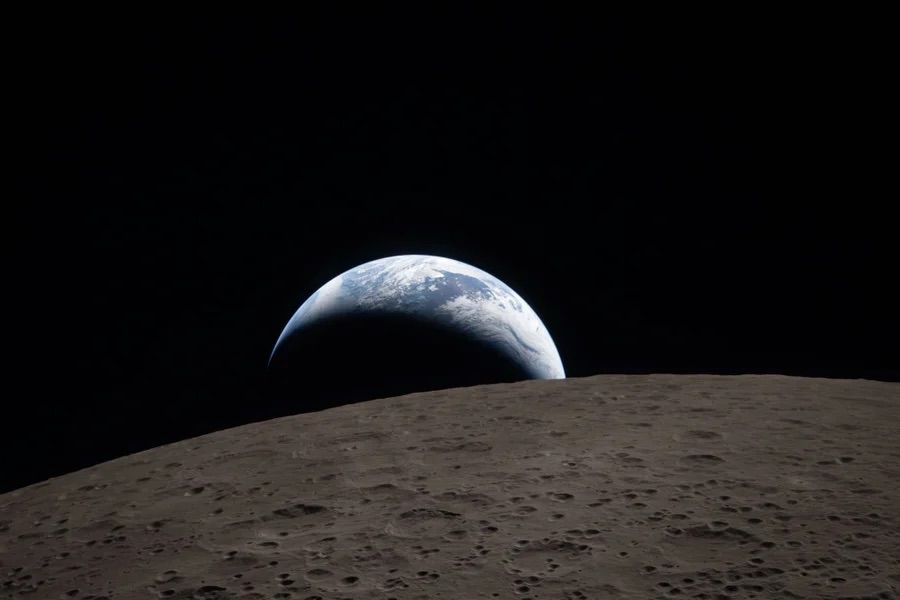
Last week many were enthralled by the ingenuity, creativity and sheer courage of NASA’s Artemis 2 mission to the moon. The research, technology and mathematical calculations in sending four astronauts 250,000 miles across space to orbit the moon, returning to Earth to within a mile of their target zone in the Pacific is awesome. People of my generation may remember the Star Trek tagline as Captain Kirk, Mr Spock and their team boldly went where no man has gone before. The Artemis 2 mission gave us a flavour of that spirit of space adventure as the four astronauts ventured further than any previous voyage.
The immensity of space and the Universe, however, is even more amazing than the quarter of a million mile trip to the moon and back. While such distances are mind-boggling to Earth dwellers who have never gone beyond the stratosphere, it is a mere stroll in the park when one considers the vastness of space. Artemis 2, building on the Apollo missions of more than fifty years ago, was a mere journey to our nearest heavenly body. Mars, Saturn, Jupiter, Pluto, Neptune together with the other planets in the solar system are much further away. Our solar system sits in one corner of the Milky Way, a galaxy with millions of stars, planetary systems, and asteroids. It is held together by the gravitational pull of a black hole around which everything moves. But there are other galaxies out there beyond the Milky Way. We are but a speck in the vastness of the Universe.
These trips out of this world with the incredible pictures taken from space give us a sense of our smallness, our insignificance. It helps us understand why God can look down upon our little planet and call the inhabitants grasshoppers (Isaiah 40:22). Humanity needs a heavy dose of the grasshopper experience. The powerful leaders and great nations of this world need to grasp their insignificance, as we zoom out and look at the big picture. Yet this vastness does not diminish our value—it reveals it.
The Biblical message which teaches us how special we really are is reinforced by space travel. Earth is seen hanging in space as this unique ball of blue, this place where life alone exists. The shots of “Earthrise” taken from the far side of the Moon are especially inspiring. We might only be grasshoppers but as grasshoppers we are uniquely privileged. We not only live in the most perfect environment in the vastness of the Universe, but we are grasshoppers with the ability to invent, communicate, compose, write, build, heal and create art forms. We are a self conscious race capable of harnessing the forces of nature for good and tragically at times, for evil.
This poses questions, big questions for the grasshoppers! Why are we here? What is our purpose?
The answer is found in the hymn I learned at Sunday School:
“Jesus loves me this I know,
For the Bible tells me so…”
In John 3:16 Jesus Christ said “For God so loved the world, that he gave his only begotten Son, that whosoever believeth in him should not perish, but have everlasting life.”
Not only did God create this awe inspiring universe, fashioning Earth as a perfect place for us to live and enjoy – but He loved us. Even when humanity rebelled against Him he continued to love. This love is personified in the person of Jesus Christ, the Son of God, who came to Earth as a man to offer His life and shed His blood as the ransom price of our redemption.
While the Universe reveals the power and omnipotence of God – it is on Earth alone that His love and grace is received. It is only as men and women suffering as a broken race that we can enjoy the mercy and forgiveness of God. Then we realise and fulfil our purpose for living.
The grasshoppers really are special—not because of what we achieve, but because of the God who loves us.
 Clogher Valley Free Presbyterian Church
Leave a comment