
1: Why Did Presbyterianism Divide?
This year the Free Presbyterian Church of Ulster marks 75 years of gospel witness since its founding on St Patrick’s Day, 17 March 1951. We give thanks for the mercies of the Lord that sustained the witness. At the same time, we maintain that Christ ultimately regards His Church as one (Ephesians 5:25–27). Throughout church history, divisions have occurred — some driven by peripheral differences, others by departures from essential doctrine. This article examines the 1927 heresy trial in the General Assembly of the Presbyterian Church in Ireland and argues that the trial’s outcome made secession the only faithful option for those who remained committed to historic Reformed doctrine.
The focus here is narrow: not an exhaustive history of denominationalism, but the specific theological and ecclesiastical developments that produced, first, the Irish Evangelical Church in 1927 and, later, the Free Presbyterian Church of Ulster in 1951. I argue that the decisions of 1927 — especially the Assembly’s handling of the case of Professor James Ernest Davey — constituted a decisive departure from the confessional standards that had governed Irish Presbyterian life and so justified separation by those who could not in conscience remain under that authority.
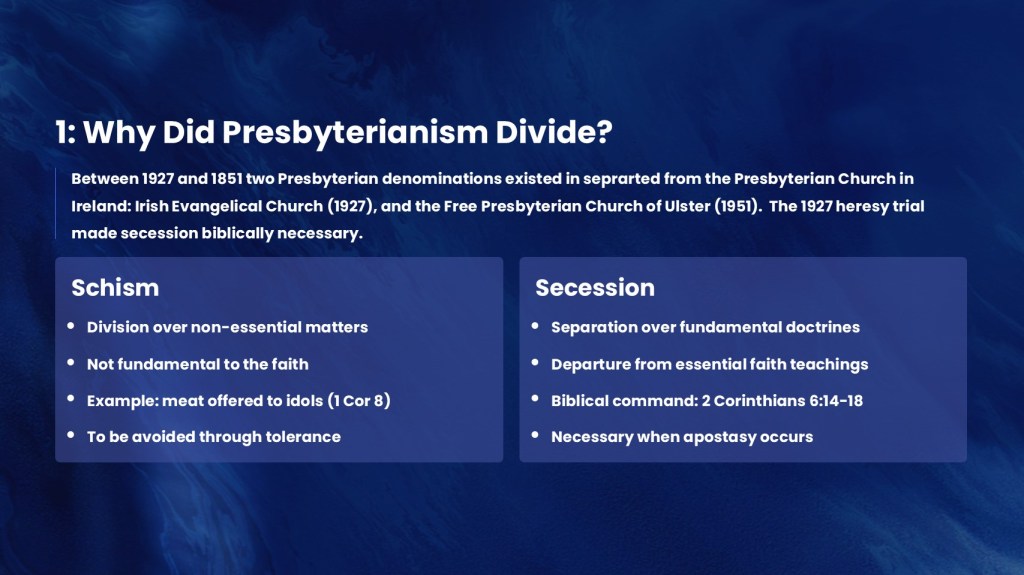
This article will focus upon why more than one Presbyterian denomination exists in Ireland post 1927. At the dawn of the 20th Century, two Presbyterian denominations existed in Ireland which subscribed to the Westminster Confession of Faith; The Presbyterian Church of Ireland and the Reformed Presbyterian Church. By 1951 there were two secession churches who had withdrawn from the Presbyterian Church; The Irish Evangelical Church (now known as the Evangelical Presbyterian Church) and the Free Presbyterian Church of Ulster.
The Distinction Between Schism and Secession
1927 was a pivotal year. Without the tragic events of that year these Secession movements would not have been biblically tenable.
It is important to appreciate the distinction between a schism and a secession.
A schism is a disruption within the church for lesser reasons. This is division based on matters that are not fundamental to the faith. Paul urged those with varying shades of opinion on matters such as consuming meat offered to idols to show tolerance and respect (1 Corinthians 8).
A secession is quite different. This occurs when a body of people continue the witness of that denomination within a new structure because of differences respecting the fundamentals of the faith. A departure from the faith once delivered unto the saints (teaching which is central and vital to the Church), or a departure from Church discipline where immorality is accepted within the Church are examples of pressure which can bring about a secession. In the 20th Century as secession has become known as separation based upon the command given in 2 Corinthians 6:14-18.
The 1927 heresy trial by the General Assembly of the Irish Presbyterian Church resulted in the formation of the Irish Evangelical Church. The impact of the teaching of Professor Earnest Davey, and others, generated an atmosphere of anti evangelical sentiment within the Presbyterian Church that many gospel loving people were left isolated and alone. It was this sad feature of Presbyterian life in Ulster that led to the session known at the Free Presbyterian Church of ULster on 17th March 1951.
My argument is that the existence of the Free Presbyterian Church of Ulster is valid on account of the official departure from the Christian faith with the Presbyterian Church in 1951. While the Irish Evangelical Church was a direct response to the acquittal of Professor Davey the emergence of the Free Presbyterians was an indirect but equally valid response.
We shall now think about the title of this study:
WHEN CONFESSION MATTERED
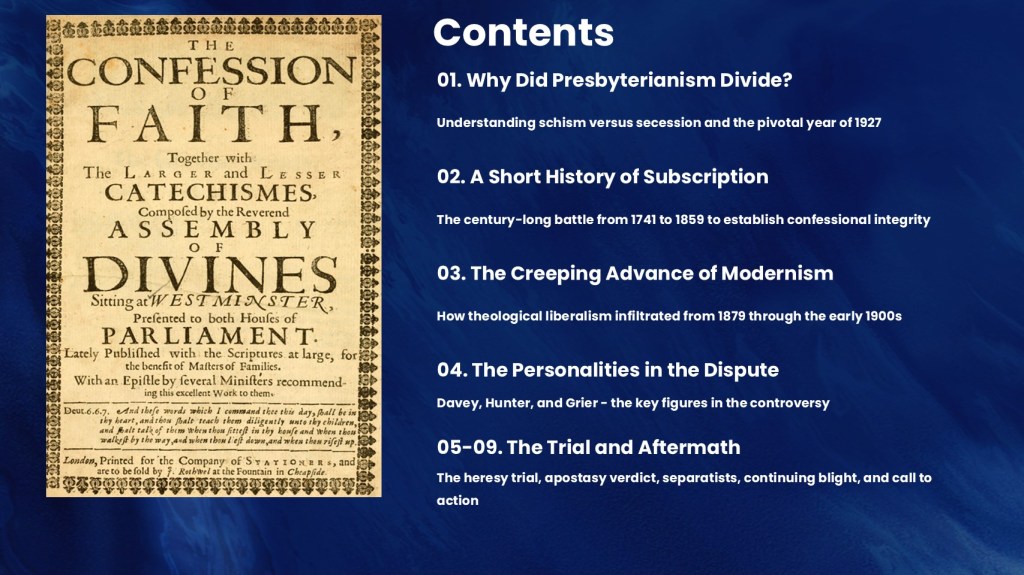
One of the defining features of Presbyterian ministry in Ireland was the requirement that ministers and elders publicly subscribe to the Westminster Confession of Faith at ordination. Subscription was intended to provide a shared doctrinal framework and to protect the church’s teaching. The history of subscription in Ireland was hard won: throughout the nineteenth century controversies over Arianism, higher criticism, and ecclesiastical union repeatedly tested the church’s convictions. Figures such as Dr Henry Cooke championed subscription as a safeguard for orthodox teaching; opponents who denied central doctrines eventually formed separate bodies (for example, the Non-subscribing Presbyterian Church of Ireland).
By the early twentieth century, however, new theological currents undermined confidence in an “external” standard. Phrases appearing in official documents — for example, that the Church may interpret its own standards “under the guidance of the Spirit” — shifted authority from the confession and Scripture toward ecclesiastical judgment. It was against this background that the controversy over Professor James Ernest Davey unfolded. Davey’s lectures and publications raised fundamental questions about the inspiration of Scripture, the deity of Christ, and the atonement. The General Assembly’s response in 1927 therefore had consequences not only for the men on trial but for the confessional identity of the whole church.
2: A Short History of Subscription
The road to subscription within Irish Presbyterianism was a long and difficult one. It was road that saw the Church plagued by false doctrine, secession, years of acrimony and debate and eventual schism. It was for a reason though – to protect the purity of Christ’s Church.
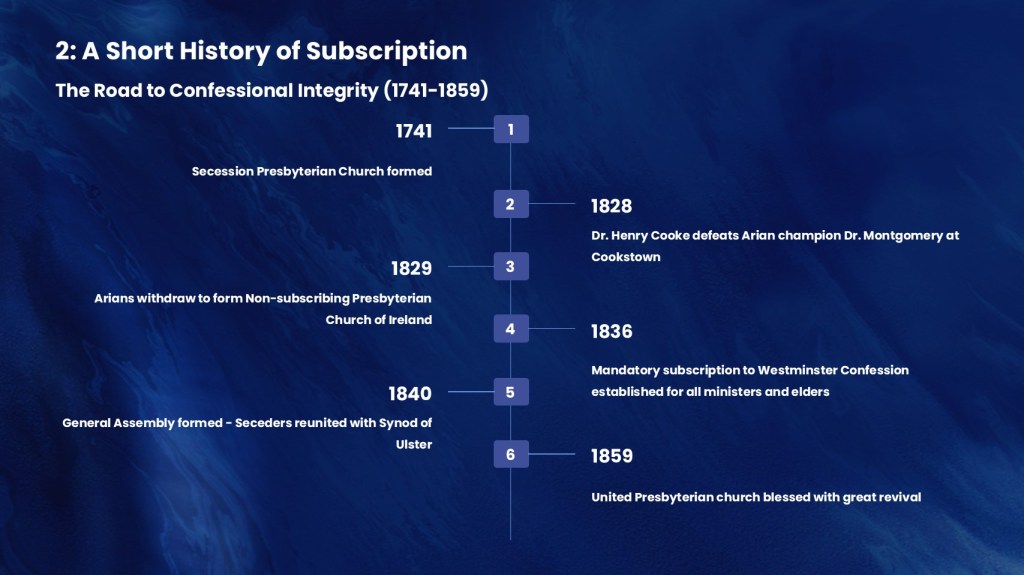
In 1741 the Secession Presbyterian Church was formed in Ulster, following a similar movement in Scotland. At this period subscription to the Westminster Confession of Faith was not obligatory. There was a body with the Synod of Ulster which were questioning doctrinal certainties. This was creating a cold spirit. The Seceders were greatly blessed of God and progressed to become almost as large as the older body from which they withdrew. This was in spite of differences within their own ranks which caused them to divide into two Synods for a period.
God, however, raised up a remarkable champion for truth within the Synod of Ulster in the form of Dr Henry Cooke. There had been a return to orthodox teaching throughout the older Presbyterian body. This was assisted in part by the formation of the Academical Institution in Belfast where both Secession and Synod theological students were lectured by Professors who were sound in the faith.
A group of ministers and elders within the Synod were Arian in theology. They refused to accept the deity of Jesus and as such were opposed to subscribing to the Westminster Confession of Faith. After years of raising the matter on the floor of the Synod Henry Cooke eventually defeated the Arian champion, Dr Henry Montgomery of Dumurry, in Cookstown in 1828. The motion carried required that any students holding Arian view should be excluded from ministry. In 1829 the Arians withdrew to form the Non-subscribing Presbyterian Church of Ireland. In 1836 the matter was finally resolved when a motion that all licentiates, ministers and elders subscribe to the Westminster Confession of Faith.
This created the doctrinal and spiritual atmosphere for the formation of the General Assembly in 1840. The Seceders were reunited with the Synod of Ulster to form a new denomination. This denomination was remarkably blessed in 1859, the year of grace and revival.
3: The Creeping Advance of Modernism
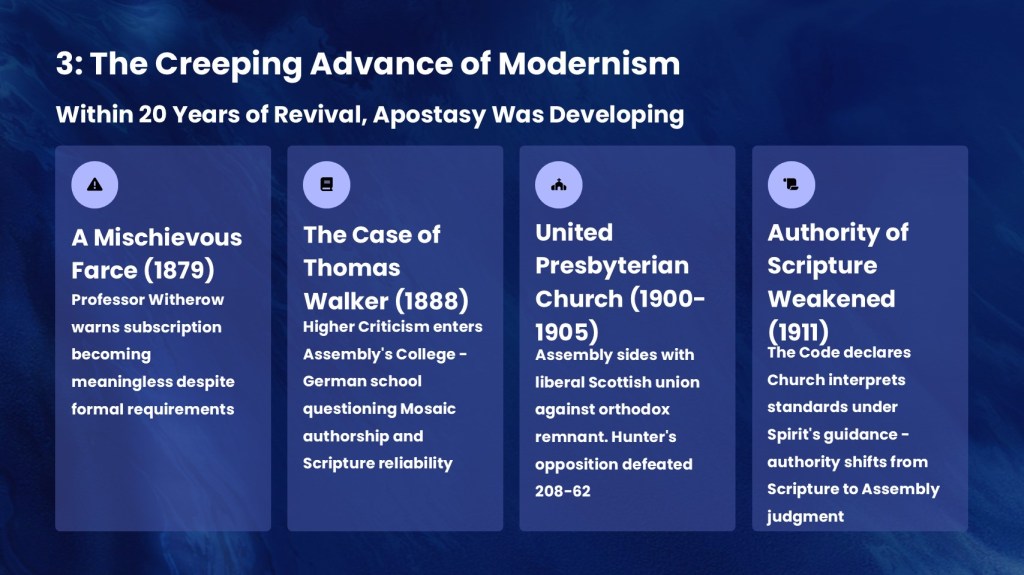
With this historical background tracing the development of subscription let us now consider the controversy, which reached a climax in 1927.
A Mischievous Farce
Writing as early as 1879 (a mere twenty years after the great revival) Professor Witherow writing in his “Historical and Literary Memorials of Presbyterianism in Ireland” expressed his fear that despite subscription Arianism existed within The General Assembly. Significantly he used the term “mischievous farce” when describing, subscription to the Westminster Confession of Faith.
The Case of Thomas Walker
By 1888 most of the men who had joined forces with Dr Cooke, who were well conditioned to the controversy that was looming on the horizon, were either dead or very elderly, without the capacity of their youth. Sadly among the ranks of younger ministers and students these older men were regarded as out of touch exciting new ideas. In this year, 1888, Thomas Walker, a well known adherent of the German school of higher criticism, was appointed as Professor of Hebrew at Assembly’s College. The Higher Critics were guilty of dismembering the Scriptures. They cast doubt on the Mosaic authorship parts of the Pentateuch. They questioned the authority and reliability of Scripture. While orthodox teaching existed within the college in other subject areas, Presbyterianism was fast becoming a body echoing the confusion of an uncertain sound. There was no champion with the courage and conviction of Henry Cooke to issue a challenge.
The Case of the United Presbyterian Church
The downgrade within Irish Presbyterianism became particularly apparent in 1900 following the union of the Free Church of Scotland with the United Presbyterian Church to form the United Free Church of Scotland. By 1900 the Fathers who led the famous Disruption in 1843 had passed away. They had taken a brave stand for the independence of Christ’s Kirk against state inference which resulted in thousands leaving the Church of Scotland. By the turn of the century decline had set in. Throughout the Free Church the heresy of Higher Criticism became accepted. When the opportunity of forming a new denomination arose it was accepted by an overwhelming majority. The difficulty was that the United Presbyterians had become weak on the vital doctrine of Christ’s atonement. This resulted in the new body not requiring wholehearted acceptance of the Westminster Confession.
Only two dozen ministers within the Free Church refused to be part of the Union. They were denied the funds of the Church they had served with Church property being denied them. Eventually they took their case to the House of Lords, winning the judgment. Not only did the General Assembly congratulate the two denominations on their union but furthermore, the Belfast Presbytery expressed their sorrow at the House of Lords decision. In so doing they sided against the brethren who had defended subscription and the precious doctrine of the atonement. For the first time in this article we relate the name Rev James Hunter of Knock, an Irish worthy if ever there was one. He was the Cooke of his generation but would not receive the accolades of such. Rev Hunter opposed the Belfast Presbytery’s decision in 1904, appealing to the General Assembly in 1905. By 208 to 62 the Assembly supported the Belfast Presbytery. Divisions were being laid bare and battle lines drawn for future confrontation.
Authority of Scripture Weakened
During the first two decades of the 20th Century the foundation was laid by the modernist faction, upon which Davey would build his defence at a later time.
In 1905 the Presbytery of Dublin employed this phrase when petitioning the General Assembly on a matter – “the Scriptures as revealed by the Spirit of Truth”. The phrase may have seemed innocuous but it was thoroughly modernistic. All of the Scriptures from Genesis to Revelation are the Holy Ghost inspired Word of God. Any other definition creates the possibility of selectively choosing what is truth and what is error within the body of Scripture.
This kind of phraseology came into view when the General Assembly published it review its Constitution and Government (known as “The Code”) in 1911. The most critical paragraph, which the modernists inserted, contained the words – “In the Church resides the right to interpret and explain her standards under the guidance of the Spirit”. Therefore the General Assembly, not the Scriptures nor the Westminster Confession, was the arbiter of truth. Truth could be whatever the General Assembly decided it so to be at a given point in time. Truth was no longer an absolute certainty.
Rev WJ Grier, one of the founders of the Irish Evangelical Church in 1927 made this comment in his work “The Origin and Witness of the Irish Evangelical Church”:
“…the church is stated to be the ultimate authority – not the Word of God., and this is a claim which, when pushed to its limits, resembles very closely the claims of the Papacy. The aim of all these changes is to set the church free from the trammels of and ‘external infallibility’ like the Scriptures”.
4: The Personalities in the Dispute
James Ernest Davey
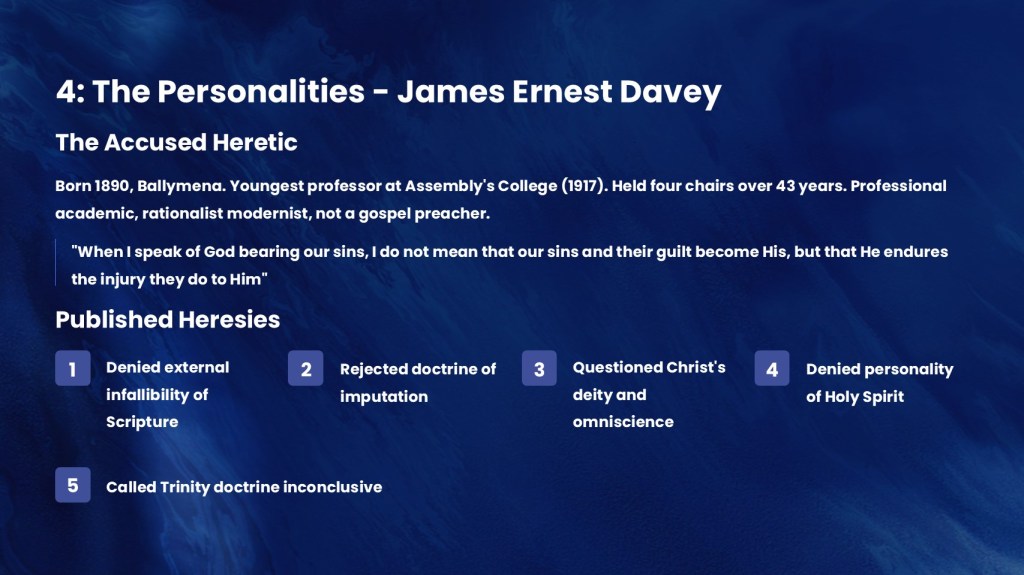
James Ernest Davey was born in a Ballymena manse in 1890 and educated at Methody. HIs high intellect and academic ability was noted from his earliest years. He pursued his studies at Cambridge, Edinburgh and Heidelberg, Germany. Licensed to the ministry and ordained in 1917, he became the youngest ever Professor at Assembly’s College. From 1917 to 1960 he held four chairs – Church History (1917-1922). Biblical LIterature and Hellenistic Greek (1922-1930), Hebrew and Old Testament (1930-1933) and New Testament Language, Literature and Theology (1933-1960). He was an professional academic, not a gospel preacher. He was drawn by the philosophy of the modernism and its rationalistic approach to Scripture and Christianity. Rationalism is the idea that we must interpret God and Scripture according to the reasoning of man. This is wrong as it ignores the sinfulness and finite nature of man when compared to the holiness and immensity of God. Ultimately Davey was not a Christian. He was one of those of whom Jude wrote – “For there are certain men crept in unawares, who were before of old ordained to this condemnation, ungodly men…denying the only Lord God, and our Lord Jesus Christ. (v4).
The Changing Vesture of Faith
Published in 1923 Davey’s lectures entitled “The Unchanging Vesture of Faith”, denied that we can be certain of an “external infallibility”. This was a flat denial of the Scriptures, God, Christ and the Holy Spirit. He further attacked the Christian assurance and hope by stating that all we have in terms of “experience, speculation, logic, feeling…is never such as to turn the life of faith into a life of certainty”. It is significant that he did not refer to the Scriptures, which is the ultimate ground of hope. But one who had denied the external infallibility would not find solace in the BIble. All he had was reason and this was grasping in the dark. This was the man who trained a generation of Irish Presbyterian ministers; men entrusted with preaching the gospel.
In a further book entitled “Our Faith in God” Davey spoke of Christ’s theories with respect to to the authorship pf Deuteronomy or Psalm 110. He argued that Christ was not final. Indeed , he had already argued that the doctrine of imputation (our sin imputed to Christ in order that His righteousness might be imputed to us) was as irrational as the Roman Catholic system of Transubstantiation. By denying that sin can be transferred he struck at the very heart of the atonement and the gospel.
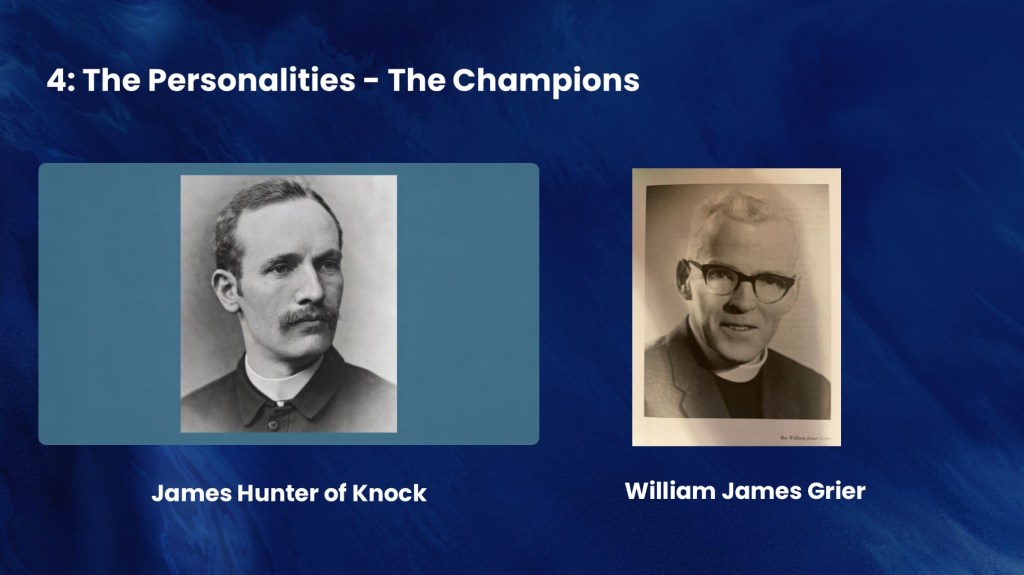
James Hunter of Knock
James Hunter, born in 1863, was the son of shopkeepers from Newtownstewart in Co Tyrone. Graduating from Assembly’s College in 1887 he began his ministry in Newry before moving to Dundela, Belfast, which eventually became known as Knock. He likewise was a brilliant academic. In contrast to Davey, however, he was attached to the old school and the principles of orthodoxy enshrined in the Westminster Confession of Faith. In the years preceding the heresy trial he was recognised as the foremost champion of of the doctrines contained in the confession in opposition to the modernists.
In 1925 James Hunter was appointed to the Formula Committee, which was responding to appeals from candidates to ministry who were unhappy with the questions asked at their ordination. Within this committee there was considerable agitation to drop the word “infallibility” with respect to Scripture and the requirement for subscription to the Westminster Confession. Such was the considerable opposition of Rev Hunter that the project was shelved.
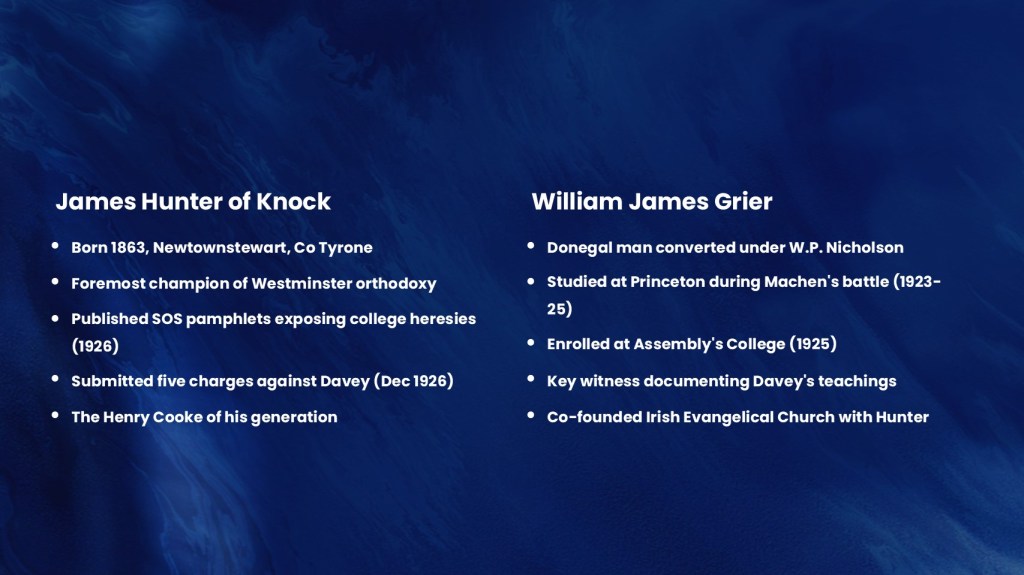
William James Grier
Jim Grier was a Donegal man, educated initially at Foyle College, Londonderry. As a student in Belfast he was converted through the preaching of WP Nicholson. The preacher’s text on that happy night was John 6:37; “All that the Father giveth me shall come to me, and him that cometh unto me I will in no wise cast out”.
Hearing the call to minister the young man set sail for America and Princeton University where a similar battle against Modernism was raging. Ernest C.Brown in “By Honour and Dishonour” comments regarding the providence of Grier’s transatlantic voyage in 1923 – “Without those two Princeton Years local church history would have been different”.
Princeton had long been a citadel of orthodox reformed theology. Some of the greatest gifts that God gave his church had taught in the seminary; Charles Hodge, Archibald Alexander Hodge, Benjamin B. Warfield and Robert Dick Wilson. Princeton however, was succumbing to the same liberalism which infected Irish Presbyterianism through the teachings of men like Ross Stevenson and Charles Erdman. Machen in his pulpit ministry highlighted the errors of Modernism, which was so polluting the nearby seminary. One Professor, Henry Van Dyke, gave up his pew in the church rather than listen to “such a dismal, bilious travesty of the gospel”. Machen in his published work “Christianity and Liberalism”, augmented his position as a leading advocate for the conservatives in this controversy.
The controversy resulted in the separation of Machen and the resignation of Robert Dick Wilson, Cornelius Van Til and Oswald T Allis from the Princeton Faculty. Together they formed the Westminster Theological Seminary and the Orthodox Presbyterian Church. The young Jim Grier had studied at a seminary and worshipped in a town immersed in the same controversies that he would later face when returning to Belfast.
In 1925 Jim Grier enrolled at Assembly’s College to complete his training for the Presbyterian ministry. Repeatedly he found himself challenging statements made by the professors which denied the infallibility of Scripture. Subsequent to this he joined forces with James Hunter highlighting the problems that he had encountered at the college.
SOS to Irish Presbyterians
James Hunter proceeded to lead a public literature campaign exposing the heresies being taught at Assembly’s College. In April and May 1926 he published SOS 1, 2 and 3 to Irish Presbyterians. Professors Davey, Haire and Paul were the subject of Hunter’s exposure.
This understandably created angst. A sub-committee of the College Committee was convened to consider Rev Hunter’s “unconstitutional behaviour”. Jim Grier was interviewed for fifty minutes by the committee as a witness. He quoted his class notes demonstrating that Professor Haire had denied that the Virgin Birth was a not a necessary belief, among other errors. He defended all that James Hunter had written in the leaflets. Hunter was censored by the Belfast Presbytery, with the findings upheld by the subsequent General Assembly.
5: The Heresy Trial
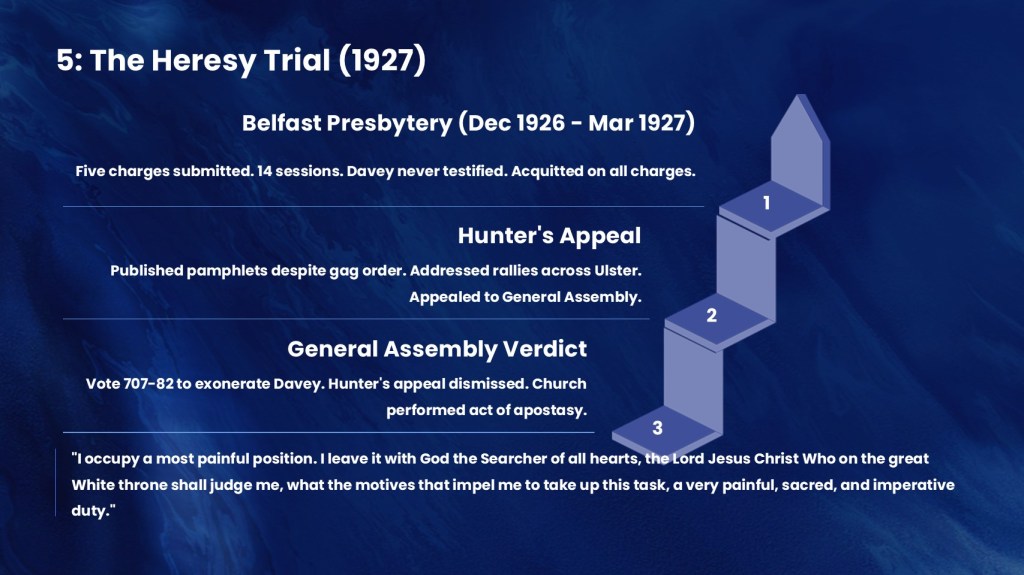
This was the time for decisive action.
The Belfast Presbytery
In December 1926 James Hunter submitted five charges against Professor Davey with the Belfast Presbytery. Over forty people supported Rev Hunter in this action; members, elders and several ministers.
Charge One – Imputation
Charge Two – Christology
Charge Three – Scripture
Charge Four – Sin
Charge Five – Trinity
The trial took place over fourteen sessions in February and March 1927. On the 15th February on the opening day, Hunter feeling the attacks upon himself, articulated his motives with this telling statement
I occupy a most painful position. I know motives have been attributed to me. I leave it with God the Searcher of all hearts, the Lord Jesus Christ Who on the great WHite throne shall judge me, what the motives that impel me to take up this task, a very painful, sacred, and imperitive duty”.
Quotations from Davey’s books together with lecture notes taken by students, including Jim Grier were employed as evidence supporting the charges. Davey, in a fashion typical of the modernists, appealed against the summons to give evidence, which was upheld. Therefore the accused was never called to defend himself, nor did he want to. James Hunter commented:
As God lives, if I were accused in a civil or ecclesiastical court on any charge, I would go into the witness box certain of my innocency.
On all five charges Davey was acquitted by a large majority.
While the Presbytery bound everyone to silence, such was the gravity of the matters concerned that James Hunter would not be muzzled. Publishing a series of pamphlets and addressing rallies all over Ulster he set his sights on appeal to the General Assembly.
The General Assembly
By the time the case came to The General Assembly Davey’s heresy had been well documented, of which the following are examples, in addition to previous quotes cited:
When I speak of God in Christ, or otherwise, bearing our sins, I do not mean that our sins and their guilt become His, but that He endures the injury that they do to him
There is no omnipotent or omniscient and independent Christ in John any more than in the other gospels…an omniscient and omnipotent Christ makes the story meaningless
The thought came to Him (Jesus Christ) in the moments of felt desolation that He had failed, that He had made a great mistake, when it was too late to go back…
..external infallibilities are a denial of the way of faith…without hesitation I should say there are literally hundreds of similar discrepancies or direct contradictions in the Old and New Testaments
I do not think Christ’s opinions which reflect the standpoint and education of His day regarding the stars, or evil spirits , or Old Testament critical questions are final for us
The Spirit is not a person in the same sense as God and Christ…I know of no proof texts for the Trinity which are conclusive
This short collection of quotes demonstrates that Davey swept aside two thousand years of Christian thought and orthodoxy. He attacked the Scriptures as the inspired Word of God, the Holy Trinity, the deity of Christ and the essence of the Gospel. This was diametrically opposed to the revelation of the Scripture and the doctrine contained in the Westminster Confession of Faith.
Tragically by 707 votes to 82 Davey was exonerated and Rev James Hunter’s appeal was dismissed.
6: Apostasy
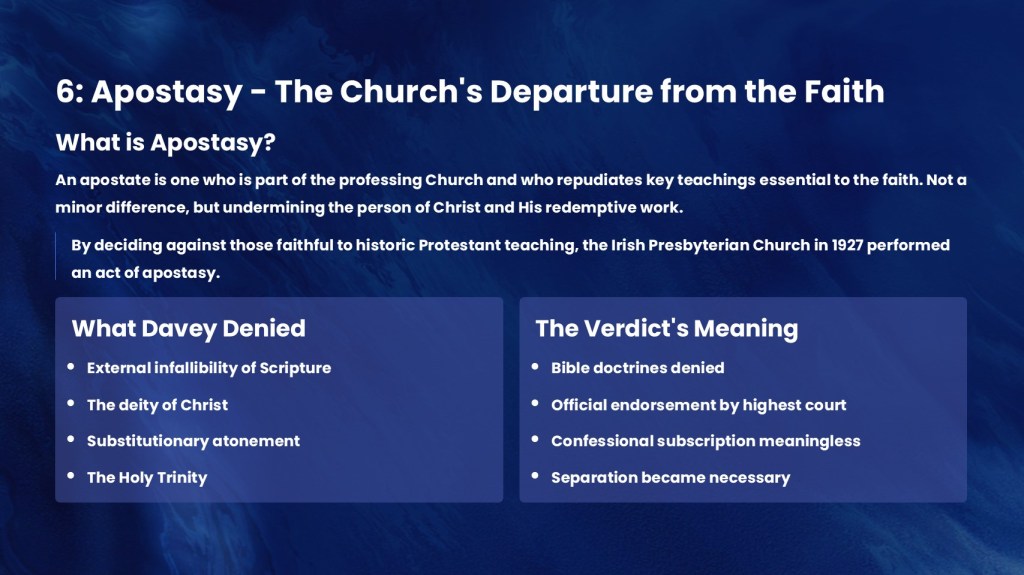
Davey’s words and teaching were those of an apostate. An apostate is one who is part of the professing Church, and who repudiates key teachings which are essential to our faith. He is not one with whom we have a difference on minor issue. Davey’s beliefs undermined the person of Christ and His redemptive work. The Bible has solemn words for such a departure from the faith. For if they fall away, it will be impossible to renew them unto repentance. Their conscience is seared with a hot iron (Hebrews 6:1-7, 1st Timothy 4:1-2).
By deciding against those who were faithful to historic Protestant and Christian teaching the Irish Presbyterian Church in 1927 performed an act of apostasy. Such a gross departure from the faith made separation necessary and unavoidable if Presbyterian witness was to remain on this island.
7: The Separatists
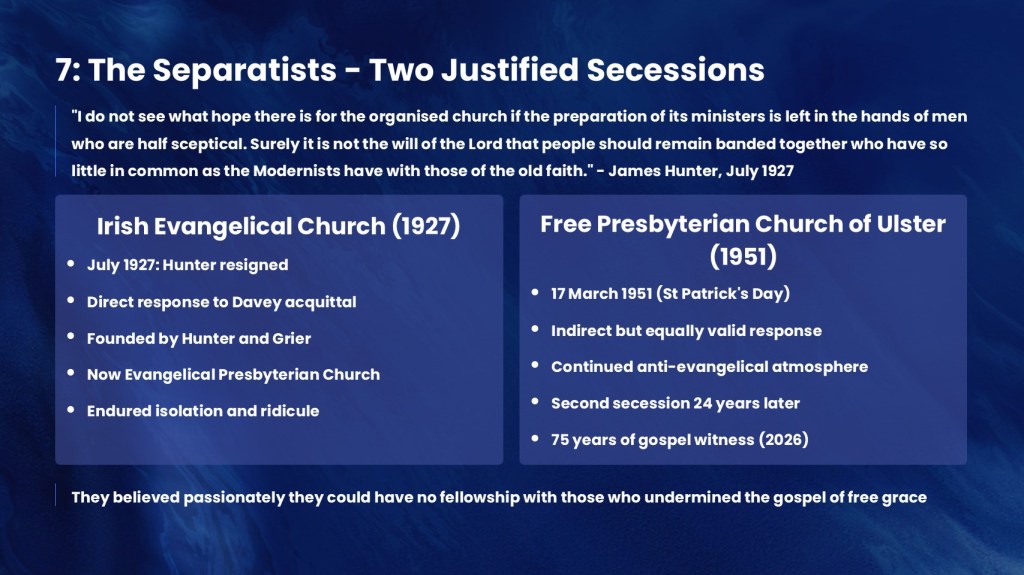
In July 1927 James Hunter tendered his resignation to the Belfast Presbytery:
I do not see how, however, what hope there is for the organised church if the preparation of its ministers is left in the hands of men who are half sceptical. Surely it is not the will of the Lord that people should remain banded together who have so little in common as the Modernists have with those of the old faith”
A recent biographer, Dr Bill Addley, sums up James Hunter’s ministry and the sacrifices he made in being loyal to Christ and his confessional vows:
…he gave of himself without limit to further what he considered would best advance the Kingdom of God, and the price he paid was very great in terms of his health and personal finances. He endured isolation, ridicule and unpopularity without complaint for the noble cause he sought to advance.
The few who joined with James Hunter included WJ Grier, who applied for ordination within the newly formed Irish Evangelical Church. They did not take this bold and brave step with any expectation of popularity or earthly reward. They were the despised minority. But they believed passionately that they could have no fellowship with those who had undermined the gospel of free grace.
The deadness within the General Assembly grew unabated, as Davey’s appointment as Moderator exemplified. This spirit generated growing dissatisfaction in the hearts of many genuine believers. Out of this spirit the Free Presbyterian Church of Ulster was formed as a second secession in 1951.
8: A Blight Upon Presbyterian History
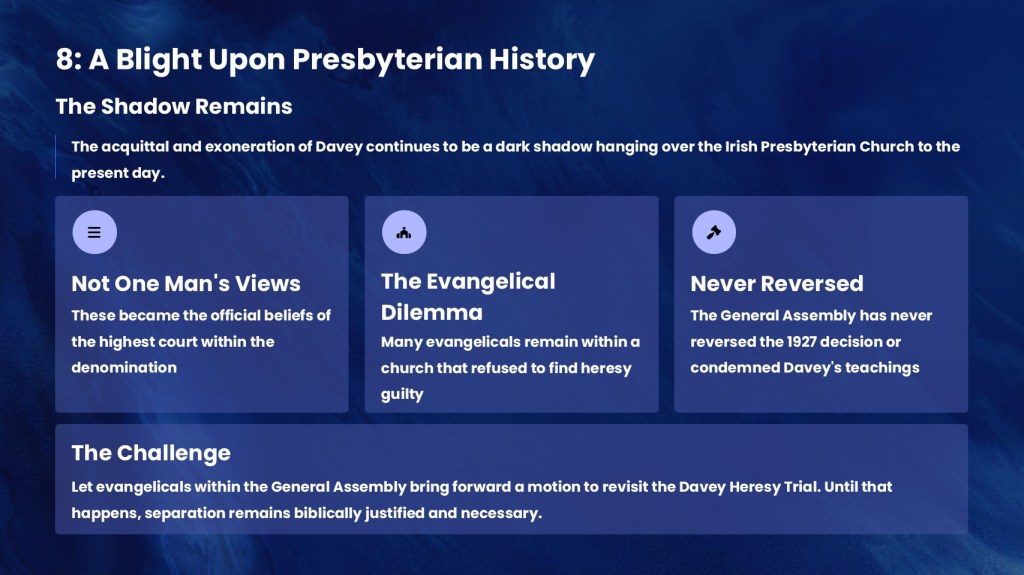
The acquittal and exoneration of Davey continues to be a dark shadow hanging over Irish Presbyterian Church to the present. These were not merely the views one man. His became the official beliefs of the highest court within the denomination.
We often hear of the many evangelicals within the present day Presbyterian Church in Ireland. The challenge remains – they are part of a church which refused to find a man whose beliefs were diametrically and publicly opposed to the gospel guilty. This continues to be the case for separation.
My challenge to the evangelicals within the General Assembly, who love the old gospel, to bring forward a notice of motion which revisits the Davey Heresy Trial. Lets see if that body will find Davey guilty in retrospect and in so doing return to the old paths.
Until that happens, we and others will remain outside the camp advocating the case for separation and secession.
9: CALL TO ACTION
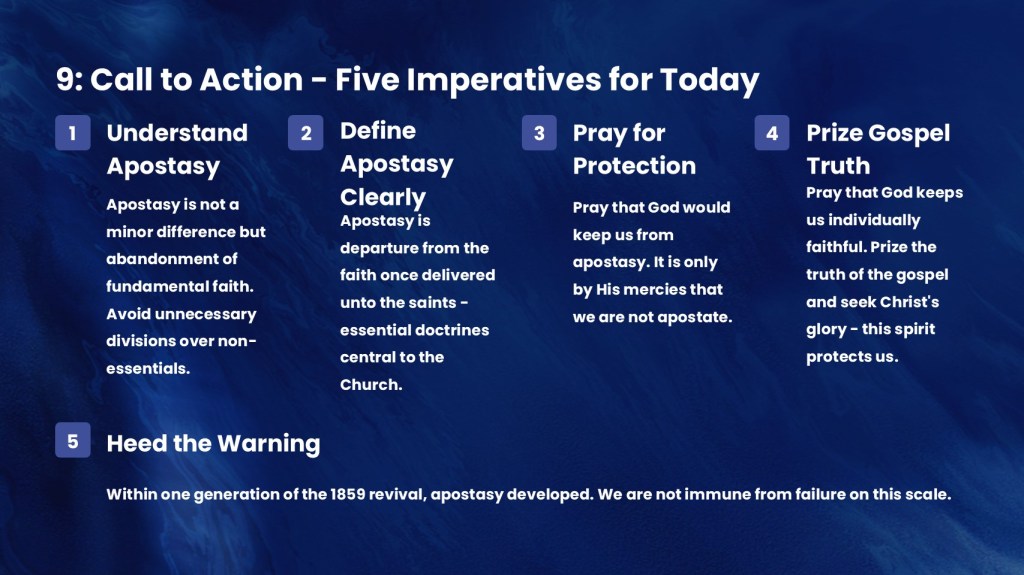
1: Understand that apostasy is not a minor difference but a fundamental of the faith. One of the weaknesses of separatists is that we can create divisions unnecessarily.
2: Apostasy is a departure from the faith once delivered unto the saints.
3: Pray that God would keep us from apostasy. It is only by His mercies that we are not apostate. We are not immune from failure on this scale.
4: Pray that God would keep us individually faithful to the gospel. We should prize the truth of the gospel and seek the glory of Christ. Such a spirit will protect us.
5: Take the warning to heart. Within one generation of the 1859 revival apostasy was developing with Irish Presbyterianism.
Further Reading
The Origin and Witness of the Irish Evangelical Church; WJ Grier
The Story of the Evangelical Presbyterian Church; By Honour and Dishonour; Ernest C Brown
Biography of James Hunter; Bill Addley
 Clogher Valley Free Presbyterian Church