
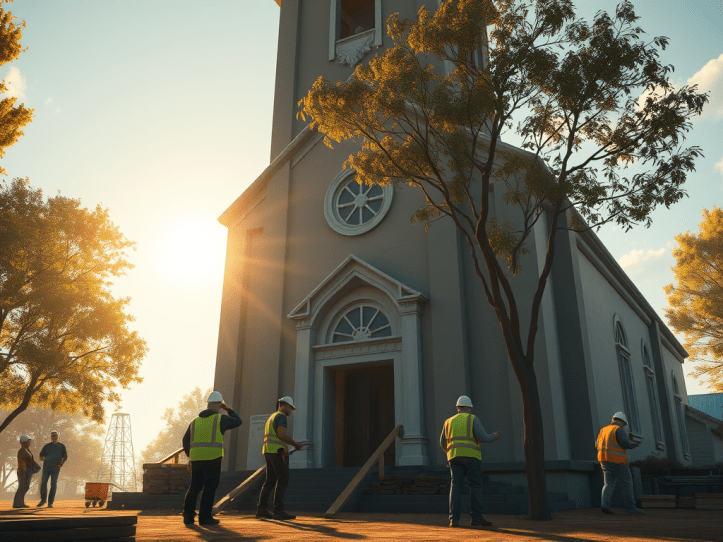
ye are God’s building (1 Corinthians 3:9)
True church building begins not with programmes but with personal spiritual growth upon Christ the foundation.
In the 3rd Chapter of 1st Corinthians Paul explores the work of Church building.
The activity of the local congregation is often described as ‘the work’. What do we mean by this terminology?
I suggest that there are two aspects in view. There is the individual work in the soul and the collective work of the body of Christians. Both are important and harmonise with one another. The Church grows as the people are strengthened in their faith. Stronger faith produces a higher degree of holiness which results in lives of service for the glory of Christ. As individuals grow, the Church as a body grows and is a more effective witness to the society in which she has been placed. Hence the title of this study – Building Churches through Building Faith.
Some mistakenly consider Church growth as the conversion of sinners or simply a numerical boost. These are the fruits of growth. To achieve the fruit there must be attention given to the root. The root of Church growth is spiritual progress in the hearts of Christians. This is the true work of the Church.
The metaphors of fruits and roots are agricultural. This study will major on another metaphor which is somewhat industrial. We are God’s building. The work of the gospel is a construction project. Jude borrowed this metaphor in his classic exhortation:
But ye, beloved, building up yourselves on your most holy faith, praying in the Holy Ghost (Jude v20).
Peter also recognised the importance of this metaphor:
Ye also, as lively stones, are built up a spiritual house, an holy priesthood, to offer up spiritual sacrifices, acceptable to God by Jesus Christ. (1 Peter 2:5)
In 1 Corinthians 3 Paul, however, simply says “ye are God’s building”. This exhortation is plural. It connects the individual with the community of believers. This challenges our responsibility before God ourselves and our duty to encourage growth in others. We build and grow together or not at all.
The Foundation

For other foundation can no man lay than that is laid, which is Jesus Christ. (1 Corinthians 3:11)
Christ is the foundation of the Church. The Church has been chosen in Him from before the foundation of the world (Ephesians 1:4). His death and resurrection lie at the heart of the Christian assurance and hope (1 Corinthians 15:3-4). The Church is Christ’s, the kingdom that He is building in opposition to the power of darkness (Matthew 16:8). He is both the shepherd and the husband of the Church (1 Peter 5:4, Ephesians 5:25-27). The Church is commanded to remember Christ through the sacrament in anticipation of the Second Coming when the symbols will disappear (1 Corinthians 11:26). The mission of the Church is to present Christ through the gospel as the only hope for a dying world ( 1 Corinthians 1:23-24).
As Christians we must constantly be reminded that we cannot grow without Christ. We would not be Christians in the first instance without His grace.
Also, the Church as a denominational entity or a local assembly, must reflect upon the One who is our sovereign head (Colossians 1:18). The work is His; Christ is the only foundation.
Is Christ truly the centre of our personal and congregational life?
The Fortitude
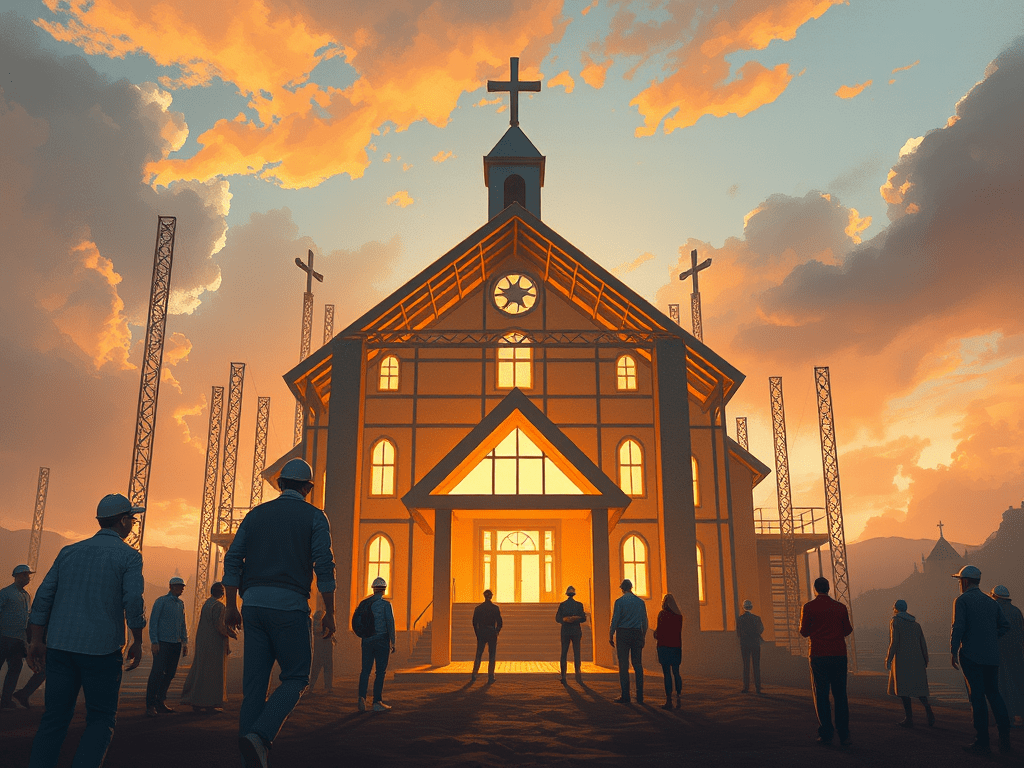
we are labourers (1 Corinthians 3:9)
Building a highly labour-intensive work. It requires skill, energy and commitment. It is a work that faces many challenges and unforeseen difficulties. But the builder must remain focused on the plan, work through the problems until the task is completed.
This business of building up our faith on the foundation laid in Christ is difficult and challenging. On that account it is a work demanding perseverance and commitment. This is the work of a lifetime; a Christian lifetime.
The difficulties that frustrate our growth include our personal sins, our external temptations, our attacks from the devil and our trials in life.
But there is a plan; one that the labourer must remain focused on:
Therefore being justified by faith, we have peace with God through our Lord Jesus Christ: By whom also we have access by faith into this grace wherein we stand, and rejoice in hope of the glory of God. And not only so, but we glory in tribulations also: knowing that tribulation worketh patience; And patience, experience; and experience, hope: And hope maketh not ashamed; because the love of God is shed abroad in our hearts by the Holy Ghost which is given unto us. (Romans 5:1-5)
Herein we learn that our building is upon the foundation of our justification through Christ. That God uses the tapestry of a lifetime of trials to produce patience, experience and hope. According to Charles Hodge, a noted Greek expert, the word translated “experience” means ‘tested’ or ‘evidence’. In other words – as we bear our temptations with patience, believing in a sovereign God, our faith grows under the test. Therefore the evidence that we are Christians becomes clearer. As we endure the trial our hope grows and our knowledge of the love shed abroad in our hearts by the Holy Ghost intensifies. Hodge notes that this love is not our love for God but His love for us, and that rather than descending upon the soul in drops it spreads abroad like a stream making us deeply conscious of His love and favour.
Not only are trials part of the master’s loving plan but this word labour teaches discipline. The builder must be committed to the task. Through the snow and frost to the blazing heat of summer he labours until the finishing is accomplished. The Christ life is built up through discipline. The daily walk with God requires dedication. There are days we don’t feel like opening our Bibles. A thousand voices are clamouring for our attention and sometimes we listen to those voices. But must get back to the Word or we perish. There are times we don’t feel like getting to Church or the prayer meeting but we must keep going – that may just be the very night when the Lord will come in a most intimate fashion.
Have we grown weary in the labour?
The Fellowship
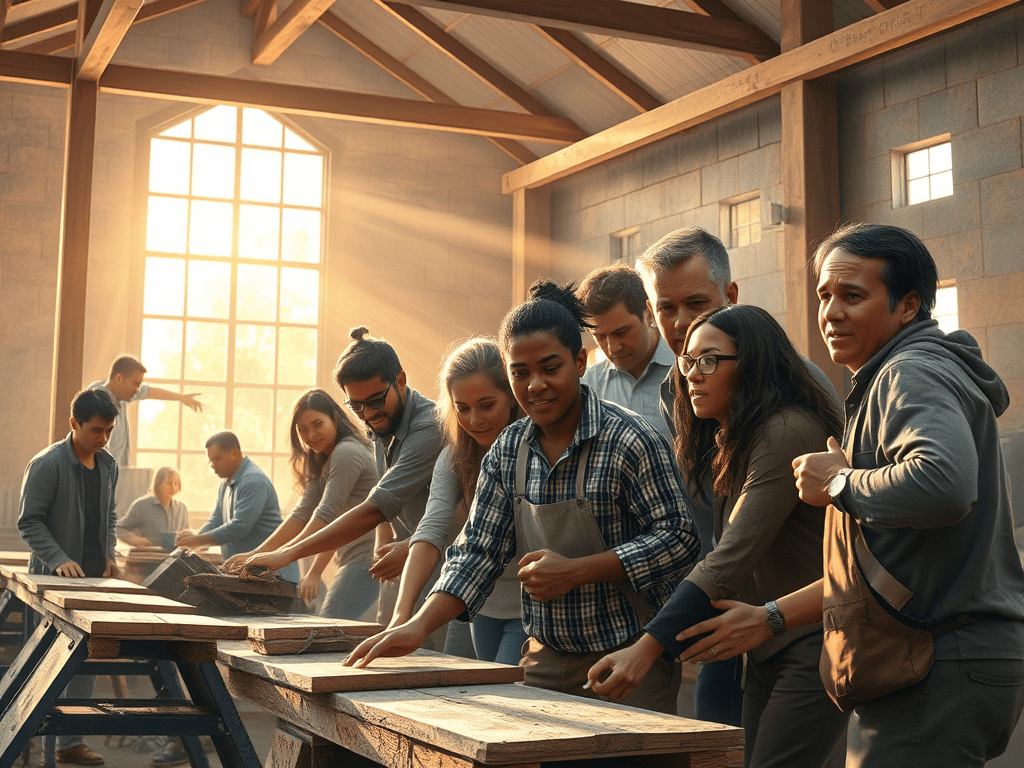
labourers together with God (1 Corinthians 3:9)
The work of building faith is a fellowship. In this passage labouring together is emphasised. This is because Christian growth can never be about one individual in isolation. We worship together, partake of the sacrament together, pray together and serve together and times we weep and laugh together. The Church is a fellowship. We are designed as a flock to grow together in the faith.
The Corinthians had been ignorant of the importance of this principle. With some preferring Paul to Apollos and vice versa, they had betrayed their carnality or their fleshly nature. Countering this divisive spirit of elevating personality highlighted that both were necessary, yet neither could operate without God:
For while one saith, I am of Paul; and another, I am of Apollos; are ye not carnal? Who then is Paul, and who is Apollos, but ministers by whom ye believed, even as the Lord gave to every man? I have planted, Apollos watered; but God gave the increase. So then neither is he that planteth any thing, neither he that watereth; but God that giveth the increase. (1 Corinthians 3:4-8)
God uses all His labourers to build the Church. The pastors, elders, deacons, youth leaders, Sunday school teachers, Bible club leaders, itinerant preachers, evangelists – all play our part in building up the body. Furthermore – everybody has a role to play in every aspect of the work from the ladies fellowship to faithtime. We should be looking out for one another, praying for one another, tolerating one another, apologising to one another, forgiving one another. In this way we grow together.
But as we labour together we do so with God. He is at the heart of every service, of every decision, of every plan. I cannot labour with God alone. I can only labour with God when I am part of a team – a fellowship.
God did something really special when He placed us into the melting pot known as the Church. Just as he placed Paul and Apollos among the Corinthians so he has placed us in the Clogher Valley – not merely for our good but for the benefit of the body believers. We all need the vision for the building up of the Church.
Paul as the wise master builder, however, urged the Corinthians to take care how they built upon the foundation. They needed to follow the apostolic example. A foundation is set and the builders must follow the plan. They dare not go off the foundation or stray from the plan. We have the benefit of two thousand years of Christianity behind us. We are positioned as part of the Protestant Reformation revival which transformed Western Europe over five hundred years ago. Let’s not go off plan. We will continue to make the Scriptures central to our worship, we will persist with our psalms, hymns and spiritual songs and we will be true to the faith once delivered unto the saints – embodied in the Westminster Standards. We build together – remaining with the plan.
Are we building unity or personality divisions?
The Future

the day shall declare it (1 Corinthians 3:13)
Paul translates this picture of building faith together to the judgment day. The true lesson is – only God knows the true quality of our faith building. That day will reveal the nature of our work for God and for the good of his Church.
The gold, silver and precious stones are not only beautiful but they endure. The fiery test of the judgement day will not destroy that which has eternal value.
Wood, hay and stubble – is rapidly consumed.
God finds us out!
Is the real lesson not a challenge – to put our building under the microscope of the judgment day now?
We can rejoice in the gold of a godly testimony, the silver of prayerful decisions and of the precious stones of Christian service.
But we must mourn with tears over the wood of unconfessed sins, the hay of bitter spirits and the stubble of proud hearts.
As we mourn over the wood, hay and stubble we are challenged to repent and become better and wiser builders because “the day shall declare it”.
 Clogher Valley Free Presbyterian Church
Leave a comment