
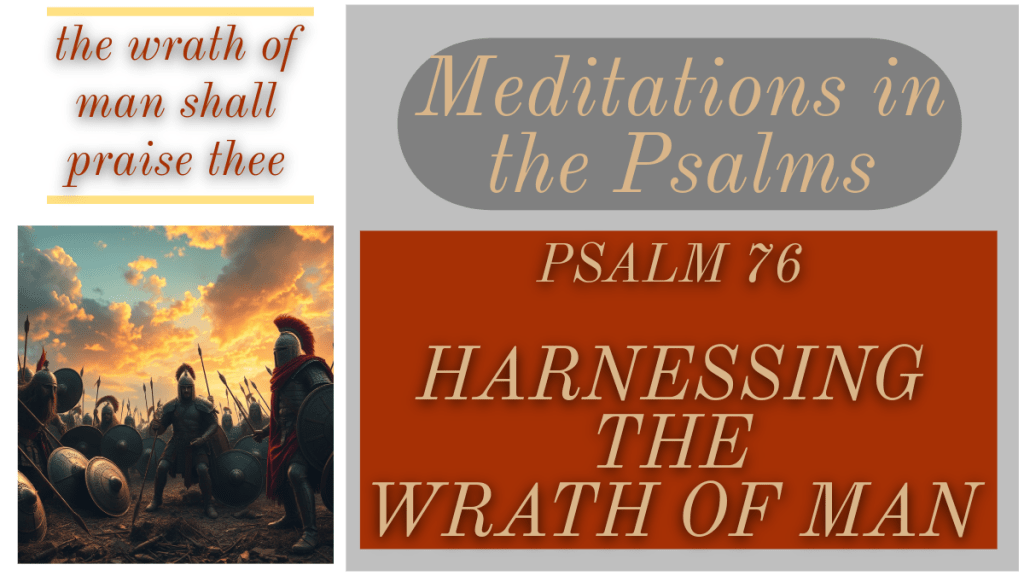
Surely the wrath of man shall praise thee: the remainder of wrath shalt thou restrain.
Psalm 76:10
THE MOST CRUEL EMOTION
The wrath of man is a fierce and unforgiving emotion. It is rooted in sin and is linked to jealousy, hatred and revenge. It manifests itself in cruelty, vindictiveness and violence.
This text teaches us that the sovereign God can seize control of human wrath. He can bring it under His control. Angry men with their wicked aspirations, unknown to themselves, carry out God’s purposes.

God many times gets up in the world on Satan’s shoulders. When matters are ravelled and disordered, he can find out the right end of the thread, and how to disentangle us again; and when we have spoiled a business, he can dispose it for good, and make an advantage of those things which seem to obscure the glory of his name.
Thomas Manton
This raises many questions; not least – How can a holy God use sin for His glory?
In response I argue that God is not the author of sin and man is accountable for his wicked actions. God, nevertheless, permits sin. He allows evil men to prosper. Meanwhile, He exercises sovereign sway over world affairs and executes His sovereign will.
While this does not answer all our questions, it certainly provides us with comfort. Wicked men in their cruelty and anger will not succeed. God’s will must triumph.
BIBLICAL ILLUSTRATIONS
A striking illustration of this is Joseph and his brothers. Their jealousy and vindictiveness led them to sell Joseph as a slave. They deceitfully told their father he was dead. It was an act of vile depravity. In Egypt, however, Joseph was placed to save that vast nation and also his entire family from starvation. Many years later, Joseph reflected on the circumstances that brought him to Egypt. He simply said, ‘you meant it for evil but God meant it for good’.
The Bible is replete with illustrations bearing witness to this noble truth. Nebuchadnezzar was inspired by Satan to destroy Israel and the holy seed out of which Messiah would spring. God used his wrath to purify and chasten His sinful people. In doing so, He would preserve them from extinction. Even in Babylon God was honoured as the accounts of Ezekiel and Daniel demonstrate. They were the captivity prophets. Even the savage Nebuchadnezzar had to acknowledge the God of Israel. He admitted, ‘none can stay His hand or say unto Him, what doest thou?’.
This Psalm is another example of this theological truth in action. This is the warrior’s song. A battle is raging and God has given the victory. He has broken the arrows, the shields and the sword of the enemy (Psalm 76:3). Strong men are vanquished and put to sleep, even a dead sleep (Psalm 76:5-6). Judgement was declared from heaven and the earth was still. The clamour and confusion of war was settled and God’s name was praised. The wrath of God was made to praise Him.
The most likely historical narrative for this song involves the Angel of the Lord overcoming the Assyrians. This is referenced in 2nd Kings 18-19 and Isaiah 36-37. After King Hezekiah prayed and laid the matter before God, the might of the greatest army in the world lay defeated. They were rendered as dead corpses in the stillness of the night. The world would not have seen the power of God if the war machine had not been prepared. If all of Judah, except Jerusalem, had not been conquered, the power of God would not have been manifested. There would be no witness to God’s might if the fearful siege had not occurred. The wrath of man praised Him.
It is a testament to the Christian virtue and Scriptural knowledge that once steeped our nation, that Lord Byron (George Gordon), not a man noted for Christian virtue, composed a poem entitled “The Destruction of Sennacherib”, and in doing, even he glorified God.
"The Assyrian came down like the wolf on the fold,
And his cohorts were gleaming in purple and gold;
And the sheen of their spears was like stars on the sea,
When the blue wave rolls nightly on deep Galilee.

Like the leaves of the forest when Summer is green,
That host with their banners at sunset were seen:
Like the leaves of the forest when Autumn hath blown,
That host on the morrow lay withered and strown.

For the Angel of Death spread his wings on the blast,
And breathed in the face of the foe as he passed;
And the eyes of the sleepers waxed deadly and chill,
And their hearts but once heaved, and for ever grew still!

And there lay the steed with his nostril all wide,
But through it there rolled not the breath of his pride;
And the foam of his gasping lay white on the turf,
And cold as the spray of the rock-beating surf.

And there lay the rider distorted and pale,
With the dew on his brow, and the rust on his mail:
And the tents were all silent, the banners alone,
The lances unlifted, the trumpet unblown.

And the widows of Ashur are loud in their wail,
And the idols are broke in the temple of Baal;
And the might of the Gentile, unsmote by the sword,
Hath melted like snow in the glance of the Lord!"
PURGING AND PRESERVING
This Psalm teaches that the unrighteousness and ungodliness of man will not prevail. The very processes used to undermine Christianity today will accomplish God’s sovereign plan. The rise of atheistic secularism or even Islam in the West will be an instrument of judgment but God will continue to build His Church.
God’s purging work is advanced among his own children by the wrath of men: there is much of the dross of corruption cleaves to the Lord’s people while in the wilderness. Now, the Lord heats the furnace of man’s wrath, and casts his people into it, that when he has tried them, he may bring them forth as gold.
Ebenezer Erskine
Therefore, amid the clamour of an arrogant and defiant world we can be still in the knowledge that all things of Him, through Him and in Him.
WHAT A NAME!
This is precisely where Psalm 76 commences.
In Judah is God known: his name is great in Israel. In Salem also is his tabernacle, and his dwelling place in Zion. (Psalm 76:1-2)
God through Israel revealed that His name was great. He resided among His people, in Salem and Zion. Thus, as the battle raged, God would glorify Himself.
Today God reveals Himself through the Church, her message and witness. It has been proved often that persecution rather than destroying the Church has been the means of building her up. The invisible Kingdom, ruling and reigning among men, has been the silent transforming agent. God among His people makes the Church, the most powerful force in all of history.
Immanuel, God with us, finds a home among his people, who then shall work us ill?
Charles Haddon Spurgeon
WORSHIP AND SUBJECTION
The Psalm concludes with a call that we submit ourselves to the God who makes all thing subject unto Him.
Vow, and pay unto the Lord your God: let all that be round about him bring presents unto him that ought to be feared. He shall cut off the spirit of princes: he is terrible to the kings of the earth. (Psalm 76:11-12).
The call to bring presents is particularly evocative. What is the gift that God desires from us ? What is worth all the treasures of the earth and which cost Him the blood of His Son? The heart is what He desires above all things.

Another suggestive phrase in verse 11 is the description of the people bringing their presents, as being “round about him”. This is an allusion to ancient Israel camped around the tabernacle. The LORD was in the midst. Our key to understanding how we bring our hearts and surrender our spirits to the Lord is here unlocked. The Lord is placed at the centre of our plans and affections.

Let us bow and worship Him today.
 Clogher Valley Free Presbyterian Church
Leave a comment