1Co 1:31 That, according as it is written, He that glorieth, let him glory in the Lord.
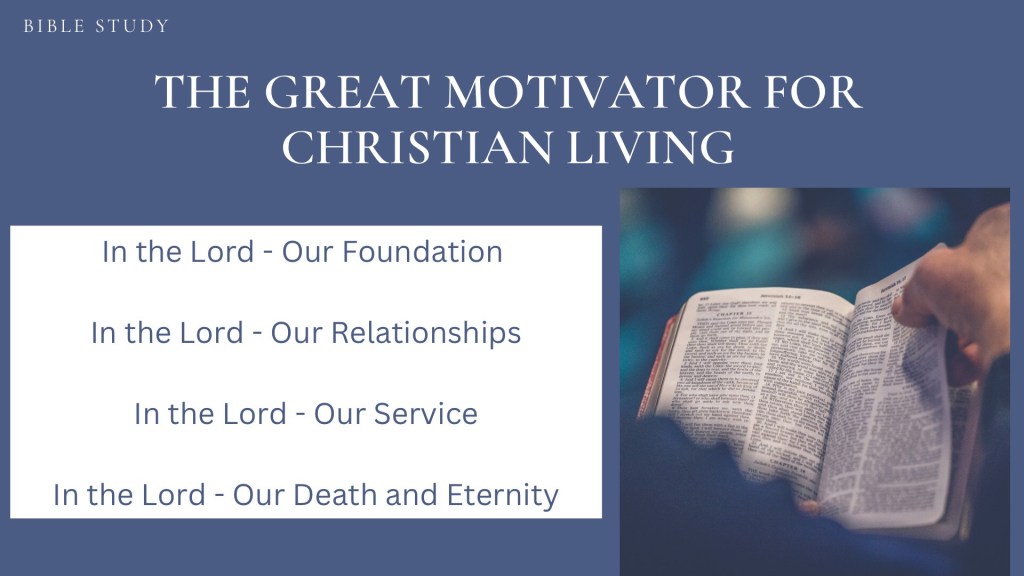
So what motivates us? What gets us out of bed and sustains us to the end? Only this: we are in the Lord—forever bound to Christ in love, life, labor, and death.
The phrase “in the Lord” appears on forty-six occasions in forty-four texts throughout the New Testament. This is one of those well worn and familiar phrases that we fail to pause and reflect upon. Repeated phrases in the Scripture are never trite. They are emphasised for good reasons. We are comforted, challenged and inspired by these three words which are the great motivator for Christian living.
THE FOUNDATION OF THE CHRISTIAN LIFE
Finally, my brethren, rejoice in the Lord. (Phil. 3:1)
Rejoice in the Lord alway: and again I say, Rejoice. (Phil. 4:4)
But I rejoiced in the Lord greatly, that now at the last your care of me hath flourished again; wherein ye were also careful, but ye lacked opportunity. Not that I speak in respect of want: for I have learned, in whatsoever state I am, therewith to be content. (Phil. 4:10-11)
Paul’s Epistle to Philippi has been entitled ‘The Life of Joy’. The source of our joy, however, is not our outward circumstances. It is Christ. Our joy is entirely based on Christ. We therefore, rejoice in Christ. For this reason our rejoicing is constant. There is no circumstance in our lives which produces constant happiness. Even the very best of situations are eclipsed by disappointment and change.
All earthly joys are fleeting—marriage, youth, friendships—all give way to change or loss. Only Christ remains.
The one and only constant in the Christian life is the Lord. He alone is the unchanging one. He is bound to us in a covenant that cannot be broken. Our election, justification and adoption stand for eternity. Every sin has been forgiven. Our redemption has been purchased. Therefore nothing can separate us from the love of God which is in Christ Jesus our Lord.
This introduces to another of Paul’s pithy, and related, phrases; short in words deep in meaning, which the Epistle to the Ephesians is particularly famed for.
IN CHRIST
Blessed be the God and Father of our Lord Jesus Christ, who hath blessed us with all spiritual blessings in heavenly places in Christ: (Eph 1:3)
In whom we have redemption through his blood, the forgiveness of sins, according to the riches of his grace; (Eph 1:7)
And hath raised us up together, and made us sit together in heavenly places in Christ Jesus: (Eph 2:6)
But now in Christ Jesus ye who sometimes were far off are made nigh by the blood of Christ. (Eph 2:13)
We are bound to Christ in a sacred, indissoluble unity. Therefore always being at peace the Christian rejoices.
In Philippians 4 the apostle spoke of rejoicing in the Lord leading to contentment at all times and in every condition. He learned not to rejoice because of any earthly blessing because these would fade. As his focus remained on Christ his contentment was secure.
We must learn to appreciate what is ours in Christ. This will keep us settled. This will curb our earthly desires and temptations. This will keep us grounded. This will prepare us for the storms of life. This is how we look unto Jesus. We are in the Lord.
THE RELATIONSHIPS WITHIN THE CHRISTIAN LIFE
No person is an island. We exist in a world of relationships. This is especially true of the Christian. We cannot understand our identity without an appreciation of who we are in connection with others. As we relate to others in our families and within the Church we must remember that together we are in the Lord.
Why should the wife obey her husband and why should the husband love his wife as Christ loved the Church?
Wives, submit yourselves unto your own husbands, as unto the Lord. (Eph 5:22)
Husbands, love your wives, even as Christ also loved the church, and gave himself for it; (Eph 5:25)
Why should children obey and honour their parents?
Children, obey your parents in the Lord: for this is right. (Eph 6:1)
Why should parents raise their children lovingly and nurture them spiritually?
And, ye fathers, provoke not your children to wrath: but bring them up in the nurture and admonition of the Lord. (Eph 6:4)
Every domestic relationship is governed by the Lord and in the Lord.
This why the Christian must only marry in the Lord. Our spouse must be the Lord’s child, therefore bringing the relationship with Him into the heart of the marital relationship.
The child from a Christian home has a parent who is the Lord’s servant This places greater onus on such a child. But the child born of such a sacred relationship is likewise set apart by God, imposing solemn duties on the parents. Each, both child and parents, must be viewed in the Lord.
This relation that we together have with Christ also governs our Church fellowship. Every believer is a brother and a sister in Christ. Sometimes we say that blood is thicker than water when defining our natural loyalties. But should the bond of the Spirit not be stronger than our blood ties? Our Church fellowship must reflect this, the tightest of all earthly bonds.
I commend unto you Phebe our sister, which is a servant of the church which is at Cenchrea: That ye receive her in the Lord, as becometh saints, and that ye assist her in whatsoever business she hath need of you: for she hath been a succourer of many, and of myself also. Greet Priscilla and Aquila my helpers in Christ Jesus. Who have for my life laid down their own necks: unto whom not only I give thanks, but also all the churches of the Gentiles. (Romans 16:1-4)
Repeatedly thoroughout his epistles Paul references fellow believers whom he was joined to “in the Lord”. This is a most beautiful expression. We have a duty to develop and strengthen our bonds for Christ’s sake.
This is also challenging. Being in the Lord means that we must put away jealousies and bitterness and practice patience, longsuffering and forgiveness.
The phrase also denotes order and cohesion within the Church:
And we beseech you, brethren, to know them which labour among you, and are over you in the Lord, and admonish you; And to esteem them very highly in love for their work’s sake. And be at peace among yourselves. (1st Thess. 5:12-13)
Our elders are over us in the Lord. This teaches honour, submission and acceptance of authority. The authority of our oversight is the Lord’s authority. The Church experiences peace by behaving in a disciplined manner.
Not one person has power, however. We are to know “them”. Authority within the Church is plural. Nor do men always get it right. We fail often. This is not an argument for infallibility but it is an argument for order. As we will all account for our submission to those who are over us in the Lord, so the oversight will account for how that authority is dispensed. Therefore for Christ’s sake we pray for and work with one another. Never for ourselves but for Him.
Obey them that have the rule over you, and submit yourselves: for they watch for your souls, as they that must give account, that they may do it with joy, and not with grief: for that is unprofitable for you. (Hebrews 13:17)
THE SERVICE IN THE CHRISTIAN LIFE
God has saved each Christian for a purpose – that we might serve.
The unique task that God has given us to do, is granted in the Lord, as was the case with Archippus.
And say to Archippus, Take heed to the ministry which thou hast received in the Lord, that thou fulfil it. (Col 4:17)
This argues for perseverance and steadfastness. There are many discouragements in God’s work, but the labour is His, the work is His.
Finally, my brethren, be strong in the Lord, and in the power of his might. (Eph 6:10)
Every work that we do for the Lord, in the Lord, will prosper. It is impossible for the Lord’s work to fail.
Therefore, my beloved brethren, be ye stedfast, unmoveable, always abounding in the work of the Lord, forasmuch as ye know that your labour is not in vain in the Lord. (1Co 15:58
At times we are tempted, and indeed fall into the trap, of doing God’s work for ourselves or for the narrow interests of denominational pride. The Lord’s honour and glory must be to the fore of every plan and scheme. Let us glory in Him alone.
THE DEATH AND ETERNITY OF THE CHRISTIAN LIFE
The earthly part of our earthly journey ends with death. There are two kinds of deaths. Dying in the Lord and dying out of the Lord. Dying out of the Lord is fearful but dying in the Lord is the access to heaven and His immediate presence.
And I heard a voice from heaven saying unto me, Write, Blessed are the dead which die in the Lord from henceforth: Yea, saith the Spirit, that they may rest from their labours; and their works do follow them. (Rev 14:13)
While death itself is not happiness, the Lord brings light into the valley. Dying in the Lord signifies hope, rest and reward. This alone ensures that the journey of lifewill never be wasted.
Therefore as we travel onward let us like Paul, keep our eyes on the prize.
I press toward the mark for the prize of the high calling of God in Christ Jesus. (Php 3:14)




 Clogher Valley Free Presbyterian Church
Leave a comment