
The Psalm 71 is unique in that it focuses almost exclusively upon the problems faced by old people. There is one fact that is certain – we are all growing old. Some people do not want to admit they are old or that they are getting old. They hide their age with a particular kind jealousy under the delusion of eternal youthfulness. And it is a delusion. One American preacher I read on this Psalm said that society celebrates youth to the extent that even some old people want to dress like teenagers! The point he was making that young people are important but so are old people and old people need to celebrate their place also in the plan and purpose of God.

We often hear it said though that it’s “no fun getting old”. There is no doubt that old age brings its own unique and peculiar challenges. Some of the greatest challenges in life are borne by the elderly. For many the way is tough, lonely and painful. This is a Psalm, however, which indicates that God is interested in and that he cares for the elderly.
This is a prayer, a most encouraging prayer, for old age.
This study focus upon the three verses about aging in Psalm 71, showing it’s message to both you and old – since the young will age if God spares them, and the old were once young.
A REFLECTION UPON A LIFE WELL LIVED
“For thou art my hope, O Lord GOD: thou art my trust from my youth.”(Psalm 71:5)
David was reflecting over his years, being grateful that he had trusted God as a young man. As he was confronted with the challenges that the onset of years bring he could testify to a faithful God. This is big theme woven into the fabric of this prayer – the faithfulness of a God who does not and who cannot fail. He begins the Psalm trusting God and in v3 the Lord is the “strong habitation, whereunto I may continually resort.” The 6th verse is a reflection upon the God who kept him in his mother’s womb. The same God who kept the baby will keep the old man because God does not change. He is our nurse and our physician who shepherds us from the womb, to the labour ward and onward to the nursing home if that indeed is where we will spend our final days.
The hope that the young man enjoyed was realised even more by the old man as he drew closer to the grave. As God was the same, so the Hope had not diminished but rather took on on a whole new meaning.
In testifying the God was his trust from he was young David is teaching the young person – knowing God early prepares the boy for when he is old. There was a consistency in David’s walk with God that prepared him for later years. Every part of life is a preparation for the next step in the journey. We may not live to see old age but when we do, to face all of those trials we want to do so as men and women who have walked with God throughout our entire lives. Growing in grace from youth into old age makes the elderly saint a vibrant olive tree in the courts of Lord. Elderly saints who have enjoyed a lifetime of communion with God have such a heavenly fragrance as they come to the very borders of Immanuel’s Land.
PRAYING FOR STRENGTH WHEN PHYSICALLY WEAK
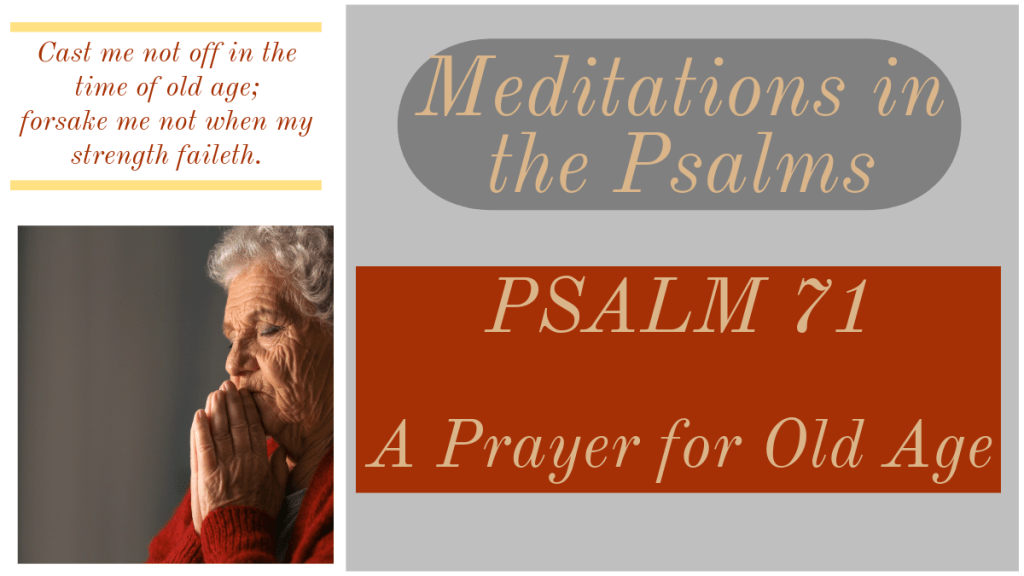
Cast me not off in the time of old age; forsake me not when my strength faileth. (Psalm 71:9)
David now turns his mind away from reflecting upon his past to praying about his present. He is deeply conscious of the constraints of old age with the reference to failing strength. John Wesley in his journal on 28th June 1789, his 85th birthday, reflected with candour on the deprivations of old age:
“It is true, I am not so agile as I was in times past. I do not run or walk so fast as I did; my sight is a little decayed; my left eye is grown dim and hardly serves me to read. I have daily some pain in the ball of my right eye, as also in my right temple (occasioned by a blow received some months since), and in my right shoulder and arm, which I impute partly to a sprain, and partly to the rheumatism. I find likewise some decay in my memory, with regard to names and things lately past; but not at all with regard to what I have read or heard twenty, forty, or sixty years ago, neither do I find any decay in my hearing, smell, taste, or appetite (though I want but a third part of the food I did once); nor do I feel any such thing as weariness, either in traveling or preaching. I am not conscious of any decay in writing sermons which I do as readily, and I believe as correctly, as ever.”
The strength which Wesley referred to was spiritual energy, which gave him a certain vigour and vitality into old age. Like his friend and colleague George Whitefield he grew weary in the Lord”s work but not weary of it.
This is the spiritual energy for which David is longing and which God bestowed upon His servant:
“But I will hope continually, and will yet praise thee more and more. My mouth shall shew forth thy righteousness and thy salvation all the day; for I know not the numbers thereof. I will go in the strength of the Lord GOD: I will make mention of thy righteousness, even of thine only.” (Psalm 71:14-16).
Here was a man growing in praise and faith although his bodily strength was failing. Does this not highlight where true strength lies? Like Samson it is not discovered in bulging muscles but in an obedient spirit. Psalm 25:14 records that the secret of the Lord is with them that fear him because the fear of the Lord is the beginning of wisdom.
We must renew our focus on the spiritual man. Like the muscles of the body the new man requires exercise that we might be strong in the Lord. This involves discipline, time spent with the Word and prayer – choosing the best part which Mary entered into but which Martha sadly neglected.
The Apostle Paul was acutely aware of these lessons. He wrote about the outward man failing while the inward man was gaining strength each day (2nd Corinthians 4:16). He testified to abundant grace even though he was inflicted with a debilitating thorn in the flesh (2nd Corinthians12:7-9). This prepared him for imprisonment and martyrdom as he was ready to be offered knowing that his departure was at hand (2nd Timothy 4). Therefore he instructed the Christians at Ephesus to place a premium upon spiritual strength in their praying:
“For this cause I bow my knees unto the Father of our Lord Jesus Christ…That he would grant you, according to the riches of his glory, to be strengthened with might by his Spirit in the inner man” (Ephesians 3:14-16).
This causes me to think about the nature of the Church? If the local congregation has large numbers, lots of activity, lots of young families, children and youth – is that an indicator of strength? Perhaps so – but not because of these mere outward reason. There needs to be prayer, surrender to God, a passion for souls, a holiness of life, a thirst for the Word – this is the Church which is strong. This is strength which lasts and makes us powerful even though everything is crumbling around about.
The story of Polycarp, the Bishop of Smyrna, who was condemned to the Roman arena in 156 AD is an amazing example of this in action. He was asked to deny Christ, offer incense to Caesar and save his life. As the city officials pleaded with him to make some small gesture to Caesar he replied:
“For eighty-six years I have been Christ’s slave, and he has done me no wrong, how can I blaspheme my King who saved me”.
A RENEWED PURPOSE FOR LIVING
“Now also when I am old and grayheaded, OGod, forsake me not; until I have shewed thy strength unto this generation, and thy power to every one that is to come.” (Psalm 71:18)
Incredible as it seems David looked ahead. He wanted this strength in order that he might teach the future generation how they themselves could be strong. Despite his age and frailty he was in prayer that God would use him for the remainder of however long his life would be.
This text demonstrates the necessity of having children young people interconnected with older people. A congregation should neither be young nor old but a place where age groups freely mix in fellowship. The young should learn from and care for for the old while the old teach and are an example to the young. This is so in the family. The interactions with grandparents are such a vital part of nurturing children and young people. So it is in the family of God. It is said that the Church is constantly one generation away from extinction. David clearly understood such thinking as he expressed his concern for the rising generation.
As an old man who had been in the depths of the earth (indicating severe trials) David wanted to be raised up so that he might fulfil God’s purpose. This meant everything to him, doing the will of God. He was not not clutching life selfishly, rather he was determined to give to the very end. All for God’s glory. The realisation that life is a gift that we must use for the glory of God and good of others is one of the fundamental ingredients. Let us strive to be in the business of giving ourselves!
This gives the lie to the philosophy behind assisted dying. That philosophy says that some lives are not worth living, they can be discarded – God says that right into old age we have a purpose. Which is more preferable? Which is more humane? Which is more uplifting? The Christian or the secular view of life?
Therefore ultimately this Psalm takes David into a place deep and profound gratitude.
“I will also praise thee with the psaltery, even thy truth, O my God: unto thee will I sing with the harp, O thou Holy One of Israel. My lips shall greatly rejoice when I sing unto thee; and my soul, which thou hast redeemed.” (Psalm 71:22-23)
God has a purpose for the young but he also has a purpose for the old. Each one has a ministry, a place in the Kingdom for which we ought to be truly grateful. What as astonishing privilege? – to be redeemed souls!
In his old age David desired to be quickened (v20). He longed for spiritual renewal. He wanted to enter new places with God, to know more of the divine presence. This what we all need today – the renewal of the inner man. David feared lest God should forsake him. Asa, Uzziah and Solomon forsook the Lord as older men. Let us pray that as we grow older we won’t turn away from the Lord and lose His blessings. Rather everyday we must pray that we fulfil His purposes.
 Clogher Valley Free Presbyterian Church
Leave a comment