

On Friday 29th November 2024 the House of Commons will have its first opportunity to vote on the Private Members Bill proposed by Labour MP for the Spen Valley, Kim Leadbeater.
This bill, if it becomes law, will bring about the single biggest social change that our nation has ever seen, apart from, David Steel’s 1967 Abortion Bill. The difference between Abortion and Assisted Dying is that one affects children who never had the opportunity of life while the other concerns people who are living and who no longer want life.
Kim Leadbeater’s “Assisted Dying for Terminally Ill Adults Bill” if passed will not legislate Northern Ireland but crucially as with all Westminster legislation MPs from the devolved nations will have a vote.
WHY ARE WE CONCERNED?
If this bill only legislates for England and Wales why should we be concerned? Proposals presently are passing through Westminster and the devolved Parliament in Edinburgh. Also the Republic of Ireland is stepping ever close to similar legislation being introduced in Dublin.
There is a juggernaut driving this social change and if Westminster, Edinburgh and Dublin legislates the battle will be then fought on Ulster soil as we will be he only part of these islands without assisted suicide. It is very much in our interests that the primary seat of legislative power in our United Kingdom does not support Kim Leadbeater’s bill.
PURPOSE OF THIS ARTICLE
The purpose of this article is two-fold:
- It is important that we understand why the ethos underlying this bill is wrong and in opposition to the Word of God and a Christian Worldview.
- On a more positive note the Church has a duty to promote the preciousness and the value of human life which means that every person in every circumstance has a real and remarkable purpose.
DETAILS OF THE BILL AND UNDERSTANDING THE TERMINOLOGY
Before developing this two-fold purpose it is important that we understand the details of the “Assisted Dying for Terminally Ill Adults Bill”.
- This bill does not make provision for Euthanasia. Euthanasia is where the state takes upon itself the power to remove human life. The word Euthanasia means mercy killing. The removal of life is regarded as an act of mercy for one who is suffering.
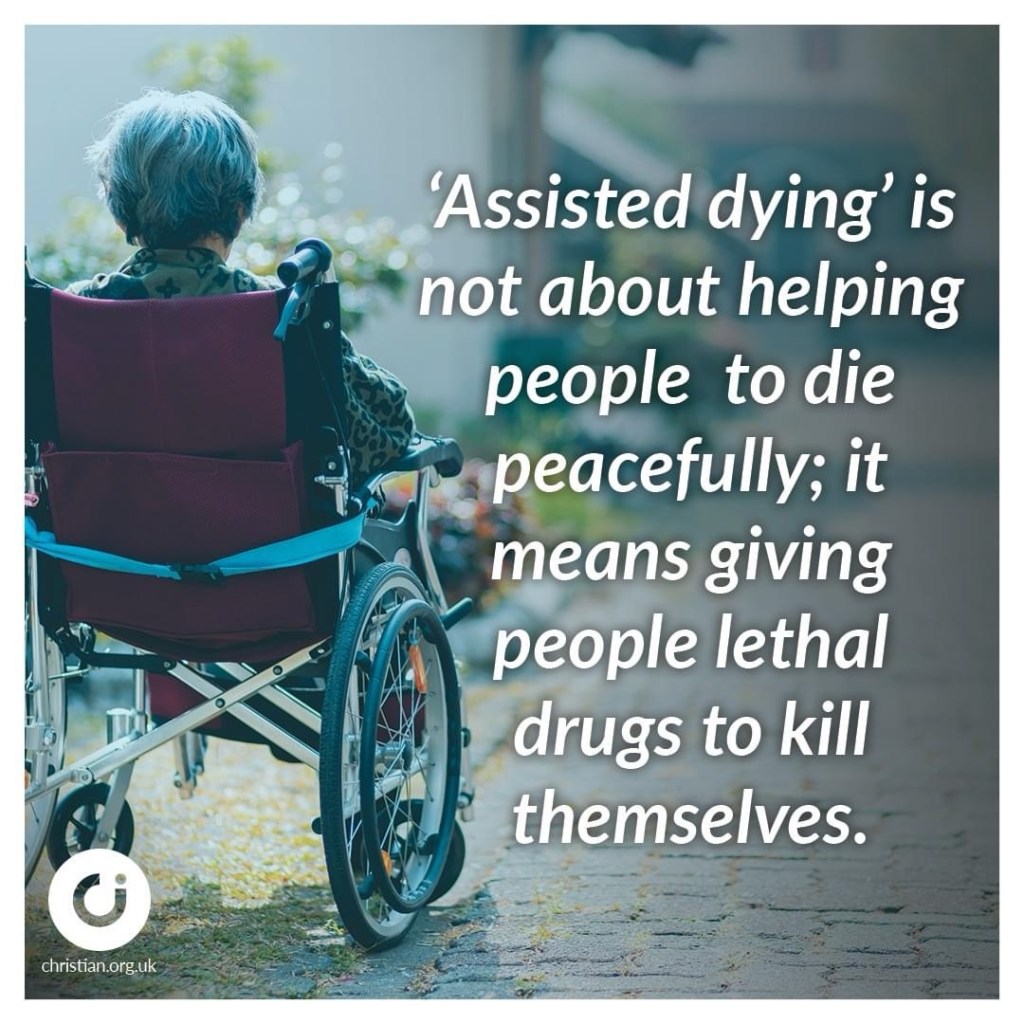
- This bill uses the phrase assisted dying. If passed the State will agree to assist an individual in the taking of their own life. The phrase assisted dying is misleading and essentially sanitises the nature of this bill. Palliative Care is assisted dying where the health professionals use the extensive treatments that are available to help the terminally ill die without undue pain and suffering. In Palliative Care , however, nature takes its course. This law is assisted suicide. The individual will be presented with medication which will cause death. This is the true nature of this proposal.
- Only those who have been certified as having a terminal illness with less than 6 months of life remaining will qualify for this bill, if legislated.
AREAS OF CONCERN
There are several points, which must be made with regard to this bill and its alleged safeguards:

- I have the utmost sympathy for people who are suffering, who are facing terminal illness afraid of dying and how that will feel for them. I do find it even more tragic, however, that that this proposed legislation presents these people with death as an option. For me, this is not kindness. There must be another answer; one that is more loving and kind and which offers true hope.
- Euthanasia and Assisted Suicide stem from the same flawed philosophy that some human lives are not worth living and that we should have the right to end our own lives or have someone else kill us.
- The National Health Service will cross the boundary from caring for the suffering to facilitating death. Institutions such as Nursing Homes and Hospitals which are designed to relieve suffering while preserving life will become places where death is the outcome by design. Doctors and nurses whose task is to protect life will become party to the ending of life. Death will suddenly become a treatment, whereas up until now every treatment is designed to prevent death, prolong life or alleviate the suffering when dying. This boundary already crossed with respect to the unborn will now be crossed with respect to the terminally ill.
- Limiting the application of the legislation to those with six months to live will prove impossible to define. A doctor generally knows if the individual has hours or days left. As one who has frequently been by the bedside of the dying, I know from experience that you can almost see the hand of death stealing over the body. But six months? How often has a doctor’s predictions not been accurate? How many people have defied all the odds and have lived? I suggest that this restriction is just a tactic to get the bill over the line and then in future years the amendments will come, the six months terminally ill criteria will be conveniently dropped and eventually full blown euthanasia (for people (with conditions which they could give, with help, live with for years) will be introduced.
- Experience has shown in other countries where Euthanasia or Assisted Dying has been introduced the initial restrictions are eventually eroded. In the Netherlands for example euthanasia is applied to people suffering from dementia and psychiatric disorders in rising numbers. Canada is another case in point where the terminally ill restriction was abandoned only five years after the introduction of euthanasia. (https://www.christian.org.uk/wp-content/uploads/Assisted_suicide_briefing_202410.pdf). Christopher de Bellaigue writing for The Guardian in 2019 makes this telling point drawing from the Netherlands’ experience; “The question for any country contemplating euthanasia legislation is whether the practice must inevitably expand – in which case…death will eventually ‘get a different meaning, be appreciated differently’. In the Netherlands many people would argue that – for all the current wobbles – that process is now irreversible.” (https://www.theguardian.com/news/2019/jan/18/death-on-demand-has-euthanasia-gone-too-far-netherlands-assisted-dying). I would certainly argue that once you open the door and surrender the principle of the sanctity of life we start on a journey to ‘we know not where’.
- Some supporters of this bill believe that the legislation does not go far enough. Once the principle is conceded they believe it will be easier to introduce a wider scope later. Therefore disability groups for example are opposed to this bill because of the real danger of ‘mission creep’. Baroness Tammi Gray-Thompson one of Britain’s greatest Paralympians has warned of this; “I’m really worried that disabled people, because of the cost of health and social care, because that’s being removed, that choice is then taken away so the only choice they have is to end their lives.” (https://news.sky.com/story/tanni-grey-thompson-warns-change-to-assisted-dying-law-could-leave-disabled-people-with-no-choice-13053353)
- It must be emphasised that there is a real difference between non-resuscitation, the removal of life support and assisted suicide or euthanasia. Non-resuscitation or the removal of life support, when properly employed after a full discussion with the family and with with the patient (if the patient is able to have that discussion), allows nature to take its course – assisted suicide and euthanasia acts contrary to the course of nature in removing the life.
In The New Atlantis, Alexander Raikin described the case of Rosina Kamis, who had fibromyalgia and chronic leukemia, along with other mental and physical illnesses. She presented these symptoms to the MAID assessors and her death was approved. Meanwhile, she wrote in a note evidently meant for those to whom she had granted power of attorney: “Please keep all this secret while I am still alive because … the suffering I experience is mental suffering, not physical. I think if more people cared about me, I might be able to handle the suffering caused by my physical illnesses alone.” She was put to death on September 26, 2021, via a lethal injection, at the age of 41.
David Brooks writing in The Atlantic on “The Outer Limits of Liberalism; What happens when a society takes individualism to its logical conclusion”MAID is the assessment system in Canada which determines if an applicant can be “euthanised” or killed by the state.
https://www.theatlantic.com/magazine/archive/2023/06/canada-legalized-medical-assisted-suicide-euthanasia-death-maid/673790/
In November 2016, Monique and Bert de Gooijer, a couple from Tilburg, became minor celebrities when a regional paper, the Brabants Dagblad, devoted an entire issue to the euthanasia of their son, an obese, darkly humorous, profoundly disturbed 38-year-old called Eelco. His euthanasia was one of the first high-profile cases involving a young person suffering from mental illness…You try to make your child happy,” Monique said in her matter-of-fact way, ‘but Eelco wasn’t happy in life. He wanted to stop suffering, and death was the only way.
“Death on demand: has euthanasia gone too far?
Countries around the world are making it easier to choose the time and manner of your death. But doctors in the world’s euthanasia capital are starting to worry about the consequences”
by Christopher de Bellinague writing in The Guardian, 2019. https://www.theguardian.com/news/2019/jan/18/death-on-demand-has-euthanasia-gone-too-far-netherlands-assisted-dying
A CHRISTIAN WORLDVIEW
Having considered the terminology and the details of the bill let us turn now to the Biblical and Christian worldview, which underlies our opposition to this abhorrent bill.
1: THE SANCTITY OF LIFE

The Bible teaches that man has been created by God and that human life is quite different from animal life. There is a sacredness in humanity which sets us apart and makes us special.
So God created man in his own image, in the image of God created he him; male and female created he them.
Genesis 1:27
And the LORD God formed man of the dust of the ground, and breathed into his nostrils the breath of life; and man became a living soul.
Genesis 2:7
On this account the removal of human life is a violation of this sacredness. The killing of humanity whether it is murder, suicide, assisted suicide, manslaughter or even by neglect are all included within the scope the sixth commandment.
Thou shalt not kill.
Exodus 20:13
We must see life as a gift. It is not our own to do with us as we wish. We use this life for the glory of God and for the good of others. It is not our right to remove the precious gift that God has given.
“Until now deliberate killing has been regarded as something abhorrent in Western society. If we begin to accept killing as a good thing in order to solve one kind of problem then we shall soon find reasons to use killing in order to solve other kinds of problems. And history provides many examples of the kind of society we get, if killing is regarded as good. We must decide what kind of society we really want for ourselves and for future generations.”
Karel Gunning in “Death without Dignity; euthanasia in perspective” (Rutherford House Books 1990)
One of the major concerns that I have with this bill is that it creates a culture where suicide is seen as a legitimate way to end life. In an article in The Atlantic published last year studies were cited demonstrating that in every country where assisted dying and euthanasia have been legalised suicide rates increase (article referenced below). Where people sadly believe their life to be without value, they need help and support in order to understand that they are precious and valued and of importance. What they don’t need is what this draft legislation provides.
2: THE SOVEREIGNTY OF GOD OVER LIFE

If God has given us life, then He also the right to remove our lives in His time. This is a truth the Scriptures affirm.
And said,
Job 1:21
Naked came I out of my mother’s womb,
and naked shall I return thither:
the LORD gave, and the LORD hath taken away;
blessed be the name of the LORD.
To every thing there is a season, and a time to every purpose under the heaven:
Ecclesiastes 3:1-2
A time to be born, and a time to die;
The secular humanists, with their evolutionary mindset, see life in terms of cells and dna. It is an existence with our sole purpose being to survive and procreate in order that man’s place in the world will be preserved. When the journey is over we disintegrate and there is nothing hereafter. The evolutionist talks about the struggle, about nature being red in tooth and claw, about the fittest surviving and that we are part of this battle. There is no enjoyment, no pleasure, and ultimately no hope. To be part of an evolutionary struggle is not to enjoy a gift. It is rather to be condemned to short-lived nightmarish existence from which death is the release back to the nothingness from which we came. I am pleased that the Christian faith provides us with something more meaningful.
3: THE SOUL AND ITS ETERNITY AFTER DEATH

The Scriptures teach that man’s soul is immortal and that the purpose of life is to prepare for the judgement and our eventual meeting with God.
And as it is appointed unto men once to die, but after this the judgment:
Hebrews 9:27
To provide someone with the means of removing their lives sends the person out to eternity to meet God. This philosophy is born out of the false idea, out of what is in essence a lie, that there is no God, no accountability, no spirit, no soul and that death ends all things. On this account the promotion of this idea of assisted dying and euthanasia is not caring, it is cruel because it is removing the precious time that the individual could be employed in preparing to meet God.
The secular world takes no account of these arguments but it our duty as Christians to make the case for eternity with an increasing burden for the lost souls of men and women.
4: THE SUFFERING AND THEIR PURPOSE IN THE WORLD

TODAY AND YESTERDAY
It strikes me that our society today views suffering in a very different way from past generations. For example, before the revolution of medicine and palliative care many people died suffering extraordinary pain. The accounts of death in previous centuries are horrific yet those people in their suffering held onto life until the very end. There was never the pressure in those times for lives to be taken or for suicide to be assisted as an act of kindness. Why was that the case? The answer is found in the deep Christian consciousness that permeated society in the past. The means to remove life prematurely was always in existence but that was never an option because human life was considered a sacred gift even in the midst of horrible pain and sufferings.
The contrast with today is striking. While there is suffering and pain that can be managed in a way and limited to such a degree that the suffering of today and the deaths of today are much easier for the individual. Despite the excellent palliative care that is provided, the growing clamour for euthanasia has become increasingly loud creating a momentum that some regard as unstoppable. Why is this the case? It is can only be explained by the godless spirit that permeates our society where death, the great symbol of the curse, is seen as something good, which is to be embraced as the only alternative to suffering.
SUFFERING AND THE FABRIC OF LIFE
As Christians we argue that suffering is part of life. There are lessons to be learned through pain, disability and old age. We either learn life lessons through suffering or alternatively we learn by caring for others and watching them suffer. Suffering is not something to be airbrushed out of the world, or swept under the carpet – we must understand its purpose.
“Dying makes life suddenly real. Watching my slow physical deterioration reaffirmed my belief that there is something else within, which would only survive if only because my personality stayed the same in spite of the eroding bodily form in which it was confined.”
Dr James Casson, “Dying, the greatest adventure of my life” quoted by David Potter in “Too Soon to Die” (Evangelical Press 1982)
COERCION
There is a grave danger that this bill, if legislated will make it possible for families to coerce a loved one to terminate their lives because they are burden or they want the family inheritance. While there are safeguards to prevent this doctors are concerned as it is very difficult for them identify coercion in many places.
SELF WORTH
We would like to think that such incidents would be rare although possible and probable. However, what is more common is the sense of being a burden that the suffering, the infirm, the disabled and often the elderly do feel within themselves. This bill will create a narrative where assisted dying becomes a real option for some people in order to be kind to their families. In essence it deprives people of their self worth and their purpose in the midst of suffering.
ALL LIFE IS PRECIOUS
Our task as a Church and as Christians is to enforce people’s purpose in life whatever their circumstances. I recall visiting a nursing home with Neville McIlwrath, our Clerk of Session, many years ago around Christmas. In nursing homes we see people who suffer from dementia and other quite profound conditions which some individuals live with for years. Our brother said when we left, “There’s human life in all of its forms”. That always resonated with me. The person in the nursing home who struggles to recognise his or her relatives and hardly knows the day of the week is a special life made in God’s image as we all are. They deserve our love and attention. The same is true of the disabled who are restricted in ways that many of us are not, it’s true of those of reduced mental incapacity. Every person in every situation serves a real purpose and their lives are given to enrich all of our lives. We don’t discard those lives as if they are unimportant – we love and cherish them, as the Scripture teaches us so to do.
Cast me not off in the time of old age;
Psalm 71:9
forsake me not when my strength faileth.
To apply the philosophy that some lives are worthless and should be discarded is cruel in the extreme. It illustrates that where biblical principles are abandoned society becomes less civilised and even barbaric. Christianity, on the other, hand teaches true compassion and care because God is love.
5: THE SATISFACTION OF ENJOYING LIFE

A SPECIAL GIFT OR AN EXISTENCE?
Life is a special gift and in all of its forms it has been given for our satisfaction and development as we journey through life.
HOPE AND GRACE
The Christian mindset is dramatically different. Man has a purpose which is the glory of God. We struggle under the burden of our sin but Christ has redeemed us from its curse giving us peace in this world and hope for the next. Living for God’s glory is to be set free, emancipated from the burdens of life. It enables us to make a real difference in this world and accept the facts that we painfully cannot change.
This is the message of hope and grace that we must present to this cruel world which sees nothing apart from death as the answer to our beleaguered circumstances. There is hope, only through the cross of Jesus Christ.
The true response to assisted dying and euthanasia is to preach Christ and the power of the cross and to encourage people to embrace the new birth.
And unto this people thou shalt say, Thus saith the LORD; Behold, I set before you the way of life, and the way of death.
Jeremiah 21:8
WHAT CAN WE DO?
The king’s heart is in the hand of the LORD, as the rivers of water: he turneth it whithersoever he will.
Proverbs 21:1
- We can write to MPs wherever are in Northern Ireland or across the UK. In Fermanagh South Tyrone the MP is Pat Cullen. We are at a profound disadvantage because Sinn Fein refuses to take their seats in the House of Commons and represent their constituents. Pat Cullen has refused to tell me what her position is on Kim Leadbeater’s bill. She did however articulate the Sinn Féin position on the Assisted Dying proposals that have been heard in Dublin; “Sinn Féin believes that any legislation that may be introduced to provide for assisted dying in limited circumstances here in Ireland – as outlined in the final report of the Oireachtas Joint Committee on Assisted Dying – must be thoroughly and carefully considered with appropriate safeguards in place to ensure that there are no unintended consequences.” This would indicate to me that Sinn Fein have surrendered the principle on the sanctity of life. I would certainly be in favour of a campaign from Pat Cullen’s constituents writing to her, highlighting the inconsistency of this position with her career as a nurse. Ultimately will she be able to look in the mirror with satisfaction if this bill succeeds by one vote?
- The best response we can offer to this assault on the preciousness of life is prayer. We must make our appeal to the God of heaven that He would enable MPs to understand the gravity of what they are doing, that they would be persuaded to vote against for the sake of our terminally ill, our elderly and our disabled members of society. Pray that God would be gracious and turn hearts against this evil.
- Let us pray for Christians in Parliament and others who are opposed that their arguments would carry weight.
- We must also pray for the suffering, that they would know God’s grace as they bear their affliction knowing that one day we too will be afflicted.
- Also we should pray for our doctors and nurses who administer palliative care and assist the dying in their final days. They are an extraordinary group of people who care for the living as the end draws near.
- The end is drawing near for all of us. The ultimate question is – “Are you ready?”
FURTHER INFORMATION
1: This discussion conducted by the Christian Institute is most helpful:
2: Briefing from the Christian Institute
3: This powerful article focuses on the Canadian example demonstrating that assisting dying with safeguards will quickly morph into a liberal regime where people are euthanised on the basis of such conditions mental illness and even hearing loss.
4: Sorcha Eastwood’s (MP for Lagan Valley) decision to oppose the bill is based partly on lobbying within her constituency but also upon the lack of scrutiny that Private Member’s Bills receive and the need for more investment in palliative care. This demonstrates the huge concern that exists where this bill is concerned and lobbying MPs really does have an impact.

This posting by Nikki de Costa, a respected Parliamentary journalist, highlights just how anxious we should be about a Private Member’s Bill being employed for an issue as important, as life changing and culturally shaping as this one.
https://twitter.com/nmdacosta/status/1857033763881935110?s=46&t=WdzKcPkYLeC9dqBhq7R-eg
JOIN THE DEBATE
If you have personal experiences or views to share comment below and I will further share my perspectives.
 Clogher Valley Free Presbyterian Church
[…] ASSISTED DYING; Compassionate or Cruel? […]
LikeLike