

There are two sides to the 60th Psalm, clearly intimated by the contrasts between the first and the final verses:
O God, thou hast cast us off, thou hast scattered us,
Psalm 60:1
thou hast been displeased; O turn thyself to us again.
Through God we shall do valiantly:
Psalms 60:12
for he it is that shall tread down our enemies.
It seems that God had taken His people from the jaws of defeat to the jubilation of triumph. There was a clear sense, though that it was God and not man which had gotten the victory:
vain is the help of man.
Psalm 60:11
Indeed the title of the Psalm indicates that it was written after a notable victory south of the Dead Sea in the Valley of Salt.
Michtam of David, to teach; when he strove with Aramnaharaim and with Aramzobah, when Joab returned, and smote of Edom in the valley of salt twelve thousand.
The history of this event is recorded twice:
2nd Samuel 8:10-14
When Toi king of Hamath heard that David had smitten all the host of Hadadezer, Then Toi sent Joram his son unto king David, to salute him, and to bless him, because he had fought against Hadadezer, and smitten him: for Hadadezer had wars with Toi. And Joram brought with him vessels of silver, and vessels of gold, and vessels of brass: Which also king David did dedicate unto the LORD, with the silver and gold that he had dedicated of all nations which he subdued; Of Syria, and of Moab, and of the children of Ammon, and of the Philistines, and of Amalek, and of the spoil of Hadadezer, son of Rehob, king of Zobah. And David gat him a name when he returned from smiting of the Syrians in the valley of salt, being eighteen thousand men. And he put garrisons in Edom; throughout all Edom put he garrisons, and all they of Edom became David’s servants. And the LORD preserved David whithersoever he went.
Now when Tou king of Hamath heard how David had smitten all the host of Hadarezer king of Zobah;
1st Chronicles 18:9-13
He sent Hadoram his son to king David, to enquire of his welfare, and to congratulate him, because he had fought against Hadarezer, and smitten him; (for Hadarezer had war with Tou;) and with him all manner of vessels of gold and silver and brass. Them also king David dedicated unto the LORD, with the silver and the gold that he brought from all these nations; from Edom, and from Moab, and from the children of Ammon, and from the Philistines, and from Amalek. Moreover Abishai the son of Zeruiah slew of the Edomites in the valley of salt eighteen thousand.
And he put garrisons in Edom; and all the Edomites became David’s servants. Thus the LORD preserved David whithersoever he went.
There are some apparent insistences in the records which require some understanding.
The Psalm speaks of 12,000 being slain whereas the historical books have the number much higher at 18,000. It is evident, however, that the writers of Samuel and the Chronicles recorded the military campaign which was much wider than the struggle with the Edomites as Syria is mentioned as is Moab, Ammon, the Philistines and Amalek. Some of these nations are also identified in the Psalm, helping to verify the authenticity of the record. Therefore, it becomes clear that the title of Psalm 60 refers to one battle, whereas the historical records scope out the wider conflict.
Samuel records that David was the victor, Abishai is the prime mover in the Chronicles whereas Joab is the conqueror in our Psalm. All are correct – David was the King, Joab his General whereas Abishai the brother of Joab was a valiant soldier. All played a significant role and receives credit. No battle can be about one person.
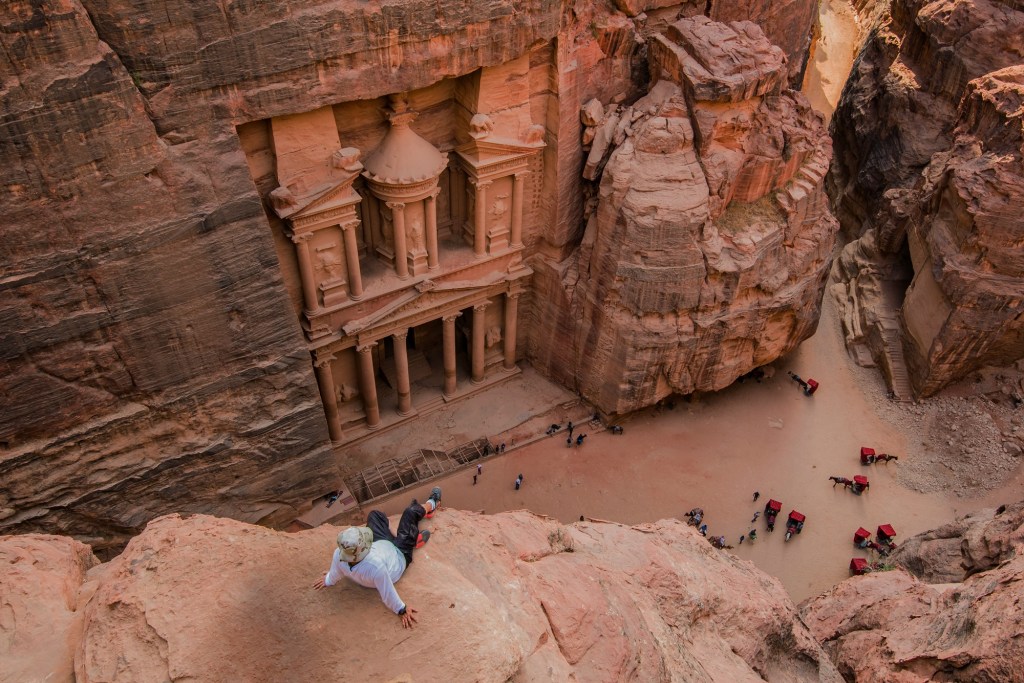
The conquering of Edom is fascinating in the light of Bible history and prophecy. The Edomites were the children of Esau, the brother of Jacob. Esau was blessed by Isaac and he became a mighty nation. The ruins of Petra, one of the fortresses of the Edomites, is a lasting testimony to the skill of this ancient race. God, however, promised that Israel the covenant people would be triumphant – a fact affirmed by Balaam:
And Edom shall be a possession,
Numbers 24:18
Seir also shall be a possession for his enemies;
and Israel shall do valiantly.
It is fascinating that the words of Balaam’s prophecy bear striking similarity to the words of the Psalmist. There was a sense here that God was fulfilling His Word.
The Psalm, however, was not so much a victory song but a prayer of humble and deep thanksgiving in a time of great discouragement. God had rescued His people. It was not so much David, Joab or Abishai but God who was victorious.
In these times when the Church is weak and powerless we must be reminded of this. What we need is not strong leaders or a great preachers but the intervention of the Holy Ghost. Only God can save this country for the Gospel in this dark time. Because He is a God who delivers in a day of defeat.
THE PRAYER
O God, thou hast cast us off, thou hast scattered us,
Psalms 60:1
thou hast been displeased; O turn thyself to us again.
David inherited a nation then in disarray. The Philistines were ascendant after the carnage and catastrophe of Mount Gilboa. This was followed by seven years of civil war with Judah making David King while the remainder of Israel were loyal to Ishbosheth and the House of Saul. A defeated and a divided nation does not have good prospects.
This background helps us understand the import of David’s cry at the beginning of the Psalm. Israel were under judgement. The hand of blessing was removed. Yet David in his cry for mercy beseeched God – “O turn thyself to us again”.
Years after David ascended the throne he still suffered from frequent incursions and no victory was easily won. David’s life was battle after battle. Constantly he recognised the need for God to come and turn His face toward His people in a day of extremity.
It is well that we understand the extremity in which we find ourselves today. This is not the hour for complacency. If the evangelical Church continues its rate of decline in these times we are both handing ashes to our children and we are hindering our ability to provide for missionaries across the world. The home front must be strengthened in these times. If we do not recognise the need, then it high time we took CH Spurgeon’s comments on Psalm 60 to heart:
To be cast off by God is the worst calamity that can befall a man or a people; but the worst form of it is when the person is not aware of it and is indifferent to it…
“O turn thyself to us again.” Forgive the sin and smile once more. Turn us to thee, turn thou to us. Aforetime thy face was towards thy people, be pleased to look on us again with thy favour and grace. Some read it, “Thou wilt turn to us again,” and it makes but slight difference which way we take it, for a true-hearted prayer brings a blessing so soon that it is no presumption to consider it as already obtained.
This is the cry for revival, the need of this hour in which we find ourselves.
THE PURPOSE
Thou hast given a banner to them that fear thee,
Psalms 60:4
that it may be displayed because of the truth. Selah.
It is apparent that David prayed with purpose and resolve. This was no prayer that caused him to remain in the closet. The man of prayer was also a man of action. Rising from his knees he would rise and lead his men into the battle because he possessed a standard.
The battle standard even to this day is an important focal point for any soldier. The symbolism of the standard can never be underestimated. It represents the ethos of the regiment, the duty and sacrifice that the soldier is called to offer as well, as the lives of all those died under the banner.
In ancient warfare as long as the standard was held aloft there was a point of unity around which the men could rally but if the standard fell never t be raised the battle was lost.
David had resolve because God had given him a standard? One wonders what David’s standard was? Was it the lion, coming as he did from the tribe of Judah, which was given this important royal symbol?
Judah is a lion’s whelp: from the prey, my son, thou art gone up:he stooped down, he couched as a lion, and as an old lion; who shall rouse him up? The sceptre shall not depart from Judah, nor a lawgiver from between his feet,
Genesis 49:9-10
until Shiloh come; and unto him shall the gathering of the people be.
Christ, as the greatest son of Judah’s tribe, claims the emblem of the lion:
Weep not: behold, the Lion of the tribe of Juda
Revelation 5:4
Today we have every confidence that we can go forward for God because we have a banner. Christ is our banner. He is our King. In the Church we sometimes talk about the bloodstained banner of the cross. The Apostle Paul certainly identified himself with the cross in his ministry in a very powerful sense.
But God forbid that I should glory, save in the cross of our Lord Jesus Christ
Galatians 6:14
For the preaching of the cross is to them that perish foolishness; but unto us which are saved it is the power of God.
1 Corinthians 1:18
Therefore, even in a day of spiritual darkness, we have optimism because of the power of the Gospel. Furthermore, as David emphasised, everything that we believe is truth. The Gospel is not an idea, a philosophy or a concept. It is truth and truth can neither be diluted nor dismembered. Truth is eternal and unshakeable. The religions and ideologies of this world have failed because they are lies. They will pass away with the fashions of this world but the Word of the Lord endureth forever.
As Christians we represent Christ and Christ is truth. Therefore we can bear a witness for him with confidence whatever the opposition. We have a purpose, let’s fulfil God’s commission.
THE PROMISE
That thy beloved may be delivered;
Psalm 60:5-6
save with thy right hand, and hear me.
God hath spoken in his holiness;
The two most important observations in these words are “beloved” and “holiness”. They are bursting with promise.
God will deliver His people, responding to their prayers and acting always in their best interests because they are in His beloved. As the beloved of God we can face down down every foe and triumph over every discouragement.
Holiness is also important. The God who loves us is a holy God. Therefore He must keep His promises, He will never fail because to do so would dethrone Him from His majesty; this is impossible. When He acts our interests will always be according to His holiness. He may not deliver us when and in the way that anticipate. His timetable is not ours, His solutions are not our solutions. But we we can sure that His way will be perfect because He is a holy God.
THE POWER
Through God we shall do valiantly:
Psalms 60:12
for he it is that shall tread down our enemies.
Through His power His victory is ours. These words are reminiscent of Paul words to the Church in Romans 8 – “more than conquerors through Him that loved us”. We are called to be overcomers! This is a priceless encouragement as we face our private battles against lust, temptation, sin as well as suffering, illness, bereavement and all of the individual circumstances that causes us to look away from Christ. It is a strengthening encouragement for the Church as we face our more public struggles against the rampant and immoral philosophy of the this secular atheistic society. The cause of Christ will always triumph!
This promise, however, is for warriors; for those with the determination to lift up the standard of truth and go forward for God as Adam Clarke elegantly expressed it:
In war these two must be joined, and indeed in all actions. HE, we; GOD and man.
1. “We shall do valiantly,” for God helps not remiss, or cowardly, or negligent men.
2. And yet, that being done, the work is his: “He shall tread down;” the blow and overthrow are not to be attributed to us, but to HIM.
While the battle in the Old Testament was a physical conflict, this is not so today. While the enemy may assault us physically as the Church experiences persecution; the core struggle is spiritual. It is a battle fought not with flesh and blood against flesh and blood. Our weapons are prayer and the word. We are spiritual warriors or we are not warriors at all. And in this warfare we are assured of victory if we are faithful.
The key and the concluding lesson exhorts us to pray faithfully for victory in a world of sin and Satan. We often stumble because we fail to pray and claim these extensive promises. We do not merely live in hope; we live in victory through Christ the ever-living one. By faith let us grasp this reality and live above feeling, seeing the invisible and going forward with resolve.
 Clogher Valley Free Presbyterian Church
Leave a comment