
Let the Good Lady Swim
Above the incessant murmur of the sea and the crashing of waves against the wooden hull, the shouts of the sailors and the lashes of their whips could be heard, as the prisoners were driven on, rowing through pain and hunger. The French sailors, knowing that some of their captives were Scottish Protestants, would occasionally taunt and provoke. Once, a little image of the Virgin Mary was thrust into the hands of one very stubborn Scot, for him to kiss. Swiftly, the image was dispatched overboard; “Let our Lady save herself. She is light enough. Let her learn to swim.”[2] The stubborn Scot was set to become one of Europe’s most famous men and certainly Scotland’s finest son. A man who could endure 19 months of pain and lashing, bent over the oars of a French galley, was one who would fear neither man nor devil. The character of John Knox, man of granite, was duly formed.
The Cardinal on the Dungheap
Eighteen years after Patrick Hamilton’s death, Protestants were still horribly persecuted and burned to death in Scotland. In the 1540s, God providentially raised up George Wishart, who initially recanted his faith in England before fleeing, broken and devastated, to Switzerland and the school of Bullinger. Returning to Scotland, he set Scotland ablaze with his expositions of truth. He was arrested, hanged and burned at St Andrews. Tied to the stake, 1st March 1546, the faithful man of God summonsed Cardinal David Beaton, as he oversaw the execution, to the judgment of God. On 29th May, less than three months later, a company of armed men, giving vent to the frustrations which Scotland experienced under the merciless Beaton, stormed St Andrews castle, killing the Cardinal and throwing his body on the dung heap. The armed Protestants then called upon John Knox to be their minister. The siege of the castle was only broken by the intervention of French soldiers, for which Knox earned his term on the galley ships.
England and Geneva

Subsequent to his release, Knox played a key role in the English Reformation, where his ability and Protestant convictions were appreciated. He refused, however, an appointment as Bishop of Rochester, preferring to act as one of Edward VI’s chaplains. His aversion to episcopacy was providential, as a man of his resolve would have remained to face the martyrs’ stake, rather than abandon his position. As it happened, he had no position to abandon after the death of Edward VI. In January 1554, on the advice of friends, Knox fled to the continent for his own safety, therefore escaping the persecutions of Queen Mary.
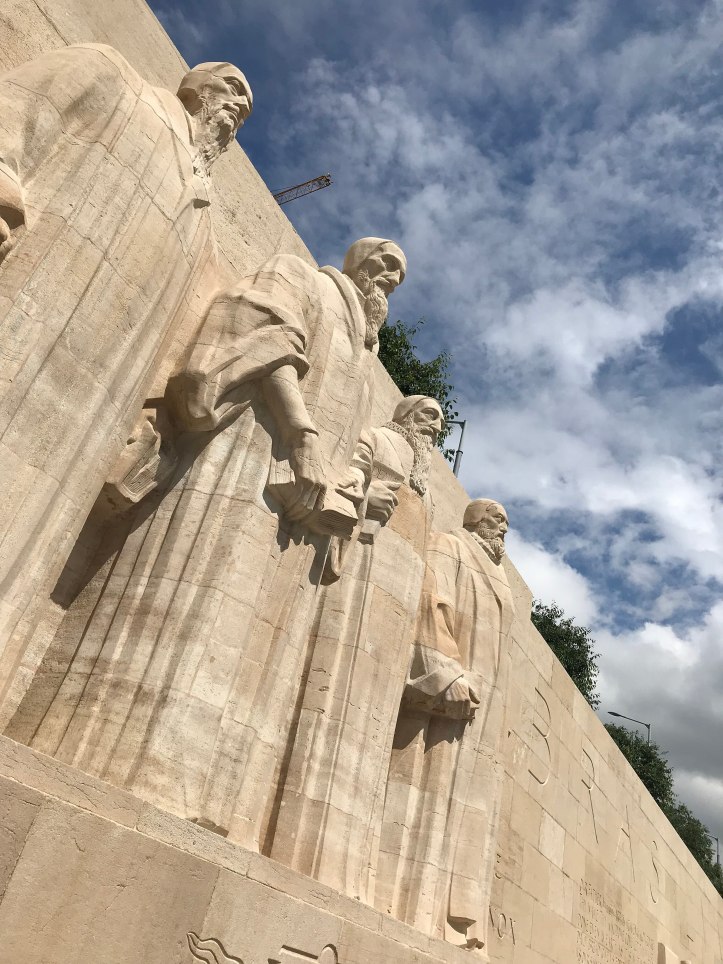
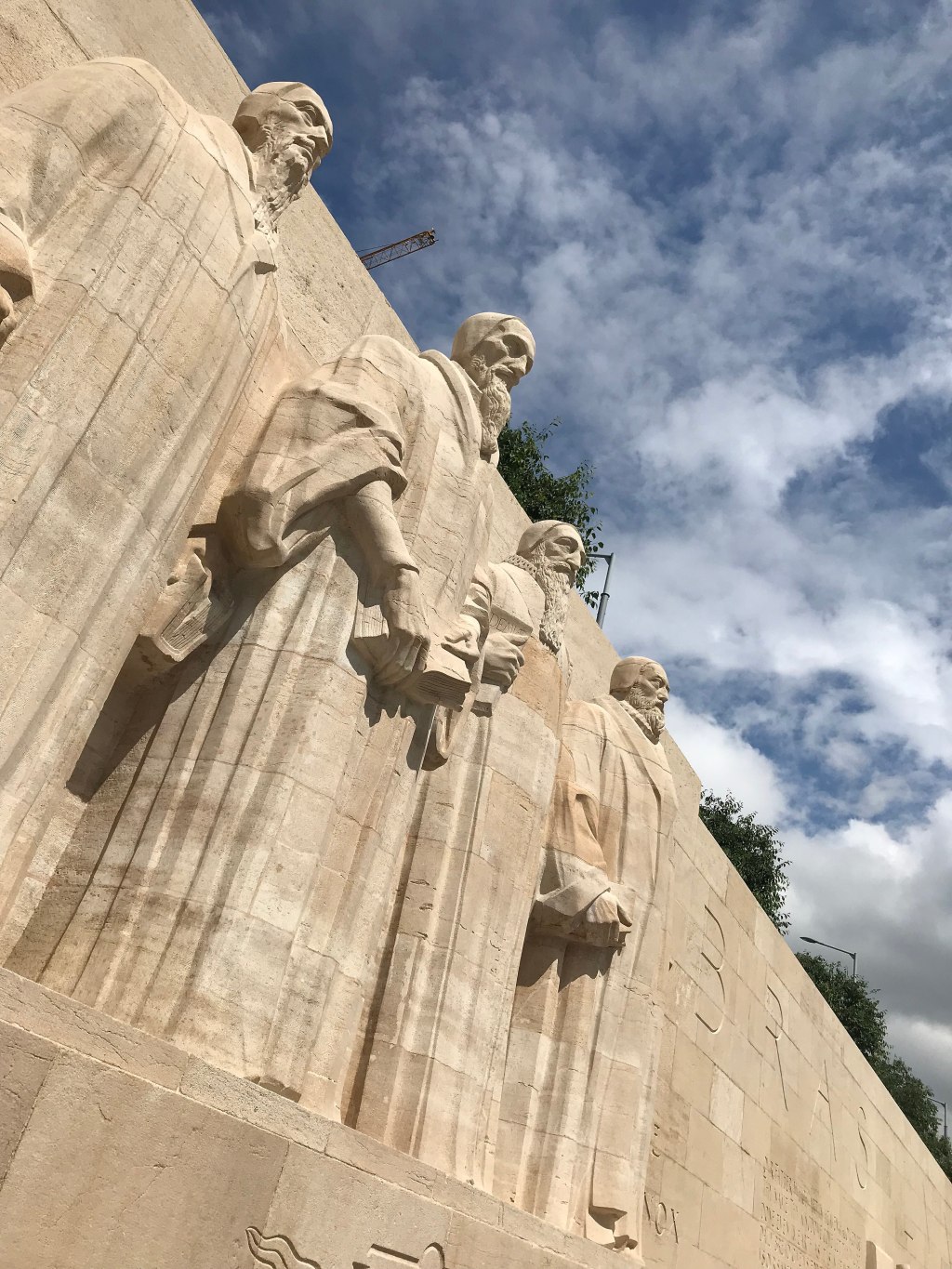
Knox made beautiful Geneva in the Swiss Alps his home. Here he was fully acquainted with the ministry of John Calvin, sitting in what he called the greatest school since Christ and the Apostles. During this time Knox ministered to English refugees in what is still known as the John Knox Chapel, right next to Calvin’s St. Peter’s Cathedral. The magnificent Reformation Memorial in Geneva continues to commemorate John Knox, where his statue stands alongside Calvin, Farel and Beza,
Scotland Calls
During his Geneva years, Knox was aware of the growing Protestant awareness in Scotland, together with the terrible persecutions experienced by many. Among the martyrs was Walter Mill, a Priest in his eighties who had been faithful to the reformed cause since the late Cardinal Beaton, when he first became an outlaw. These times were dark yet exciting. Throughout Scotland, people were abandoning the Mass and observing the Lord’s Supper in a biblical fashion; God was gathering together His people. Eventually a group of Protestant nobles known as ‘The Lords of the Congregation’, appealed to John Knox, that he would come and lead their cause.
The greatest opponent to the spread of reformation truth was Mary of Guise, the Regent, who was governing the nation until the maturity of her daughter, Mary Queen of Scots. To halt the spread of this teaching, she summonsed four Protestant preachers. At this critical juncture, a ship was approaching, bearing John Knox, a man whom she feared more than 10,000 soldiers. When news broke that Knox had stepped on Scottish soil on 1st May 1559, everyone from the Regent to the Church authorities were in disarray. When Knox demanded that he appear alongside the Protestant preachers, Mary of Guise dismissed them and then treacherously made them outlaws for refusing to appear.
‘Pulling Down the Nests’
To capture Scotland for Protestantism, Knox knew he must go to St Andrews, the citadel of Romanism, the place where young Patrick Hamilton met his death thirty years earlier. As he journeyed, he preached, rallying people to his banner. In Perth, after he finished preaching in the parish church, a young boy spotted a Priest celebrating Mass. He shouted at the Priest, who then beat the lad. A riot ensued, resulting in the wholesale breaking down of images and destruction of the wealthy abbey. When Knox was asked about the violence, he wryly said, “The best way to get rid of the rooks is to pull down their nests”.[3] Violence was not his method of dealing with Rome and advancing the Gospel, yet he knew that these people were filled with fury as a result of decades of abuse and violence against them by the body which claimed to be ‘acting for God’. Rome’s days were numbered in Scotland! Mary of Guise came to realise this when she brought a company of several thousand soldiers to Perth in order to quell the disturbance. She met with such resistance that she made terms and backed away.
The Little Horn
John Knox then took the cause to St Andrews. The risks for him personally were grave. He expected to be assassinated as he preached in the parish church. His sermon that day, 10th June 1559, was fearless. He identified the Papacy as the little horn of Daniel’s beast, the system of anti-Christ. As a result the authorities in the town declared for Protestantism. St Andrews was soon followed by Edinburgh and Glasgow, with Parliament declaring the nation Protestant. The anti-Christ had been deposed! In a few weeks, Scotland, long in the grip of tyranny, was now gloriously free; the light was now shining brightly!
Establishing a Reformed Church
Knox was installed as Minister in St Giles Cathedral, Edinburgh. He established the Presbyterian Church of Scotland. Bishops were disposed of, with every congregation being ruled by teaching and ruling elders. No longer were clergy foisted on local parishes; the people themselves, as the congregation of Christ, would be able to choose their ministers and elect their elders. Deacons were established to help the elders with practical and financial oversight; superintendents oversaw districts – and doctors appointed to teach students for ministry. Church Courts were instituted, Kirk Sessions for local business, Presbyteries for regional affairs, Synods for groups of Presbyteries and a General Assembly for the national Church.
Knox also oversaw the establishment of free schools and colleges, to lift the people out of illiteracy and ignorance. A Confession of Faith was drafted providing the new Church with a theological basis. It was ironic that John Calvin’s Biblical ideas of what a true Reformed Church looked like would find a home in a land that many in Europe regarded as the ‘ends of the earth’. While England was wrestling with internal divisions between the Puritans, who shared Knox’s vision, and the Anglo-Catholics, as they became known (who agitated for a half-way house between Rome and Protestantism), Scotland in a fairly short time had built the strongest and purest of all the Churches in the Protestant world.
Mary Queen of Scots
Knox’s final challenge came from Mary Stuart, who returned to Scotland, after the death of her husband, Francis II of France in 1559, as Mary Queen of Scots. She was a strong Roman Catholic, who did what Knox feared more than thousands of French and Spanish troops; she celebrated Mass at Holyrood Palace. It was famously said that ‘the Queen trembled when John Knox prayed’. In his three interviews with the Queen, he left her white and shaken, such was the force of his language. She attempted to have the minister of St Giles tried and deposed, but Knox was exonerated. Instead, she had to flee, having been implicated in adultery and the murder of her husband, Lord Darnley. Feeing to England for refuge, she left behind a little boy, still a baby; the future James VI of Scotland and James I of England. As for Mary Queen of Scots – Elizabeth I confined her to house arrest. But when she was implicated in one of the many plots against the Crown, Elizabeth signed her death warrant in 1586.
Death and Funeral
John Knox lived to learn of the bloody and cruel St Bartholomew’s Day massacre of Protestants in France, August 1572, which he found particularly heartbreaking. His final weeks were spent in bed when he talked much about the coming glory:
“By the grace of God I am what I am. Not I, but the grace of God in me. Wherefore, I give thanks to my God through Jesus Christ, who has been pleased to give me the victory…Would to God, that you and all men had heard them as I have heard them; I praise God for that heavenly sound…Now it is come.”
One hand was lifted heavenward as the faithful servant entered his everlasting rest, 24th November 1572.
At his funeral in St Giles Churchyard, James Douglas, 4th Earl of Morton, and Regent of Scotland, was heard to utter words which sum up the life of the man of granite – “Here lies one who never feared the face of man”.[4] Quite a commendation from one who was not exactly a friend of the Presbyterian cause!
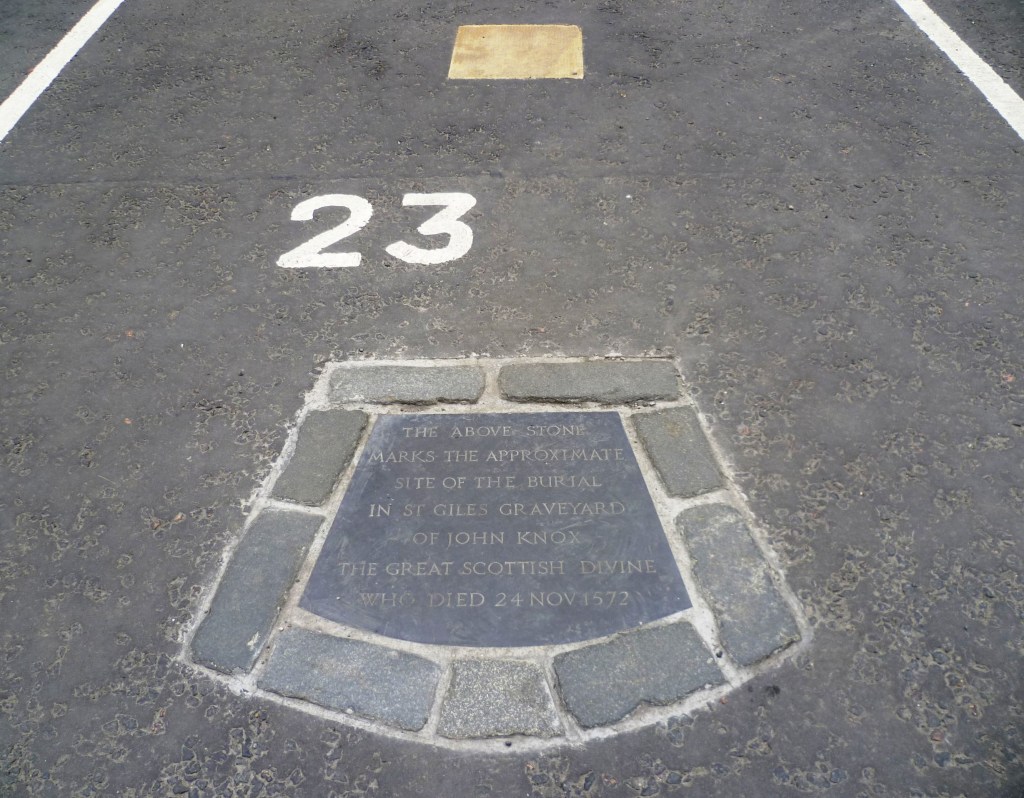
Knox wanted no statues, memorials or headstones. Scotland was his memorial. Nevertheless, a simple stone slab once marked the place where the man of God lies, with letters IK reflecting his Latin name. That slab has long since gone. Every day, in Edinburgh city centre, a car will park on a space above the bones of Scotland’s greatest son. But tourists still flock to see his home. When the funeral cortège of Queen Elizabeth II passed through Scotland’s historic capital, the commentators made reference to John Knox, as her coffin lay in state in St Giles. Knox is the colossus of Scottish history. Internationally, wherever Presbyterian Churches have been established, with their good order, equality and sense of freedom – all look back to Knox, who formed the first such national body in the history of the world. May God give us the passion and conviction of the man of granite, who was heard to pray: “Give me Scotland or I die”.
[1] Monument international de la Réformation, Geneva where John Knox is commemorated along with John Calvin, William Farel and Theodore Beza, Wikipedia Commons.
[2] McCrie, Thomas, Life of John Knox, Henry G. Bohn, London, 1854. Page 39.
[3] Houghton, S.M., Sketches from Church History, Banner of Truth Trust, 1980. Page 127.
[4] McCrie, Thomas, Life of John Knox, Henry G. Bohn, London, 1854. Page 39; Houghton, S.M., Sketches from Church History, Banner of Truth Trust, 1980. 308-310.
 Clogher Valley Free Presbyterian Church
Leave a comment