
“There is no doubt that we have been living on the capital of the past – as you go round this country and look at the congregations, you will see that very quickly. You can carry for a certain length of time on tradition, and by custom and habit, but the point is bound to come when you cease to have any capital left and then you realise that you are facing something absolutely ultimate, something which is fundamental.
D. Martyn Lloyd-Jones, Revival can we make it happen?, Marshall Pickering, 1986, page 22. First preached in 1959 to mark the hundred years since the 1859 Revival.
The problem confronting us is the need of life itself, the need of that fundamental power and vigour in every activity of the Church which really can make an impact upon the world, and do something vital and drastic with regard to the whole trend of affairs at the present time: the need of life, the need of power, the need of the Spirit itself.
There are times in the life of the Church when what is needed is some sort of line or adjustment here or there, but that is not the trouble today. This is not a minor matter, it is not a third-rate or a fourth-rate matter that is in the balance at the moment. It is the whole life of the Church. It is the whole question of a spiritual outlook upon life, over and against anything that is represented in the world.
If revival is indeed our greatest need, then we must constantly endeavour to understand what it is that we need.
Isaiah is particularly helpful in this regard. There are two major themes that dominate the third section of his prophecy which spans chapters forty to sixty-six. One is the coming of Christ, styled as the servant of Jehovah. The second theme is revival, which is characterised as renewal and restoration – a work accomplished by the Holy Spirit alone.
Isaiah began his long ministry in the days of King Uzziah, concluding possibly during Manasseh’s tenure. He witnessed the sins of Uzziah, who was struck by leprosy because he attempted to enter the sanctuary, doing the work of the priests. He saw the apostasy of Ahaz’s corrupt reign and was engaged during Hezekiah’s reforms. What happened to the Lord’s servant subsequently is unclear but the Jews have a tradition that he was sawn in half during the persecutions under Manasseh.
Isaiah not only had a ministry for Judah in his own generation but for the Lord’s people in the future. In his days Assyrians had risen as the dominant kingdom in the region, with the northern kingdom of Israel losing their independence. These years would also see the rising of another power, even greater than Assyria – Babylon. Isaiah, had a ministry of consolation and hope for the Lord’s faithful servants in the days of spiritual declension and a changing international scene. As the people would suffer a slaves in Babylon in a future day they would need the promises of from Isaiah’s pen.
Isaiah, also foresaw the emergence of the New Testament Church with the ministry of Messiah. Therefore the revival lessons that he taught come to our hearts with power in this dark day that we find ourselves in.
These studies will focus upon several of the key revival texts and passages from the one who is sometimes called the evangelical prophet.
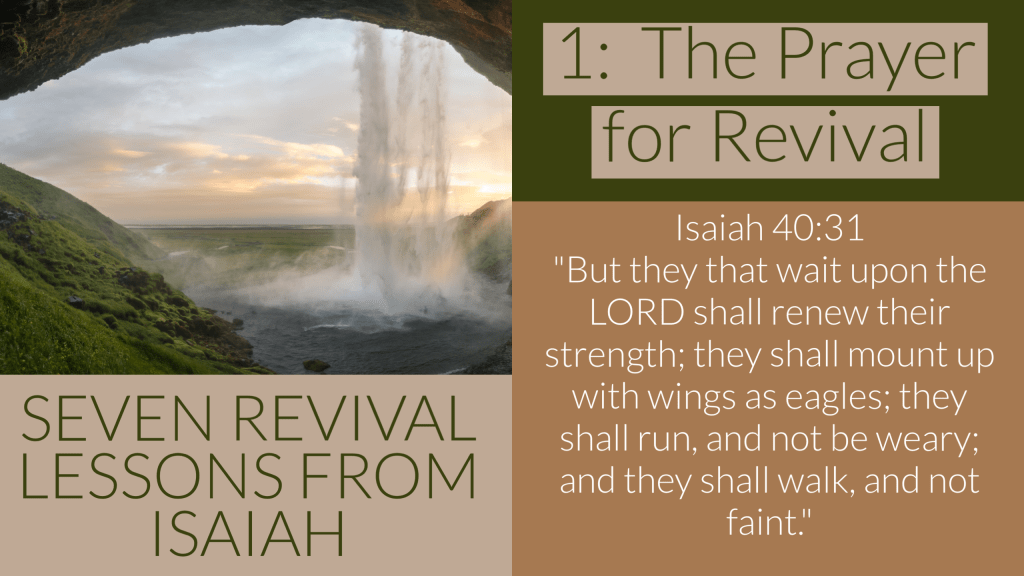
The first lesson concerns the subject of prayer;
PRESENTING THE PRAYER FOR REVIVAL
1: THE WEARINESS WITH WHICH THE PRAYER FOR REVIVAL IS PRESENTED
“Even the youths shall faint and be weary and the young men shall utterly fall: But they that wait upon the LORD…”
Isaiah 40:31
This famous appeal for prayer is issued against a background of weariness and weakness. The people described as being weak are the strongest and fittest that humanity has to offer. The young men with their vigour and energy grow tired BUT those wait on the Lord are strong.
We are apt to grow tired and weary in Christian work. Sometimes the commitment grinds us down, even though the work itself is good. The apostle talked about being weary in well doing. On other occasions we become tired as a result of illness and incapacity which prevents us doing all that we aspire to achieve. Paul, also suffered from this possessing his thorn in the flesh, the messenger of Satan which tortured him. There are times when we grow weary because of people around us, those whom we expect to encourage and help but instead they criticise and discourage. The apostle suffered from this difficulty also – he mourned over Peter’s failure to support the Gentiles, John Mark’s abandonment of the work, Barnabus’ separation as he supported his nephew, Hymaneus’ and Alexander’s apostasy and Demas’ backsliding. But there is a greater problem which produces even more acute weariness – our own personal sins, failings and inconsistencies. At our very best we are unprofitable servants. We examine all of this in the light of the powerlessness and helplessness of the Church today and we are constrained to believe that praying for revival is the only answer – we must have His power.
THE PERSON TO WHOM THE PRAYER FOR REVIVAL IS PRESENTED
“Lift up your eyes on high and behold who hath created these things, that bringeth out their host by number: he calleth them by their names by the greatness of their might, for that he is strong in power; not one faileth.”
Isaiah 40:26Isaiah Chapter Forty is one of the most memorable chapters, describing God and His power in the world. Prayer is lifting up our eyes to the great and glorious omnipotent, omniscient God of the universe, who is also our God; we are bound to Him by covenant engagement.
THE PATIENCE WITH WHICH THE PRAYER FOR REVIVAL IS PRESENTED
“…wait upon the LORD”
Isaiah 40:31
Often throughout the Old Testament, especially in the Psalms, prayer is described as waiting upon God.
Waiting is a good term for prayer. We wait for something to happen. Waiting is doing something, it is expecting that something will happen. Often we need to wait with patience for good things to happen in life. Sometimes waiting is difficult and arduous but we will persist because we know there will be a reward at the end.
Waiting upon God is patiently expecting and anticipating that He will answer our prayers. It is not a work – it is an act of patient and heartfelt faith; absolute dependence upon Him. We must accept that He is sovereign, that He will respond in His time. But yet we do believe that He will and must respond.
If we believe that the Bible is a revival book and that God is a revival God – then we must wait at His feet for the revival to come – trusting , obeying, praying, waiting.
THE FAITH WITH WHICH THE PRAYER FOR REVIVAL IS PRESENTED
“…renew their strength…mount up on wings as eagles…run and not be weary…walk and not faint.”
Isaiah 40:31
Faith is such an important aspect of waiting, and faith rests upon the promises.
There are three promises built into this text, which identify what true revival is, the impact that it has upon the Christian.
Firstly the strength is renewed. The Hebrew word specifies the changing of their strength. Natural weakness is exchanged for spiritual power. Revival is the visitation of the Church with supernatural power from heaven, the outpouring the Holy Ghost Himself.
Secondly the mounting up on eagles’ wings describes the spiritual place where revival takes the Church as she comes under the influence of the Holy Spirit. The people of God rise above this world of sin, they are taken beyond all of the preoccupation with worldly cares and they are transported into the presence of God. Heaven comes down and glory fills the soul!
In one of my favourite books, “Memories of a Wayfaring Man”, by Rev Murdoch Campbell, the author describes encounters with God in a chapter entitled, “A People Near to Him”. In a highland village he sat in the company of an elderly woman who described her spiritual pilgrimage. Beside the fire, in a home permeated with the presence of God she told of one day when she felt herself transported into the immediate presence of God. Like Paul she could hardly tell whether she was in the body or out of the body. She had little awareness of where she was. God was all in all. When the minister asked her how this long this experience lasted she simply replied “For me time had ceased to be”. (Memories of a Wayfaring Man, Murdoch Campbell, Banner of Truth, 1974, page 129). Experiences such as this are personal and cannot be replicated in others in the same way, but yet they teach us that God has a deeper experience with Himself for us all to realise. That’s both the challenge and the promise!
The third promise of revival in this remarkable text relates to strength for the journey – running without being weary. and walking without fainting. Revival equips the Christian for living, for following and for serving. Revival is the true answer to the spiritual weakness which afflicts us. We will only be strong when we are endued with His strength. The secret of our power is not in our abilities or planning or energy – the secret is found in the one to whom we must be surrendered! Let us surrender to Him and claim the promises!
"Make me a captive Lord,
Then I shall be free,
Force me to render up my sword
And I shall conqueror be,
I sink in life's alarms,
When by myself I stand,
Imprison me within thy arms,
And strong shall be my hand."

George Matheson.
For more on revival visit our studies on Ezekiel’s Revival Word Pictures by following the link.
https://hopeinthevalley.co.uk/category/ezekiels-revival-word-pictures/
 Clogher Valley Free Presbyterian Church
Leave a comment