
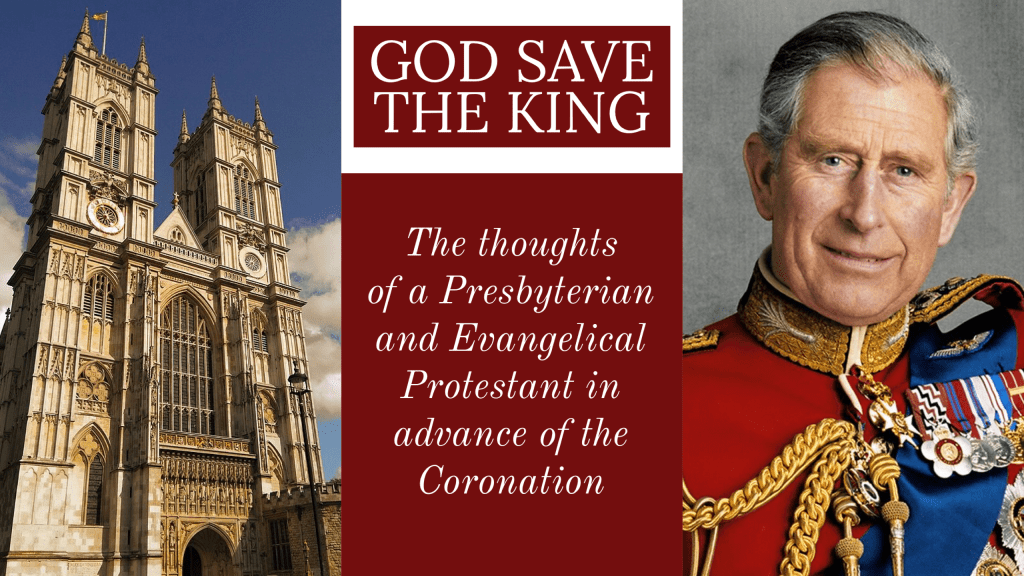
For Your Reading – The Official Coronation Liturgy & Commentary
The Thoughts of a Presbyterian & Evangelical Protestant
The history of Britain is often defined by the eras over which our Kings and Queens presided. We refer to the culture and even the people of these periods as being Elizabethan, Georgian, Victorian or Edwardian. Our nation has in this past year passed out of a second great Elizabethan era with the death of Her Majesty the Queen, and we have entered a new era; an era which the Coronation of His Majesty King Charles 3rd will make official.
Britain is unique among nations in that ancient and highly symbolic Coronation rites are retained. Therefore people from across our nation and throughout the world will watch the spectacle on television savouring the ancient mysticism.
The coronations of the English and Scottish monarchs have always been deeply religious affairs steeped in Christian symbolism. The first recorded Coronation of an English King was that of Edgar who was crowned in 973 AD by Dunstan the Archbishop of Canterbury. The foundations of the Kingdom that Edgar presided over were laid down by his Great Grandfather Alfred the Great, King of Wessex, who not only saw off the Viking threat but more crucially, formulated law that was according to Scripture and was the first to the translate portions of God’s Word into the newly emerging English language. The Stone of Scone or The Stone of Destiny, moved from Edinburgh to Westminster Abbey for the Coronation, has a longer history still. While the exact origins of the stone are unknown it has been associated historically with Christian monks, who brought it out for the crowning of the ancient Scottish Kings at Scone. Therefore the consciousness that our Kings and Queens should be solemnly crowned in the presence of God, being accountable ultimately to the Creator and sovereign Lord of all affairs, is deeply engrained in our national story
Westminster Abbey in all of its antiquity has hosted these grand and momentous events in the history of our nation. William the Conqueror received his crown within the old stone walls after overcoming Harold at Hastings; representing the most dramatic transfer of power in our history. Another, more benign transfer occurred in 1603 when James 6th galloped over the border from Scotland to receive the Kingdom bequeathed him by Elizabeth 1st, as he became James 1st of England. In April 1689 history was made as our first and only joint sovereigns were crowned in the Abbey after the successful Accession of William 3rd and his wife Mary 2nd, following the flight of the discredited James 2nd. As King Charles 3rd follows in the footsteps of the Kings and Queens of ancient times his thoughts naturally will be filled with his mother, who as a young woman received the crown on 2nd June 1953, almost 70 years ago, ushering in a new Elizabethan age. One of the important benefits of our royalty is the identity and sense of history that the noble tradition gives to the nation. The Coronation emphasises the continuity of our history like nothing else.
As an Ulster Scot Presbyterian, however, there are elements to the Coronation ceremony that I find disquieting.
The Erastian pretext of the monarchy in England is most unbiblical. Erastianism is the idea that the State and Church are not only joined but that the State has authority over the Church. Throughout the 17th Century there was much controversy over this point, especially in the relationship between Presbyterian Scotland and England. In England also many objected to the role of the monarchy over the church, which eventually led to the Westminster Assembly, which also met in the Abbey, as they produced the famous Standards. While Scotland won its religious freedoms the Monarch ultimately retained its control over the Church of England. At this Coronation season I am grateful more than usual for our Presbyterian and covenanting forefathers who won our precious independence for Scottish (and in principle Irish) Presbyterians.
The position of the Monarch as Supreme Governor of the Church of England has probably contributed to the retaining of the anointing with “holy” oil. This rite, hidden behind an ornate screen, recognised as the most sacred of all, is modelled upon the anointing of the Kings, Priests and Prophets of ancient Israel. It transports the monarch above the secular world into the spiritual and is derived from the pre-democracy concept that Kings had a divine right to govern. For me, this elevates a human being to a place in this New Testament age, where no human being ought to be taken.
The High Anglican nature of the worship and ceremony is foreign to my historic and biblical understanding of what true worship is. The simplicity of Reformed worship rescued the Church from performances and rituals, which in medieval times, replaced God. Our Lord taught that God is not found in temples made with hands but where people worship Him in spirit and in truth.
As a Reformed Protestant when reading the liturgy for the Coronation, as published by the Archbishop of Canterbury, I was disturbed, but sadly not surprised, that the Cardinal Archbishop of Westminster will offer prayers after the crowning along with other Christian faith leaders. Such participation is contrary to the 39 Articles of Religion which highlights the apostasy of the Roman position. This participation of one acting on behalf of the Pope, as Christ’s self proclaimed representative on earth, who claims jurisdiction over the souls of all Christian denominations, is a betrayal of Christ Himself.
While non Christian faith leaders are not taking part in the religious ceremony they are given a place in the procession and at the conclusion when they welcome the King using the curious phrase “as neighbours in faith”. I find this to be a needless act, without meaning, unless it is a nod to a future, less Christian and more pluralistic, monarchy. This nod to the future leads us away from the unashamed utterances of Her Majesty Queen Elizabeth who spoke regularly of the importance of Jesus Christ in her journey. I believe passionately in tolerance and religious freedom but by the same token I present Christ exclusively as the way – the one whom all Protestant, Roman Catholic, Orthodox, Moslem, Jew, Sikh and Hindu followers need for their souls’ salvation. Therefore I watch this tinkering around the edges of an important ceremony with caution.
As a Protestant, however, despite my misgivings, I am encouraged by the manner in which the core elements of the Coronation, which I consider essential, have been retained unchanged.
The King will receive a copy of the Scriptures from the Moderator of the Church of Scotland:
“Sir: to keep you ever mindful of the law and the Gospel of God as the Rule for the whole life and government of Christian Princes, receive this Book, the most valuable thing that this world affords. Here is Wisdom; This is the royal Law; These are the lively Oracles of God.”
The message that these remarkable words will beam our across the world speaks volumes of the power of Scripture, man’s need for the Bible and the importance of its principles in guiding the governance of nations.
The Archbishop of Canterbury will administer the Coronation Oath, which is a reminder of the deep influence that the Willamite Settlement continues to have upon our national affairs:
“Will you to the utmost of your power maintain the Laws of God and the true profession of the Gospel? Will you to the utmost of your power maintain in the United Kingdom the Protestant Reformed Religion established by law?…”
The King will be obliged to declare:
“I Charles do solemnly and sincerely in the presence of God profess, testify, and declare that I am a faithful Protestant, and that I will, according to the true intent of the enactments which secure the Protestant succession to the Throne, uphold and maintain the said enactments to the best of my powers according to law.”
The Prime Minister, Mr Rishi Sunak, representing the King’s Government will read from a particularly well chosen passage, Colossians 1:9-17.
The assembled congregation of invited guests and the international audience of millions will listen to the words of the King James Version, expounding Christ as the exclusive Saviour of mankind:
“For by him were all things created, that are in heaven, and that are in earth, visible and invisible, whether they be thrones, or dominions, or principalities, or powers: all things were created by him, and for him: And he is before all things, and by him all things consist.”
This is particularly relevant because every vow made by our King renders him and the Governments who act in his name, accountable to God. Unless there is a turning in our nation this Coronation event condemns our people still further as we rush headlong into the embrace of atheistic secularism and all the evils that are spawned therefrom.
The ceremony is filled with other relevant scriptures and words of praise, which we ought to take note of.
The words recited as the regalia are presented are particularly thoughtful and Christ exalting:
“Receive this kingly Sword. May it be to you, and to all who witness these things, a sign and symbol not of judgement, but of justice; not of might, but of mercy. Trust always in the word of God, which is the sword of the Spirit, and so faithfully serve our Lord Jesus Christ in this life, that you may reign for ever with him in the life which is to come. Amen”
The presentation of the jewelled sword
“Receive the Bracelets of sincerity and wisdom, tokens of God’s protection embracing you on every side”
The presentation of the Armills
“Receive this Robe. May the Lord clothe you with the robe of righteousness, and with the garments of salvation.”
The Presentation of the Robe and Stole Royal
“Receive this Orb, set under the Cross, and remember always the kingdoms of this world are become the kingdoms of our Lord, and of his Christ.”
The Presentation of the Orb
“Receive this glove. May you hold authority with gentleness and grace, trusting not in your own power but in the mercy of God who has chosen you.”
The presentation of the glove
“Receive the Royal Sceptre, the ensign of kingly power and justice; and the Rod of equity and mercy, a symbol of covenant and peace. May the Spirit of the Lord which anointed Jesus at his baptism, so anoint you this day, that you might exercise authority with wisdom, and direct your counsels with grace; that by your service and ministry to all your people, justice and mercy may be seen in all the earth: through the same Jesus Christ our Lord. Amen.”
The presentation of the Sceptre and Rod
The anticipated climax arrives when the Archbishop places St Edward’s Crown upon the King’s head.
The Coronation prayer, which is subsequently offered, is one that each one of us can offer for King Charles 3rd our earthly Sovereign:
“King of kings and Lord of lords, bless, we beseech thee, this Crown, and so sanctify thy servant Charles upon whose head this day thou dost place it for a sign of royal majesty, that he may be crowned with thy gracious favour and filled with abundant grace and all princely virtues; through Jesus Christ our Lord, who with thee and the Holy Spirit liveth and reigneth, supreme over all things, one God, world without end. Amen.”
While society at large, at least the royalist proportion of it, will treat the Coronation as a season of revellery and party, for the Christian it ought to be a time of deep and solemn reflection and prayer. We come from a strong lineage of committed subjects to the royal household of the United Kingdom. We believe that Monarchy has been a means used by God in the preservation of our liberties. Yet, in this age when society is moving in a post Christian direction we fear for the future.
It is with these thoughts and prayers we pledge allegiance to our Sovereign, we earnestly ask God to open his eyes to gospel truth and for a revival of true religion throughout his realms as we say God save the King.
 Clogher Valley Free Presbyterian Church
Leave a comment