
Habbabuk was a man in whose heart God had planted a deep burden for Israel. He described the nation as “thy work”. He did not see the people as the product of chance historical incidents or as a community built around strong leaders or philosophical ideals. Rather he had a vison that the Jewish people were God’s work. They were the vine that God had planted, watered and cared for. Therefore he had a heart not merely for his nation but for the work that God had established. Therefore his appeal was for the glory of God; that Jehovah would nurture His own great work. He was pleading that God would revive His own work among His own people.
As we watch and observe the historic events transpiring this week as a consequence of the passing of our beloved Queen, we are reminded that this United Kingdom exists because she has signally and uniquely been favoured by God.
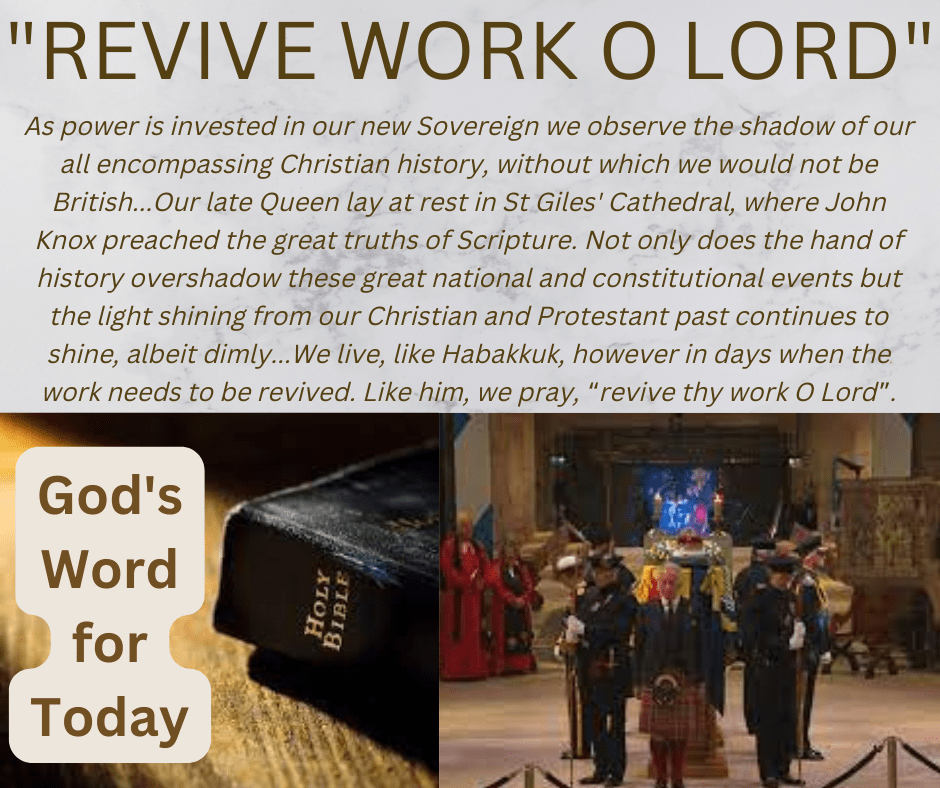
As power is invested in our new Sovereign we observe the shadow of our all encompassing Christian history, without which we would not be British. The Proclamation concluded with a call to prayer; “…beseeching God, by whom kings and queens do reign…”. King Charles 3rd promised to grant Presbyterian and Protestant freedoms to the Church of Scotland in a ceremony which had its roots in the Covenanters and their struggles. Our late Queen lay at rest in St Giles’ Cathedral, where John Knox preached the great truths of Scripture. Not only does the hand of history overshadow these great national and constitutional events but the light shining from our Christian and Protestant past continues to shine, albeit dimly.
This United Kingdom, to which we belong has arisen as a consequence of the work of God in establishing Protestantism through the struggles that erupted in the 16th and 17th Centuries. There are, therefore, certain parallels with Israel in the Old Testament…we are a nation constituted as a result of the work of God.
We live, like Habakkuk, however in days when the work needs to be revived. Like him, we pray, “revive thy work O Lord”.
THE BURDEN
LORD, I have heard thy speech, and was afraid
The man of God was constrained to pray for revival because the LORD had spoken and proclaimed that judgment would visit Judah on account of their sins.
And the LORD answered me, and said, Write the vision, and make it plain upon tables, that he may run that readeth it. For the vision is yet for an appointed time, but at the end it shall speak, and not lie: though it tarry, wait for it; because it will surely come, it will not tarry. Behold, his soul which is lifted up is not upright in him: but the just shall live by his faith. Yea also, because he transgresseth by wine, he is a proud man, neither keepeth at home, who enlargeth his desire as hell, and is as death, and cannot be satisfied, but gathereth unto him all nations, and heapeth unto him all people: Shall not all these take up a parable against him, and a taunting proverb against him, and say, Woe to him that increaseth that which is not his! how long? and to him that ladeth himself with thick clay! Shall they not rise up suddenly that shall bite thee, and awake that shall vex thee, and thou shalt be for booties unto them? Because thou hast spoiled many nations, all the remnant of the people shall spoil thee; because of men’s blood, and for the violence of the land, of the city, and of all that dwell therein. Woe to him that coveteth an evil covetousness to his house, that he may set his nest on high, that he may be delivered from the power of evil! Thou hast consulted shame to thy house by cutting off many people, and hast sinned against thy soul. For the stone shall cry out of the wall, and the beam out of the timber shall answer it. Woe to him that buildeth a town with blood, and stablisheth a city by iniquity! Behold, is it not of the LORD of hosts that the people shall labour in the very fire, and the people shall weary themselves for very vanity?
Habakkuk 2:2-13
It is clear that Habakkuk was witnessing the decline in godliness that accelerated after the death of King Josiah; God had pronounced the judgement that would fall.
Behold ye among the heathen, and regard, and wonder marvellously: for I will work a work in your days, which ye will not believe, though it be told you. For, lo, I raise up the Chaldeans, that bitter and hasty nation, which shall march through the breadth of the land, to possess the dwellingplaces that are not theirs.
Habakkuk 1:5-6
As one given sight of the coming doom he cried, “Revive thy work O Lord”.
We too have witnessed a terrible decline in true Christianity among the British people. Not only have a multitude of unrighteous and God defying laws been passed at Westminster but the day of true principled Protestantism inspired by Biblical convictions is almost gone. The flurry of ecumenical activity that we will witness and have already witnessed in these days only serves to compound the sadness we feel. These are sad days – “Revive thy work O Lord”.
THE BELIEF
In dark solemn days Habakkuk prayed because he believed there was hope. Amid the awful verdict on the state of the nation God produced an astounding promise, yet to be fully realised.
“For the earth shall be filled with the knowledge of the glory of the LORD, as the waters cover the sea.”
Habakkuk 2:14
When Habakkuk prayed for revival he was asking for the realisation of this promise, a revival of truth when the Word of God would reign supreme in the hearts of men and women.
Had John Knox been standing in his familiar pulpit, had James Ussher, formerly Archbishop of Armagh been ministering at St Anne’s, had Thomas Cranmer been Archbishop of Canterbury today – the messaging that the nation is receiving at this time would be dramatically different. These were the men who helped to lay the Protestant basis of our nation. They did so as men who believed in the power of the Book. John Knox was not a writer and scholar like Calvin his teacher and mentor. But he was a man who believed in the plainness and authority of the Word of God. More than other nation under the sun, the Scottish Reformation was a revival of the authority of the Scriptures; this produced an effect that made this Reformation the deepest and the most rooted.
This promise which Habakkuk claimed though was not merely for Israel but for the nations of the world. It has been partially realised but there is still ground to claim from the enemy. Where Mohammed is reverred, where the Hindus worship their gods, where godless secularism reigns, where Romanism and apostate Protestantism holds sway let us claim the promise – “Revive thy work O Lord”.
THE BEQUEST
Ultimately these words spoken by Habakkuk were a bequest; he is a man beseeching the Almighty, pleading for the revival of the work that was in, what seemed like, irreversible decline.
John Knox, the great Scottish Presbyterian Reformer, is also noted as being man of prayer, in addition to his forceful leadership and fiery preaching style. Although leaving Scotland as a very young man, where it was simply too difficult to be a Protestant, he never lost his love for the homeland. He served God very comfortably in Switzerland ministering to British exiles, at the Genevan meeting house that still bears his name. Having passed his fiftieth birthday, however, the call came from Scottish Protestants to lead their Reformation. It was a dangerous mission, so difficult that those who called him almost reneged on their request but for Knox the die was cast some years earlier; he had long prayed for this opportunity :
“My own motion and daily prayer is, not only that I may visit you, but also that with joy I may end my battle among you. And assure yourself of that, that whenever the greater number among you shall call upon me than now hath bound me to serve them, by His grace it shall not be fear of punishment, neither yet of death temporal, that shall impede my coming unto you”
16th March 1557 in a letter to written to friends in Edinburgh
Scotland was the most unlikely European Kingdom to embrace Protestantism. Rome ruled supreme, the bishops governed with an iron fist and the royal throne was heavily influenced by the Catholic French court. Many Protestants had lost their lives contending for the faith in Scotland; most notably two of her finest sons – Patrick Hamilton and Goerge Wishart.
John Knox, however, although only one man was feared by the royal court more than anyone, such was his reputation. Under his leadership the fledgling Protestant cause was galvinised into one voice. Wherever he went the crowds flocked, both Crown and Church were rendered powerless.
He described one man with God as being a majority. He famously prayed “Give me Scotland or a I die”. He was undoubtedly a man who knew God and gave his life for the Gospel. The work was revived. Whereever Presbyterianism has been established in the world, in virtually every case the origins of the witness can be traced back to ministry of John Knox. The great Kings and Queens of our realm are buried in tombs and there are magnificent memorials to their life and work. In contrast John Knox, the fiery and passionate preacher who loved his people is buried in a car park. Once a stone marked the place in the ground and then the authorities tarmaced over it. But the man who belived in a God who answers prayer had a greater memorial, a greater legacy. I don’t believe St Giles’ Cathedral hears the doctrine of Knox preached today. The Church of Scotland has long departed from the historic Reformed Faith. Yet when Her Majesty’s cortege passed along the Royal Mile the television commentators referred to her passing John Knox’s house. When she entered the Cathedral, the minister welcomed the congregation to the church where John Knox confronted Mary Queen of Scots. His legacy as a man of God can never be forgotten, even in this liberal age.
We don’t need to conform to the spirit of this age to make our mark for God; indeed such compromise will endure we never make our mark. We will only be seen in the darkness when we let our lamps shine. Let us shine as a people of prayer who believe in a God of mercy, a God who will revive His work again – let us pray with one heart and with a burden – “Revive thy work O Lord”.
 Clogher Valley Free Presbyterian Church
Leave a comment